

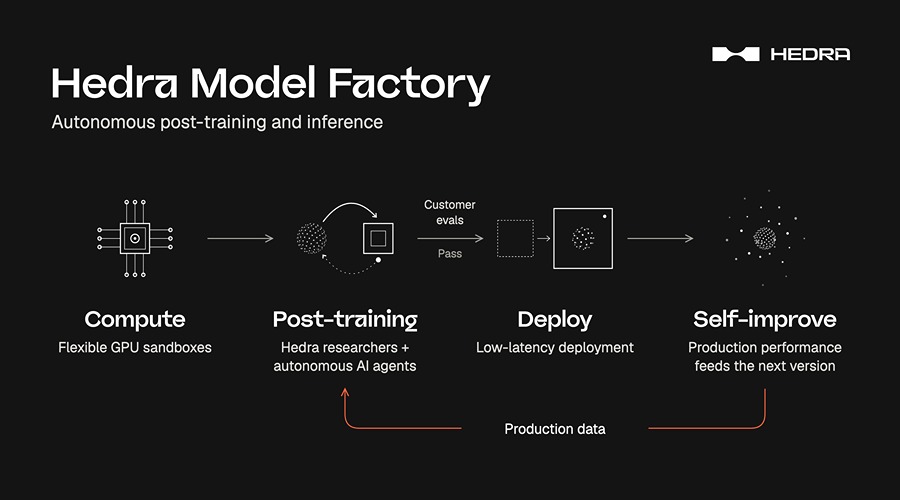
SAN FRANCISCO, CA, Nov 12, 2026 – Hedra has launched Hedra Model Factory, a platform for post-training, deploying and improving AI models using customer data. The platform combines GPU computing, reinforcement learning, low-latency deployment and continuous evaluation for applications in robotics, manufacturing, biology and defense.
Hedra researchers work alongside AI agents to develop and refine models using multimodal data, including video, sensor information and simulation. The platform also provides computing resources for reinforcement learning environments that require GPU acceleration.

“Recursive self-improvement is already changing how frontier models get built,” said Michael Lingelbach, founder and CEO of Hedra. “The next step is the real world, where the data is video, sensors and simulation. Hedra Model Factory gives robotics, manufacturing, biology and defense teams the infrastructure to post-train, deploy and keep improving their own models.”
Computing, Training and Deployment
Hedra Model Factory combines four functions covering model development and operation:
- GPU computing: Flexible GPU sandboxes provide computing capacity through Hedra’s inference engine. Customers can scale training workloads without long-term GPU commitments.
- Post-training: Customers supply simulation engines and data, while Hedra researchers help develop learning environments and training datasets. Vision-language models can caption and score data or provide feedback during online learning. Hedra researchers also help establish data collection, evaluation and training-to-deployment workflows.
- Deployment: Models run on low-latency computing infrastructure, either on premises or at Hedra’s partner data center. The platform supports distilling world action models to run faster without losing physical coherence. It also supports fitting vision-language-action models and running existing models on Hedra’s inference engine.
- Model improvement: After deployment, Hedra researchers analyze production performance and retrain models. Updated versions are released only after passing the customer’s evaluations.
Research and Performance Results
Hedra noted results from three model development areas: video generation, image editing and robotic control.
Video generation: Hedra retrained its H3 model to improve physical consistency. The retrained model scored 34.9 on Google DeepMind‘s Physics-IQ benchmark, compared with 30.3 for H3 Max, while maintaining comparable visual quality. An autonomously distilled version rendered a five-second video clip in less than three seconds using AMD MI355X GPUs.
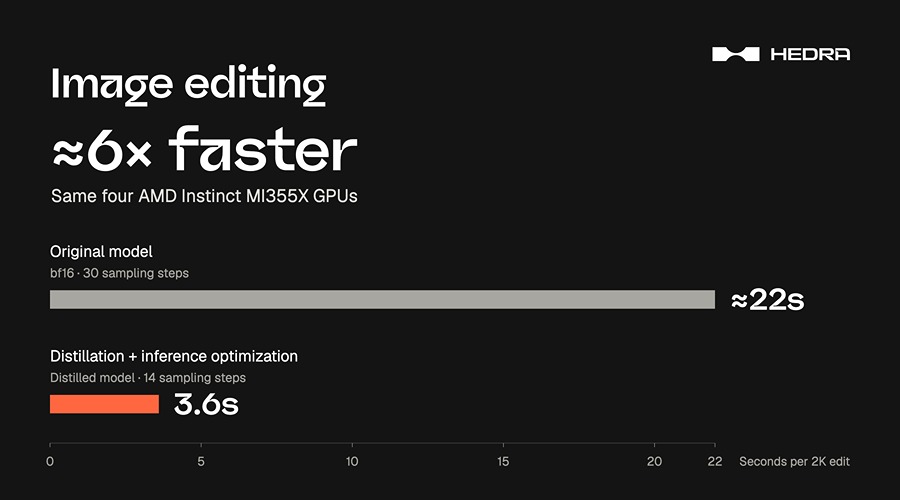
Image editing: Hedra used model distillation and inference optimization to reduce processing time for Krea 3 image edits at 2K resolution from approximately 22 seconds to 3.6 seconds. The original baseline used a bfloat16 (bf16) model with 30 sampling steps, while the optimized version used a distilled model with 14 steps. Krea 3 runs on MI355X GPUs through Hedra.
Robotic control: In a simulation study, Hedra fitted a robot running a trained control policy with a new gripper. By matching the new gripper’s reach and grasp point in the wrist camera view, Hedra reported restoring task success from nearly zero to almost 100% without retraining the model.
Hedra founder and CEO Michael Lingelbach previously worked on reinforcement learning for visual and physical systems at Stanford and NVIDIA. The company’s research team includes personnel from Stanford, Berkeley and the University of Illinois Urbana-Champaign (UIUC), with experience at NVIDIA, Meta Superintelligence Labs, Fireworks AI and Salesforce. The research team has published work on generative video and embodied AI at NeurIPS, CVPR and ICLR.
Source: Hedra
About Hedra

Hedra is a U.S. artificial intelligence company founded in 2023 and headquartered in San Francisco, CA. The company develops AI software for generating videos, images and audio. Its Hedra Play platform allows users to create digital content using AI models. Hedra serves content creators, software developers, marketing teams and businesses in advertising, education and digital media. Its services include AI model development, computing infrastructure and tools for producing digital content. The company also develops software for processing and operating visual AI models. Hedra maintains offices in San Francisco and New York City. It reports more than 20 million users and 125,000 businesses using its services.
