

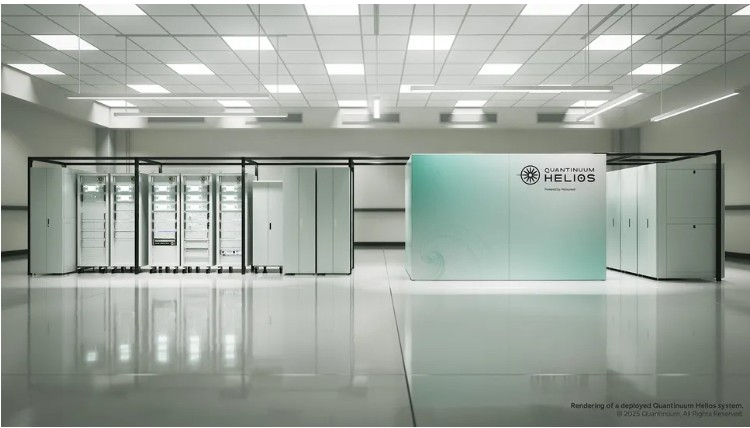
Quantinuum’s Helios quantum computer uses 98 physical qubits in a novel “junction ion trap” architecture, where barium ions are manipulated through a ring-and-junction geometry to boost interconnectivity and reduce routing overhead, tells this Live Science article. Of those, 48 logical qubits (physical qubits paired with spares) operate with full error-correction protocols, marking one of the highest physical-to-logical qubit ratios yet achieved.
The machine achieved unprecedented fidelities: 99.9975% for single-qubit gates and 99.921% for two-qubit gates across all qubit pairs in benchmarking tests. These results place Helios beyond the performance envelope of prior publicly announced systems, and the team claims that the classical compute power required to match Helios’s output would exceed the energy usage of all the stars in the visible universe, an illustrative way to emphasize the quantum advantage.
Besides raw performance, Helios introduces a modern control stack: the system includes a language (Guppy), real-time error-correction using NVIDIA GPUs linked to the classical control tier, and an integrated architecture designed to scale to hundreds of junctions in future machines. In one demonstration, the system simulated superconducting metal behavior and revealed previously unseen electron-pairing phenomena in a high-temperature superconducting material, showing direct value for materials research.
Helios signals a shift: quantum hardware is no longer purely exploratory; it is now producing meaningful computational fidelity and is poised for real-world deployment in domains such as materials modeling, advanced cryptography, and algorithmic optimization. The machine’s architecture and control design set a blueprint for quantum systems moving toward fault-tolerant computing at scale.
Helios is positioned as a milestone in quantum computing, blending high qubit count, error-corrected logic, and performance that claims to outstrip classical systems for selected tasks.
