

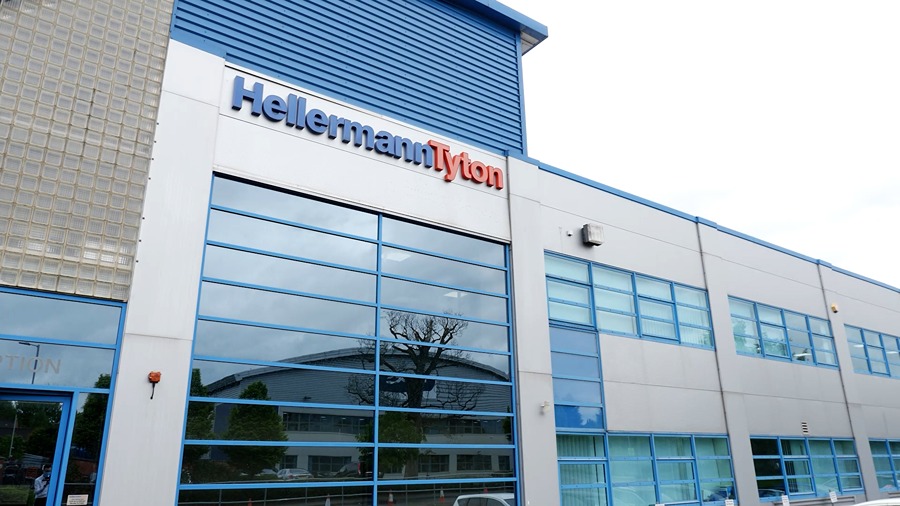
HellermannTyton has moved end-of-arm tooling production in-house using a Stratasys Fortus 450 3D printer supplied by SYS Systems. The company reports lower tooling weight, shorter lead times and lower costs after replacing its manufacturing process with additive manufacturing.
HellermannTyton’s automation project team had previously questioned whether plastic tooling had sufficient strength between layers to withstand production loads and repeated cycles. Working with SYS Systems, the team tested a trial tool made with nylon 12 carbon-filled material before investing in the printer.
“Switching end-of-arm tooling to additive manufacturing and bringing this part of the process in-house has been a gamechanger,” explained Wajahat Muhammad, automation project engineer at HellermannTyton.
“To date, we have used the Fortus 450 to print 38 different tools that, collectively, have successfully completed tens of millions of cycles, producing billions of basic ties and bespoke fixings.”
He continued: “On average, we are looking at weight savings and lead time reductions of up to 50%, and cost savings of up to 75%. Having complete control of the printing also means we can make iterations in a few days rather than a few weeks if it had to go to an outside supplier.”
“It’s really important to have access to experts when you are introducing a new technology and discussions quickly led to trying nylon 12 carbon filled material,” added Wajahat.
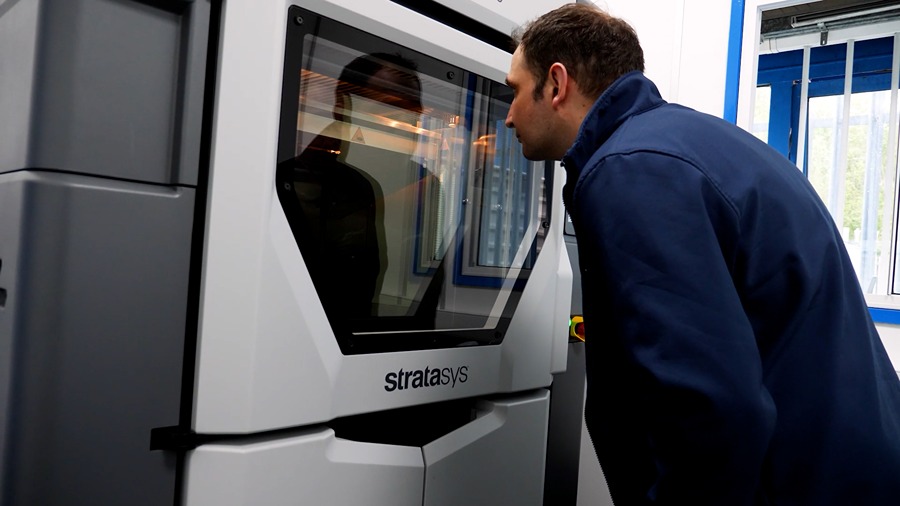
“This got us thinking and, working with SYS Systems, we developed a trial end-of-arm tool that we tested in a real-world environment. It didn’t take long for our initial ‘strength’ fears to be dispelled and led to us happily pressing the button on a £150,000 investment into the Fortus 450.”
Wajahat continued: “We were all pleasantly surprised at how quickly the machine could be installed and up and running.
“A combination of the Fortus 450 ease-of-use GrabCAD software and expert training for our project team meant we were printing within a week, producing tooling that continues to support the manufacture of 34 different types of cable management systems.”
SYS Systems’ Chris Andrews added his support: “The freedom that design additive manufacturing allows has enabled HellermannTyton to service, set-up and maintain the tools significantly quicker than the ones it used in the past.
“This saves considerable amount of downtime – previously two to three hours whereas printed tools are less than one hour for example.”
He concluded: “The firm is also enjoying reduced automation time cycles due to the lighter payload of the end-of-arm tool, which means effectively running robots faster, optimizing output and increasing productivity in manufacturing.”
HellermannTyton can also sell the printed tooling to sister companies in Morocco and South Africa.
Source: HellermannTyton
About HellermannTyton

HellermannTyton makes products for fastening, routing, connecting, insulating, protecting and identifying cables. The company employs 100 people at its factory in Wythenshawe. It also supplies network connectivity products and custom cable management components. Its markets include automotive, aerospace, rail, renewable energy, shipbuilding, mechanical engineering and electrical installation. The company traces its roots to Paul Hellermann GmbH, founded in Hamburg, Germany, in 1935. It reports more than 7,000 employees in 40 countries, with 19 production sites and 13 development centers.
