

CAE tools have become increasingly capable, but engineers still spend considerable time preparing models, defining boundary conditions, extracting results, and documenting simulations. HelloTriangle aims to reduce this repetitive work by using AI-generated code to automate parts of FEA and CFD workflows, tells Machine Design.
Traditional CAE automation often requires engineers to write scripts, typically in Python. This approach can save time but requires knowledge of both simulation software and programming. HelloTriangle lowers that barrier by translating plain-language engineering prompts into Python-based CAE scripts within a web browser.
Users can upload an STL file and inspect its mesh in a 3D environment. They can then prompt the AI to modify the mesh, define materials, loads, and boundary conditions, and progressively refine the simulation setup. The resulting mesh and Python script can be exported for use with FEA or CFD software.
Rather than operating as a black-box generative AI system, HelloTriangle emphasizes reproducibility and transparency. Its generated Python code can be inspected, verified, modified, version-controlled, and rerun. The platform combines an external large language model with retrieval-augmented generation using internal documentation and validated engineering workflow examples. This approach is intended to produce code aligned with simulation practices rather than generic programming patterns.
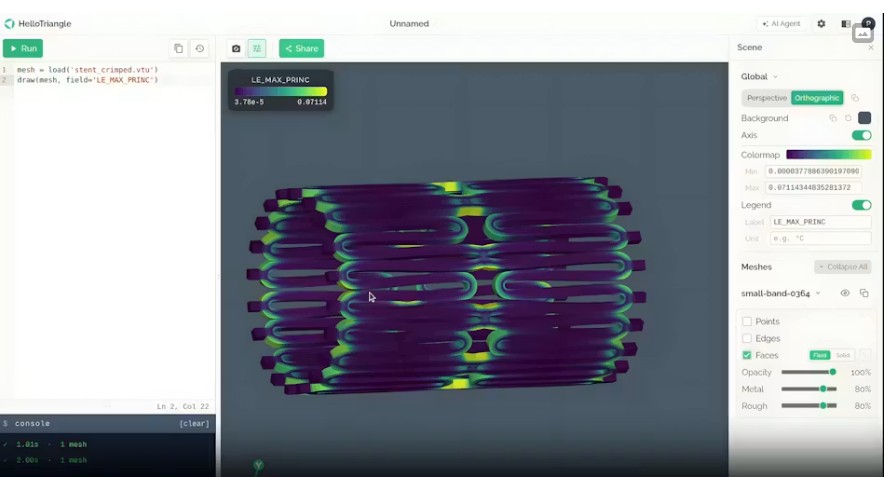
HelloTriangle also extends automation into post-processing. Engineers can import results, visualize stress, strain, and other fields, and use prompts to isolate specific values or regions. Interactive 3D scenes can then be shared through a link or exported as HTML, reducing dependence on screenshots and conventional presentations.
Currently, HelloTriangle supports solver input generation for LS-DYNA and Abaqus, while Abaqus results can be imported for analysis. Future plans include additional FEA and CFD solver integrations, animations, advanced result exploration, model annotations, and collaborative script editing.
