

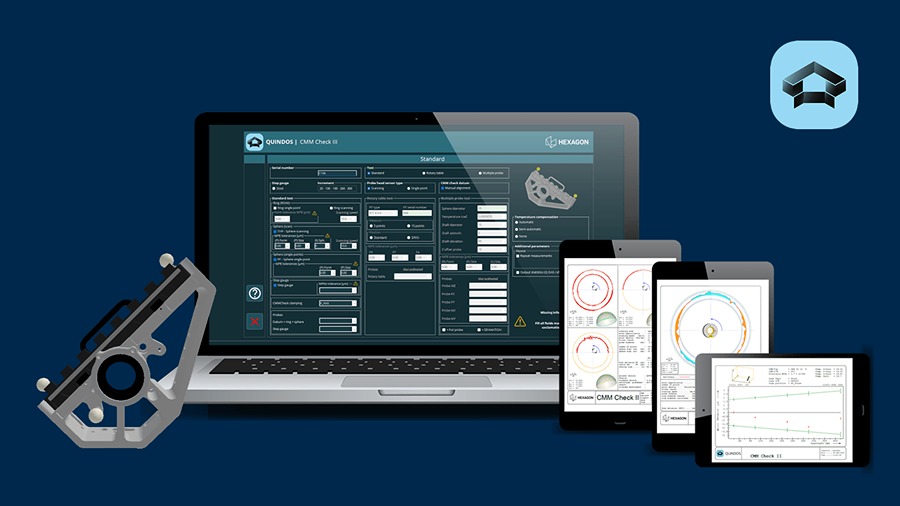
Hexagon’s Manufacturing Intelligence division announced the release of QUINDOS 2026.1, adding CMM Check 3.0 monitoring, variable high-speed scanning, and analysis tools for gear and multi-axis inspection workflows.
QUINDOS 2026.1 extends CAD-based programming with support for rotary table workflows. Users can generate measurement points for multi-axis setups in a single step, reducing manual input and improving consistency in complex inspection tasks.
“QUINDOS 2026.1 is designed to help inspection teams work faster and more efficiently without compromising accuracy,” said Karin Schneider, product manager for QUINDOS at Hexagon. “By simplifying complex workflows and introducing more automation, we’re enabling users to focus on what matters most – delivering high-quality measurement results and improving overall productivity.”
QUINDOS 2026.1 expands functionality for gear and drivetrain analysis. New and evaluation tools include Hirth serration runout analysis, gear tooth thickness visualization, and cylindrical worm tip relief evaluation, providing measurement data for component inspection.
Additional updates focus on usability and workflow efficiency. Guided geometry handling, predefined evaluation strategies, and user interface refinements support both new and experienced users. The software also supports E57 point cloud data and includes improved mesh handling for integration with 3D scanning technologies.
QUINDOS 2026.1 is available for use in inspection workflows across automotive, aerospace, and energy applications.
Source: Hexagon
About Hexagon

Hexagon AB, founded in 1975 and headquartered in Stockholm, Sweden, provides digital reality solutions by integrating sensors, software and autonomous technologies. Its products and services are used across sectors including manufacturing, construction, mining, agriculture, aerospace, automotive and defense. Core offerings include reality capture, intelligent positioning systems, industrial design and situational intelligence tools. The company has pursued a growth strategy through acquisition, completing more than 170 acquisitions since 2000. The company employed approx. 25,000 people across 50 countries. The company continues to expand its global customer base, focusing on innovation and digital transformation.
