

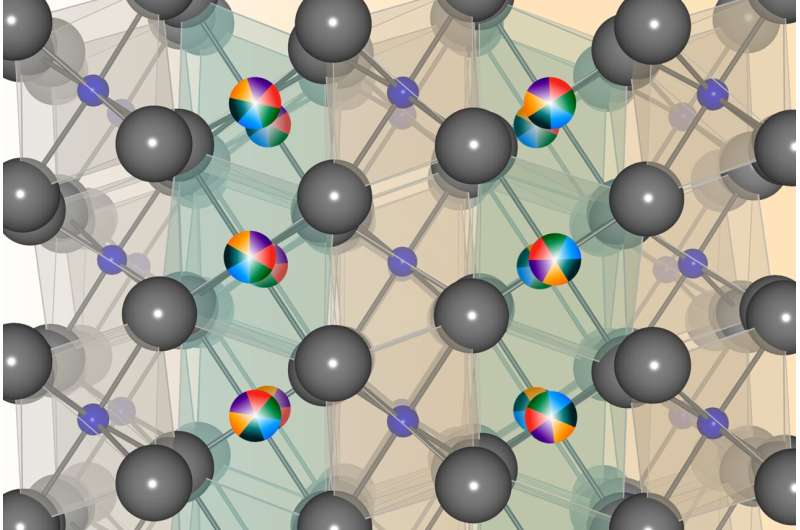
Semiconductors power nearly every modern electronic device, yet the range of materials suitable for these applications remains surprisingly limited. Most metal oxides are naturally insulating, making them unsuitable for electronic components despite their excellent durability and stability. Researchers from Carnegie Mellon University and Penn State University have now demonstrated a new way to overcome that limitation by redesigning the material at the atomic level rather than searching for entirely new compounds, tells Tech Xplore.
Their approach relies on high-entropy mixing, a materials engineering strategy that combines multiple metallic elements in nearly equal proportions. The team incorporated manganese, iron, cobalt, nickel, copper, and zinc into a tungsten oxide framework with a wolframite crystal structure, intentionally creating a highly disordered atomic arrangement. Instead of weakening the material, this carefully controlled disorder produced entirely new electronic behavior, transforming the originally insulating oxide into a high-performance semiconductor.
The newly developed material, known as A₆WO₄, combines semiconducting behavior with exceptionally low thermal conductivity. This unusual combination makes it especially attractive for thermoelectric devices, which convert waste heat into electricity or provide solid-state cooling. Low thermal conductivity allows the material to maintain temperature differences more effectively, improving the efficiency of these systems.
Beyond its immediate performance, the research introduces a broader design philosophy for semiconductor development. Rather than depending on traditional trial-and-error methods or incremental improvements to existing materials, scientists can deliberately manipulate configurational entropy to create entirely new functional properties. According to the researchers, the microscopic mechanisms activated through high-entropy mixing could become guiding principles for engineering future electronic materials and next-generation devices.
Published in Communications Materials, the study highlights the growing role of entropy-driven materials design in semiconductor research. If the concept proves scalable, it could expand the range of available semiconductor materials while enabling more efficient thermoelectric systems and other advanced electronic technologies that demand both strong electrical performance and effective thermal management.
