

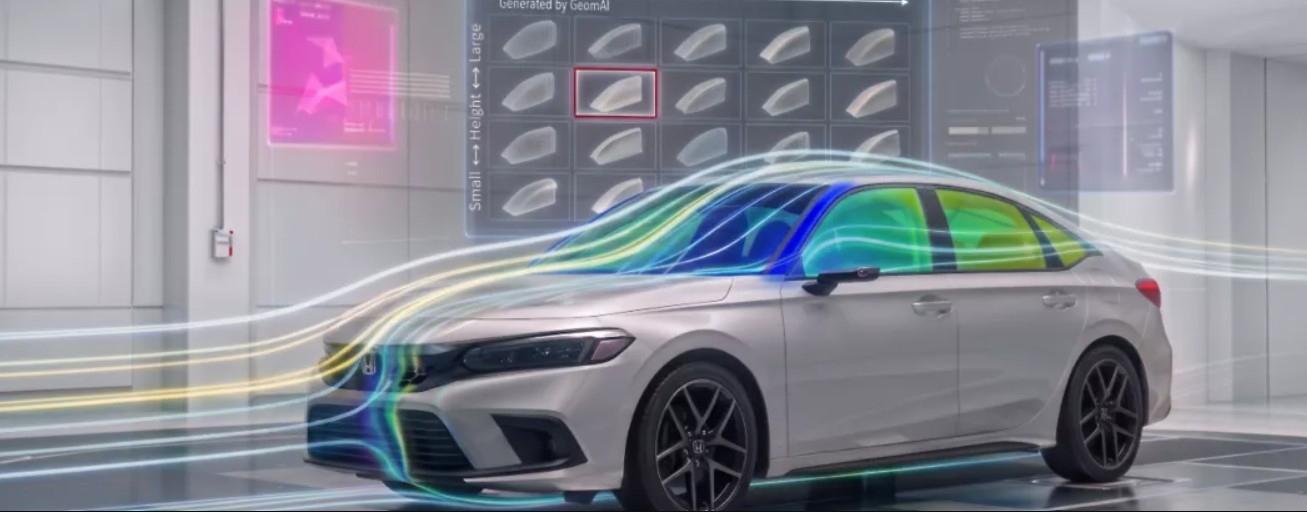
Honda is using simulation and artificial intelligence to shorten vehicle development cycles while preserving the performance, quality, and styling expected from its vehicles. Facing faster-moving competition and trends such as software-defined vehicles, AI-based driver assistance, and hybrid powertrains, the automaker is expanding digital engineering to evaluate designs earlier and more efficiently, tells Ansys Blog.
One focus is exterior vehicle development, where engineers must balance styling with aerodynamic performance and customer experience. Honda studied A-pillar geometry because airflow separation around the pillars can strengthen vortices and increase wind noise. Traditionally, engineers relied heavily on full-scale models and wind tunnel testing. Honda shifted part of this work to computational fluid dynamics using Ansys Fluent and Ansys Discovery, reducing dependence on physical testing.
Simulation introduced another bottleneck, however. Every design variation required engineers to prepare a separate computational model, making broad design exploration time-consuming. Honda therefore evaluated Ansys GeomAI, an AI-powered geometry-generation platform trained on previous designs to produce new geometric alternatives.
For the A-pillar study, Honda trained GeomAI with only four geometries representing combinations of pillar width and gap dimensions. The platform then generated numerous consistent design variants, including useful shapes outside the original training examples. This expanded the design space beyond what engineers could practically explore through manual modeling.
The productivity gains were substantial. Previously, preparing one model manually took about half a day. Once trained, GeomAI could generate a new geometry in roughly one minute. For a CFD study involving 10 alternatives, Honda reduced model-preparation effort from approximately five days to about two days, including training time.
Honda remains in the proof-of-concept stage but plans to expand GeomAI use. By automating repetitive model creation, engineers can spend more time analyzing flow behavior, validating alternatives, and optimizing designs, helping Honda pursue faster development while maintaining a careful balance between vehicle appearance and aerodynamic performance.
