

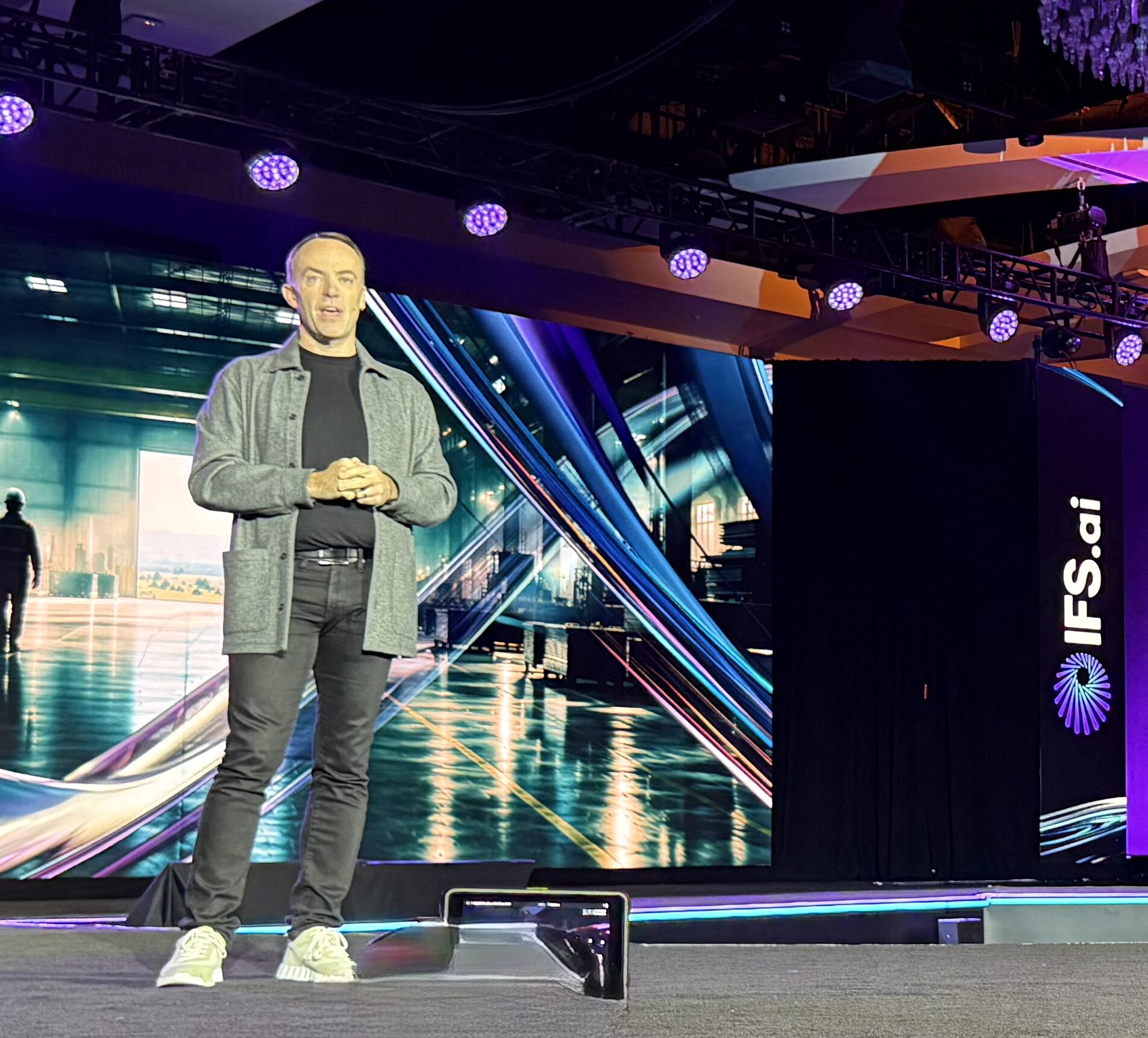
I am attending my second IFS annual user meeting. The first, IFS Connect North America, was in 2023 in Minneapolis, in the stadium the Minnesota Vikings play. The annual user meeting has been renamed IFS Unleashed and the company is now known as IFS.ai.
Apparently, the company that got its start in field maintenance and service software wants to be considered an AI company.
But there’s more to becoming an AI company than adding “.ai” to your name. Mark Moffat, who took the reins at IFS in 2024, last year questioned whether IFS was “building our products in the right way” and concluded, “No.’”
“We had to disrupt ourselves and learn again from the ground up.”
This week’s IFS Intelligence is a conversational layer, a digital workforce and a tool for extending IFS in plain language. Now the “AI company” label is beginning to fit.
 Global CTO Vaibs Kumar took aim at traditional software, including the very apps IFS has sold for decades. “Enterprise software taught you that you had to use these rigid screens, and those who are good at using these rigid screens are the ones that were able to take more meaningful action.”
From Cathie Hall, IFS’s Chief Product and Customer Officer: “The role of your core system is changing, from a system of record to a prerequisite for the action and trust that Mark talked about.”
The product that carries the pitch is IFS Intelligence, launched Tuesday. It has three modes: Cowork, where a human leads and the AI assists; Loops, digital workers that run in the background,

and Runway, for configuring and extending IFS in plain language. Underneath sits what IFS calls its Industrial AI Harness.
Loops “just executes in the background, 24 by 7, every day of the week, tirelessly, bringing the human in the loop when needed.”
Customers on Stage
IFS brought customers to back the claim.
Chris Green, CIO of Cadillac’s F1 team, said: “We chose IFS before we bought our first coffee machine.” (The unlikely Cadillac is the newest Formula One team.)
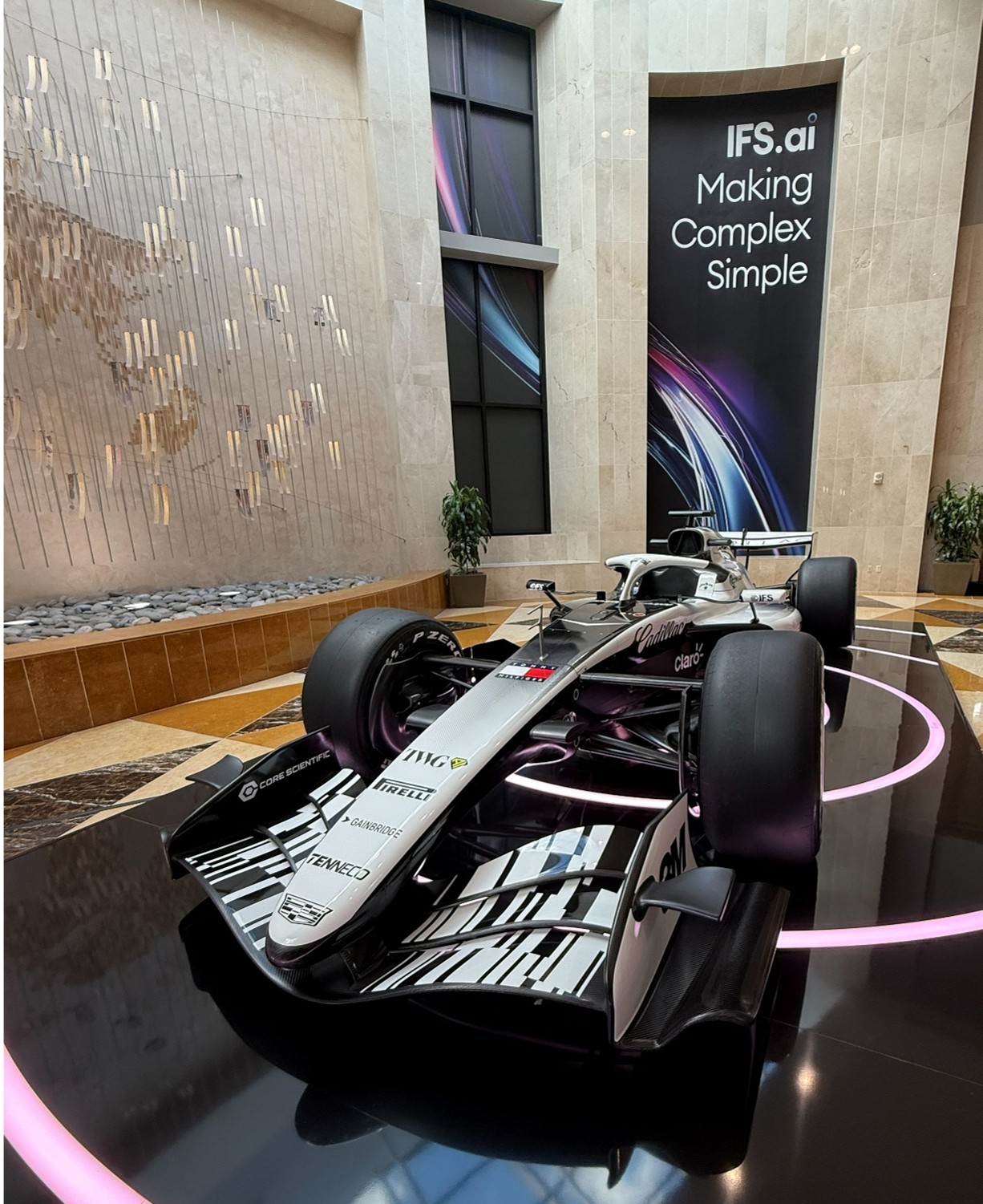
Green has had early access to IFS Intelligence, in beta. He described a data cleanup in which he had “examples of one part type taking us two weeks to correct.”
Vaibs: “So that’s two weeks for part now shrunk into minutes.”
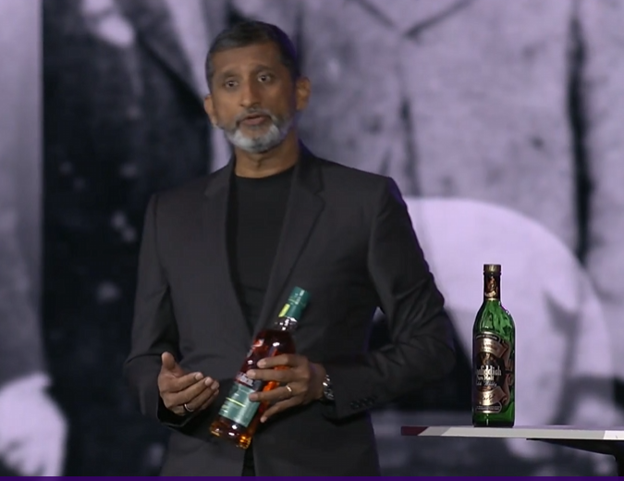
William Grant & Sons. Badri Narasimhan, Chief Technology and Business Growth Officer at the maker of Glenfiddich, The Balvenie and Hendrick’s Gin, described “a 140-year-old family-run company.”
The problem: “Being on the windy west coast of Scotland, we were losing a fair amount of our batches.”
Enter Kriti Sharma, CEO, IFS Nexus Black (IFS’ front-line AI unit). Her team arrived at the William Grant & Sons distillery, put on orange coveralls and steel-toed shoes, to observe the whisky-making operation.
The Belvenie single malt may sit in barrels for 19 years but Kriti’s team had only weeks to turn things around.
She describes Badri “unreasonably impatient” but with a smile.
The IFS team noticed that ”operators in gloves did not want to take their gloves off to fill out a form.”
The IFS solution is Resolve, which can scan text and sound on a smartphone and automatically fill out forms and listen for aberrations.
Next up was trying to save money on operations that would fund capital investment. Badri’s method was to pore over “28 spreadsheets and have 36 consultants on the ground.”
Badri needed to migrate from an ERP system (Aptean) but was faced an enormous job of having to migrate the data.
“Three weeks, we had a tool.”
Then, in 30 minutes, 48 out of 52 reports, says Badri, a task that he estimates would have taken 200 days.
IFS claims it saved William Grant & Sons ₤10 million.
Unreasonable Impatience
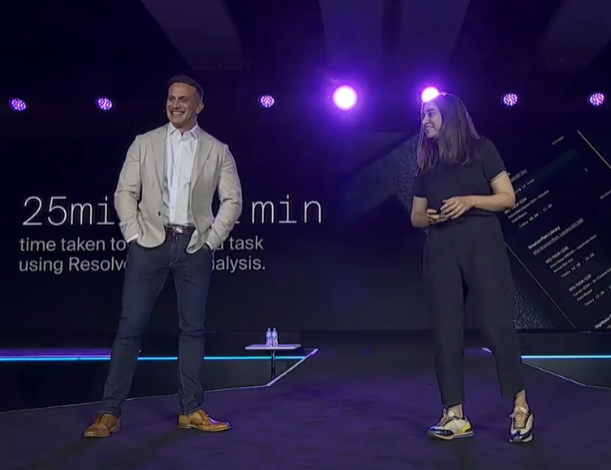
Kriti then introduced Mo Dawood, Group CIO at Eight Group, a technical service provider. On his third day, he told colleagues, “We’ve made the wrong choice, guys,” and pivoted away from a system they had pursued for about six months. He spent weeks with engineers, “on rooftops, we were in lift shafts,” before choosing tools. With two weeks of placing the order, they had resolved. In one demo, AI “completed in about 60 seconds” a “job that was taking about 25 minutes.”
Next up was Joe Marcella from Southwest Airlines. Marcella runs planning, performance and operations at the airline. Southwest has worked with IFS since 2021. Before that “all of our aircraft records were pen and paper.” The transition involved moving “76 million records” to the new system.
On AI, he was careful. “You need a license to fly an airplane. You need a license to dispatch an airplane. You need a license to maintain an airplane.” So airlines can’t run at full speed “because the regulator will have a thing to say about that.”
Asked if the checks and balances sometimes make the work slower, Marcella said: “This is a trade-off we’re willing to make as an airline.”
Asked what the oddest AI incident he has heard of, he recounts the day: “customers bought seats for their robots.” Southwest “didn’t have a policy for that.”
 Kodiak Gas Services. CIO Pedro Buhigas said Kodiak went live on IFS in August 2025 and “just a few weeks” after meeting the Loops team had a first agent nearly ready. Kodiak estimates “about an 85% efficiency gains for all those transactions.”
We heard of a veteran electrician who resisted. “I don’t need AI,” he said. An AI agent read a photo of a distribution board and filled in the data in “about 60 seconds. And that job was taking about 25 minutes.”
The 40% Gap
 Every speaker was on topic with 40%, which is the gap IFS says it is addressing.
Mark set it up: “Sometimes they reach 60% of their potential.”
IFS’s estimate of the efficiency gap may be conservative. The World Economic Forum’s Kiva Allgood offered a different number. Of the sites in the Global Lighthouse Network, “some of these sites are improving 100%.”
Energy: The Upcoming Constraint
Energy producers will soon have a supply problem, says Mark and venture capitalist Chamath Palihapitiya (more on him later).
One of the ways of generating electricity is with a gas turbine. Good luck with that, says Mark. “If you’re in the market today for a gas turbine, 2034 is the earliest you’ll get one if you order today.”
Smaller backup power isn’t much earlier. “Diesel gensets, hospitals, construction sites-they all rely upon auxiliary power. You won’t get one until the end of 2028.”
Siemens Joins the Stage
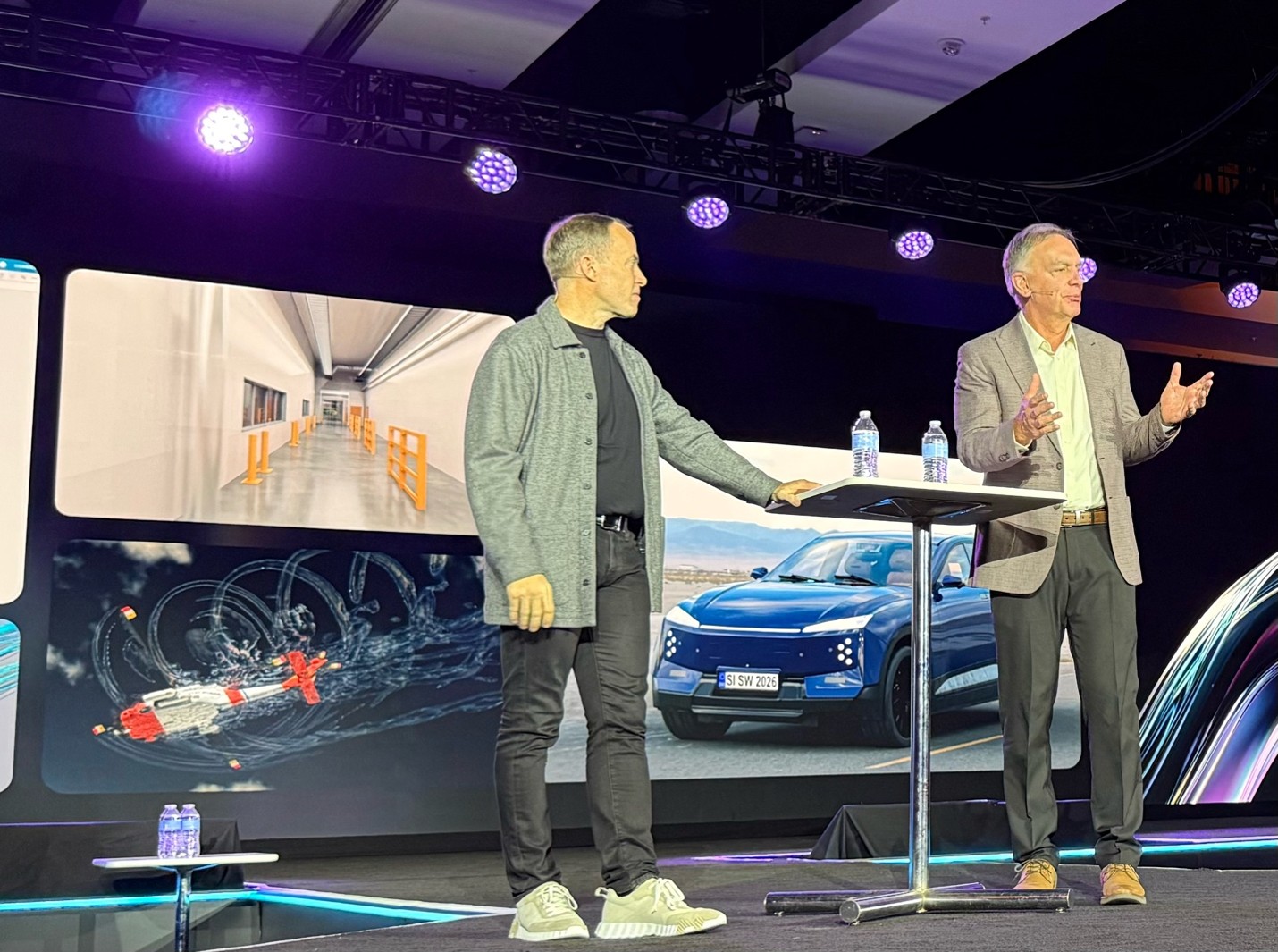
Siemens Digital Industries Software president and CEO Tony Hemmelgarn joins IFS CEO Mark Moffat onstage at IFS Unleashed, October 13, 2026.
Siemens Digital Industries Software president and CEO Tony Hemmelgarn joined Mark onstage. Siemens announced a partnership with IFS four months ago.
Mark was all praise for Siemens, which he called a “world-class in designing and engineering industrial products,” while IFS is “world-class in knowing how they’re operated, how they’re maintained, and how they’re serviced.”
The timing is notable: only last week, Schneider Electric announced it would buy PTC for about $22.6 billion. PTC owns ServiceMax, a field service platform that competes directly with IFS.
AI Agents Never Sleep
We see demos of AI agents on the job. AI agents can do what people can’t: watch everything, all the time.
In a video, an AI agent “catches a fluctuation on a fleet of pumps. Harmless on its own, except it preceded three failures last year. That used to only get noticed after something broke.”
On stage, a maintenance technician in the demo spotted a hydraulic oil temperature alert on what is supposed to be a “giant swing beam folding machine.” “The bending pressure really jumped up about three days ago.” Operational intelligence, he said, is “continuously monitoring and analyzing millions of different sensor readings every single minute.”
“I hear shrieking. Sounds like metal on metal.”
“I felt the sheet in the folder, and I could feel the uneven thickness with my bare hands.”
Hmm… Not sure if that is possible. But for the sake of the demo, let’s continue.
The system took that, added photos and the machine’s history, and diagnosed an overloaded bearing.
Would a human have noticed sensor creep, a shudder, grinding noise? Probably not, is the implication. With an ever-alert IFS-built AI-based system in place, it will not only notice; it can issue a work order, call for an inspection, check inventory for the replacement part and, not finding it, prepare a purchase order for your approval.
For a gas turbine in operation, you could write programs and build processes to monitor it. Or you could just ask the AI. It’s as simple as “How is my turbine doing at this moment?” The answer came from the operations system and IFS Cloud “without any of the traditional integrations.”
Agents That Know an Industry
 Building an agent is “the easiest thing in the world. My 11-year-old can build that,” says Somya Kapoor, CEO of IFS Loops. But “moving them into a production-grade environment, especially in industrial scenarios, is very hard. We’re making it easy for each and every one of you with the industrial-grade AI harness.”
IFS claims that it understands your industry or business. “There is no generic agent builder in the market that can do that.”
AI Safety: First on your Mind When it Fails
Safety is the last thing on your mind when you are designing the system. It is the first thing on your mind when the system fails.
We hear that when “the AI is unsure, a person decides.”
Somya was specific about what the agents may do. They are “always scoped to the permissions of the user in a very, very deterministic manner.” Anything written back to the system of record needs approval, “because we know that you can’t just write things and unwrite things like that.”
On keeping your data where it should be, we hear that IFS will “make sure that your data remains yours and it never goes to a frontier AI lab.”
This references the Hugging Face incident. In July, the Hugging Face site had a frontier AI model employ 1,200 AI agents to wreak havoc on its site infrastructure after going through its data-processing pipeline. Once inside, the AI agents stole internal datasets and cloud credentials.
IFS’s answer is a “harness,” by which the AI model can be restrained. The harness tells the AI model which tools it is permitted to use and which tools are forbidden, has guardrails and writes logs to aid audits.
Here Comes the Robots
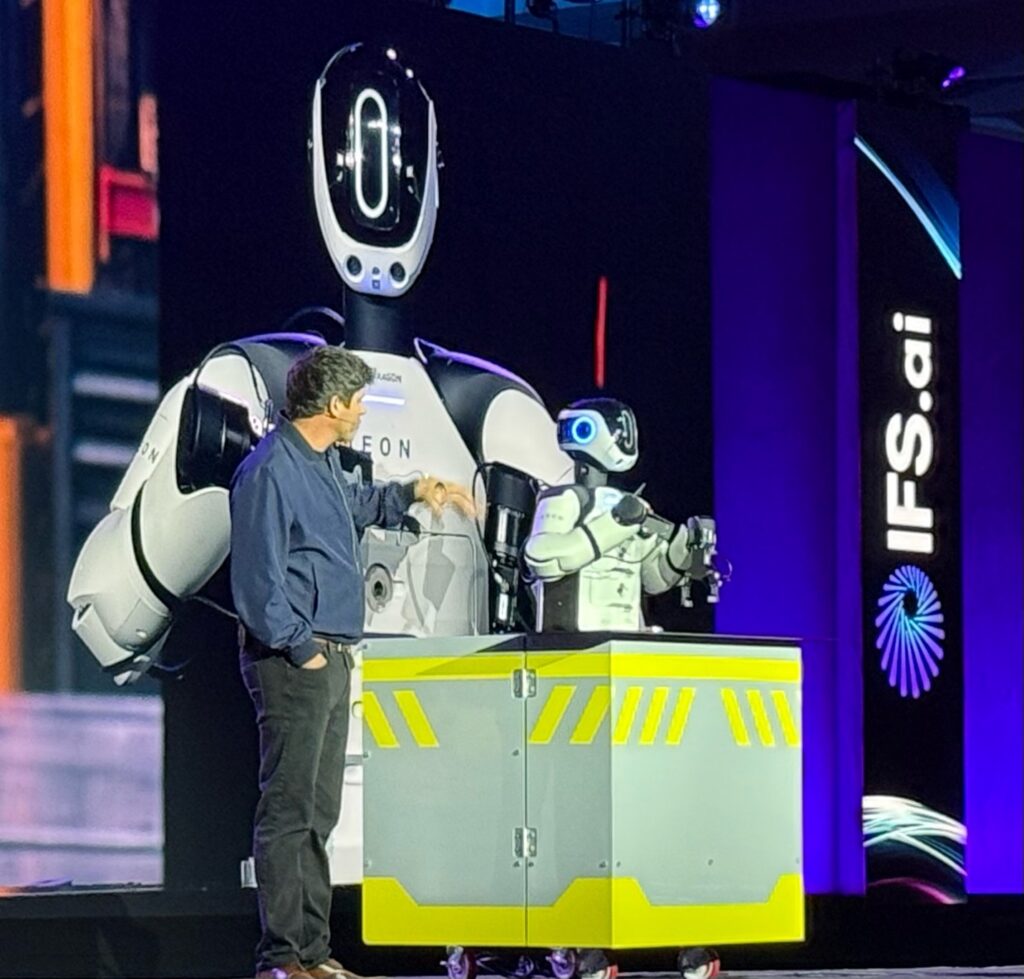
A humanoid robot was brought onstage to inspect two bearing housings for the demo. The first one it flagged: “Micro fractures detected.” The second passed.
The audience was polite. It gave the slow-as-molasses robot a bit of applause.
A later robot demo was an autonomous inspection robot called Taurob, built to inspect offshore oil platforms, able to sniff out gas leaks and photograph other problems with its “sharp eyes,” though the photographs were nowhere to be found.
Getting robots to the show was a scramble. IFS Industry Advisory Board member Jay Crotts tells us how in July the FCC forbade any foreign manufacturing robot to be imported without a written sign-off from the Department of War.
AI Moving Fast
 Curtis Taylor of Sims Crane & Equipment, a longtime IFS customer with more than 15 years in the IFS ecosystem, gave an account of how fast AI is moving.
Just before he first saw IFS Intelligence, he said, “I was in the office on Friday building a custom MPC connector or MCP connector and building skills out of IFS, and I got like three done.”
Then IFS showed him the demo of AI tools made from prompts. “You just saved me a bunch of man-hours, so I appreciate that.”
Chamath and Mark Confer
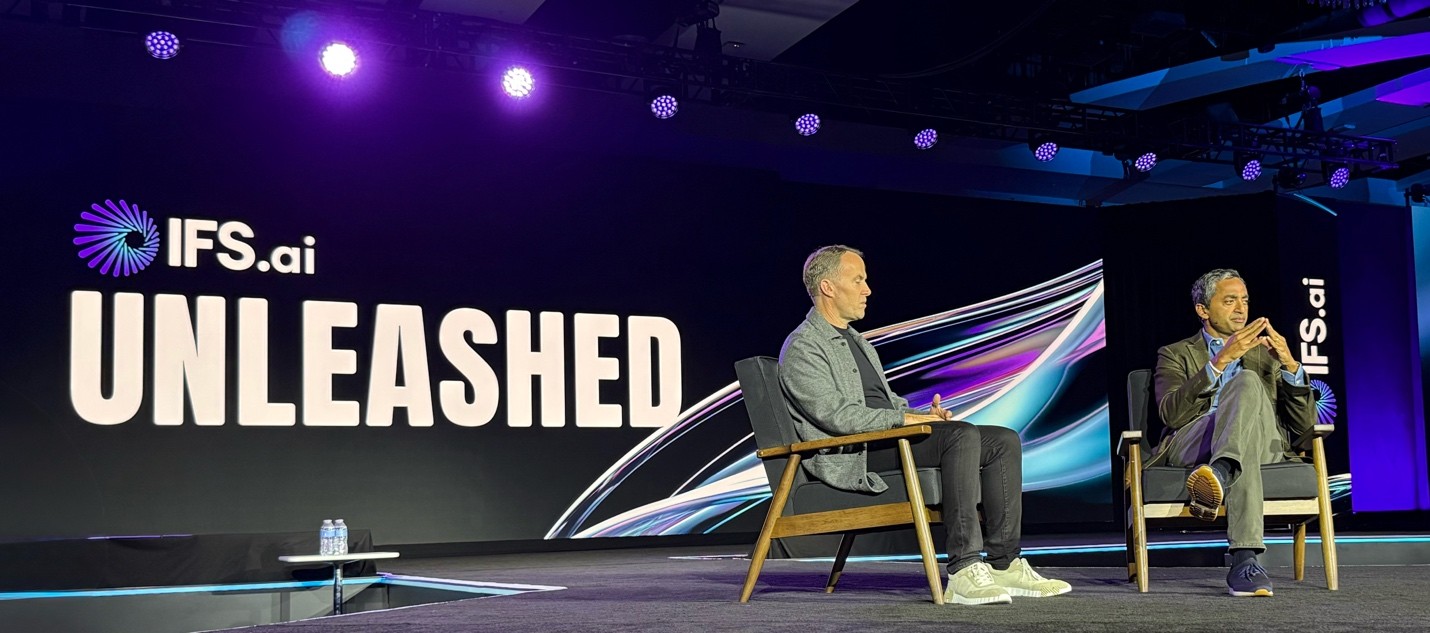
Chamath Palihapitiya is an early Facebook executive who now runs Social Capital and 8090. Mark introduced him as someone who helped “Facebook scale from fast-growing startup to a platform used now by almost a billion people.”
Chamath made a few sobering remarks about AI.
“I don’t think that we have seen the investment returns that people have expected for the amount of money that people have spent in AI.”
“AI creates breathtaking valuations, but I don’t think that these multiples are sustainable.” Some companies, he said, have swapped annual recurring revenue for annualized run rate, “and so you do all these tricks to just show bigger and bigger numbers.”
He advised the audience to “make sure you can explain yourself in a world where AI is making decisions.” “You’re not going to be able to point to an alphanumeric ID of an agent and blame it.”
IFS promised to “bring us, humans, into the loop when it needs input or a decision.”
He also had an insider’s note on harnesses. His lab, he said, found that Anthropic’s Claude Fable 5.1 performed almost 30% better in OpenAI’s Codex harness than in its own Claude Code harness. “It goes to show you that the model harness combination matters.”
He also made the case for IFS over SAP. “if for $1 of licensing, you’re going to pay another $3,” he said, then “the real AI businesses will be able to do that, and everybody else will kind of be swimming upstream in a business model that doesn’t work.”
How do you get the tribal knowledge in people’s heads encoded so that it’s machine-readable?”
The average person carries a gigabyte of experience in their head. With 3.5 billion in the workforce, that’s 3.5 thousand petabytes.
“Is it fair to say that all of the intelligence in this room might exist in today’s AI models? Mark asks.
Chamath does not think so. He says AI models may have captured the perfunctory knowledge but not the decision-making, awareness of why certain things work or don’t… the higher order of thinking. Language and now, mathematics, are solved problems, but taste, judgment? No, not yet.
On when will humanoids be able to work in factories?
“Probably within the next 10 years,” he says.
__________________
Disclosure: IFS paid for travel and hotel to attend this conference.
