

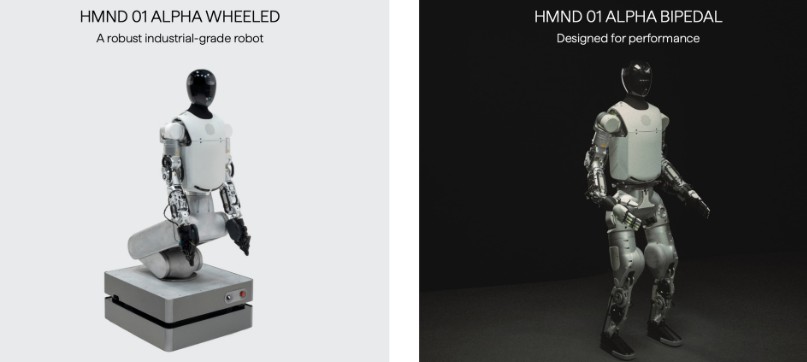
London-based Humanoid AI is developing HMND 01 as Europe’s answer to the rapidly expanding humanoid robotics market. Rather than focusing primarily on walking robots, the company is directing about 90% of its engineering effort toward a wheeled humanoid designed for industrial applications, tells Forbes.com.
The decision is practical. Wheels consume less energy, provide greater stability, and allow a larger working envelope. They also simplify certification. Existing standards for autonomous mobile robots and collaborative robots can support certification of wheeled machines, while industrial standards for bipedal humanoids are still developing. Humanoid aims to have a fully certified product by late 2027.
Behind HMND 01 is a four-layer physical AI architecture. System 3 serves as an agentic fleet coordinator, receiving tasks from warehouse management or enterprise resource planning systems and assigning work according to each robot’s location, battery level, and capabilities. System 2 uses vision-language models, including Google Gemini, to convert tasks into deterministic, verifiable workflows.
System 1 is Humanoid’s proprietary vision-language-action model. It executes individual tasks, such as picking an object from a shelf. System 0 translates those instructions into physical movements through whole-body control. This layered approach allows probabilistic AI models to contribute to robotic decision-making while keeping physical actions controlled and checkable.
Humanoid wants fleets of robots that can move between jobs rather than machines dedicated to single tasks. Its robots currently achieve about 80% of human speed and success rates on some core activities. Reinforcement learning could eventually push performance beyond human levels.
Founded in 2024, Humanoid has secured deployment agreements with Bosch, Schaeffler, and Siemens. Schaeffler has committed to at least 1,000 robots, while manufacturing partnerships could provide capacity for 100,000 humanoids by 2031.
The strategy reflects Humanoid’s broader goal: develop practical, adaptable robotic workers that can reach industrial customers sooner while bipedal technology continues to mature.
