

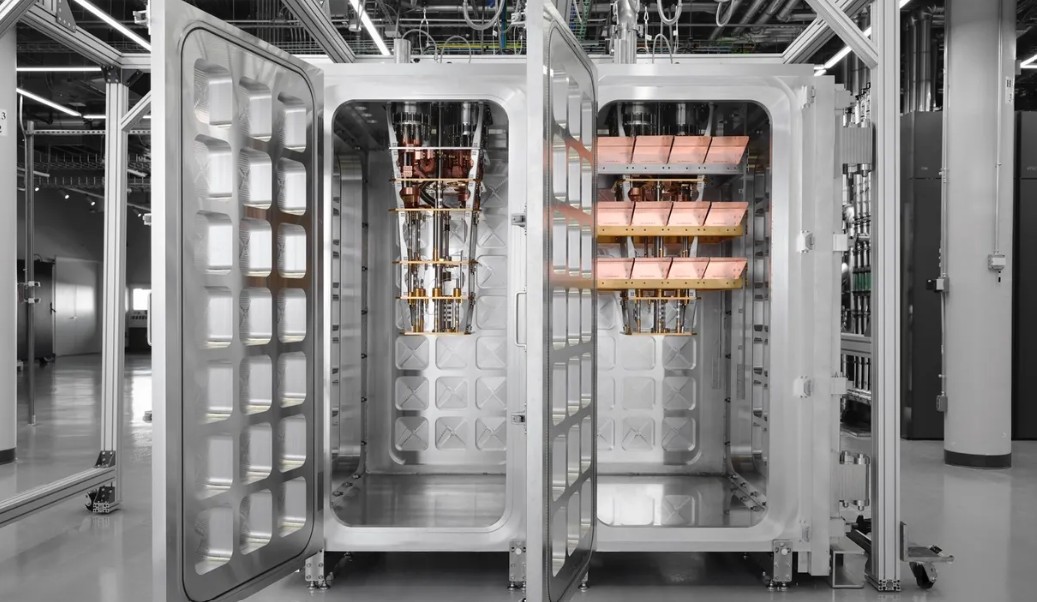
IBM has unveiled a modular cryogenic system designed to overcome a major obstacle in scaling superconducting quantum computers. The new quantum fridges can cool processors to about 10 millikelvins, close to absolute zero and more than 180 times colder than deep space, tells Live Science.
Such extreme temperatures are essential because superconducting qubits are highly sensitive to heat, electromagnetic radiation, and other disturbances. This noise creates errors that limit the length and complexity of quantum computations. Fault-tolerant quantum computers aim to address the problem through quantum error correction, allowing calculations to continue despite errors.
Scaling these systems presents another challenge. Engineers cannot simply build ever-larger refrigerators because maintenance or hardware upgrades could require warming the entire system. IBM’s approach divides the infrastructure into independent cryogenic modules, each measuring roughly 8 feet tall and wide. Individual modules can house quantum processors while remaining connected to others.
The critical technology enabling this connection is the L-coupler, an aluminum superconducting cable about 3.3 feet long. It allows quantum operations to extend between processors housed in separate refrigerators. IBM says it has demonstrated that two modules can be interconnected and simultaneously maintained at the required operating temperatures. However, complex computations across modules have not yet been demonstrated.
IBM plans to deploy the modular architecture in 2027. Initial systems could connect two or three modules and support approximately 1,000 qubits. The longer-term target is Starling, IBM’s planned fault-tolerant quantum computer for 2029. It is expected to contain 10,000 physical qubits organized into 200 logical qubits and execute 100 million quantum operations in a single session.
The development shows that achieving fault-tolerant quantum computing depends not only on better processors and error correction but also on solving difficult cooling, connectivity, maintenance, and infrastructure engineering problems.
