

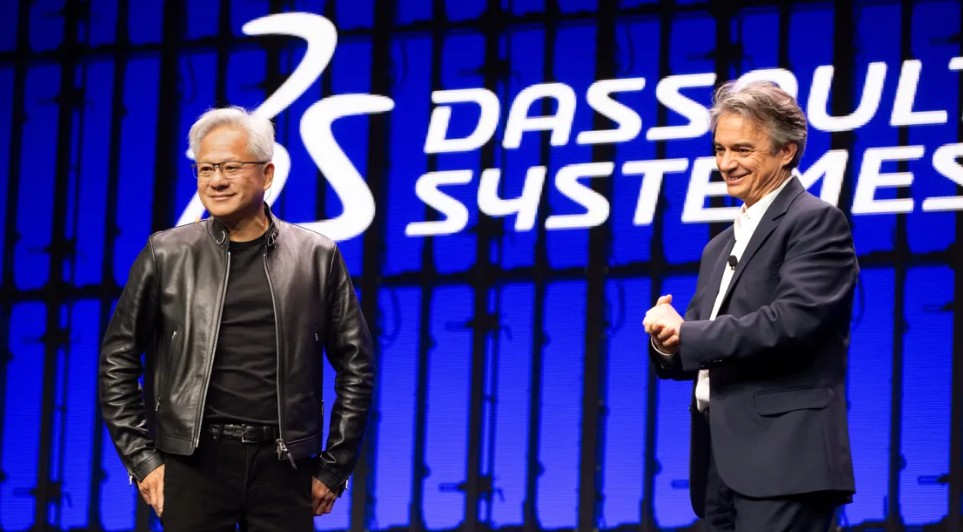
Dassault Systèmes and Nvidia are expanding their collaboration around industrial artificial intelligence, aiming to reshape how manufacturers design, simulate, and operate products and factories. According to The Engineer, the partnership reflects a broader industrial shift in which AI is becoming deeply integrated into engineering software, digital twins, and real-time manufacturing operations rather than remaining a standalone analytical tool.
At the center of the collaboration is the integration of Dassault Systèmes’ 3DExperience platform with Nvidia’s accelerated computing and Omniverse technologies. The goal is to create highly detailed virtual environments where engineers can simulate products, production systems, and operational processes before anything is physically built. These digital twins are intended to improve collaboration, reduce development time, and help manufacturers make decisions earlier in the design cycle.
The partnership places particular emphasis on generative AI and physics-based simulation. Rather than simply automating repetitive tasks, the companies envision AI systems capable of assisting engineers with design exploration, performance optimization, and scenario analysis. Nvidia’s GPU infrastructure provides the computing power needed to process massive engineering datasets and run advanced simulations at an industrial scale.
One important aspect of the collaboration is interoperability. Industrial environments often involve fragmented software ecosystems spread across design, manufacturing, logistics, and operations. Dassault and Nvidia are positioning AI-enhanced digital twins as a way to unify these disconnected systems into a continuous data environment where information flows across the entire product lifecycle.
The article also highlights the growing importance of realism in virtual engineering. Nvidia Omniverse enables physically accurate rendering and simulation, allowing engineers to evaluate products and factories in immersive environments that behave more like real-world systems. This becomes increasingly valuable as manufacturers attempt to optimize energy use, automate production, and shorten development cycles.
Beyond technology, the partnership signals changing expectations around industrial software itself. Engineering platforms are evolving from passive design tools into intelligent operational systems capable of generating insights, predicting outcomes, and supporting decision-making in real time. As AI becomes embedded within industrial infrastructure, companies are beginning to treat simulation and virtual collaboration not as optional enhancements but as core components of future manufacturing strategy.
