

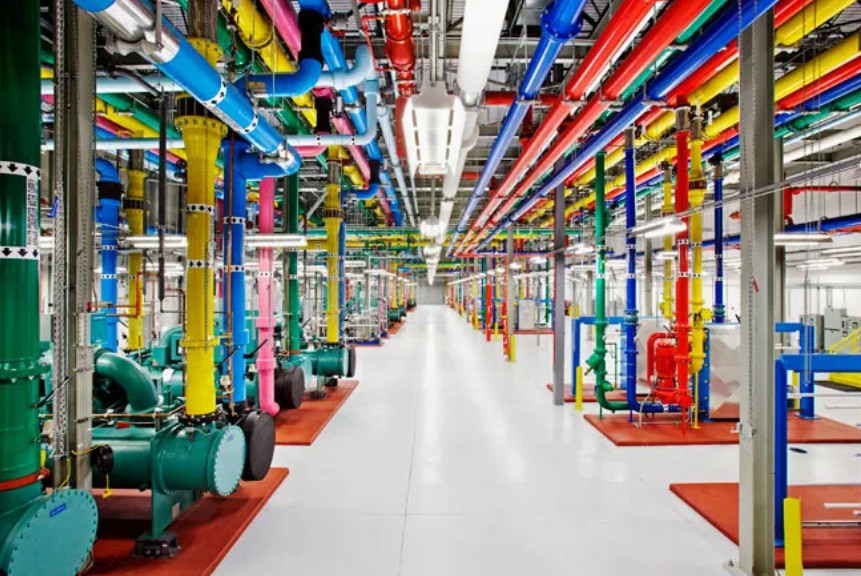
In 2012, Wired gained rare access to Google’s data center in Lenoir, North Carolina, revealing the physical infrastructure behind search, Gmail, YouTube, advertising, and other services. The Wired article shows that Google’s success depended not only on software but also on its ability to design and operate enormous computing facilities more efficiently than conventional data centers.
As Google expanded during the early 2000s, rented data center space became increasingly expensive and inadequate. The company began constructing its own facilities, including a $600 million center in The Dalles, Oregon. Engineers challenged established practices, particularly the assumption that servers required extremely cold environments. Google allowed cold aisles to reach about 80°F and captured heat from hotter areas using water-based cooling systems.
Google also redesigned power delivery. Instead of relying on large centralized uninterruptible power supplies, it installed backup batteries near individual servers, reducing electricity losses. These changes helped the company achieve a power usage effectiveness rating of approximately 1.2, compared with 2.0, then considered reasonable for data centers.
Hardware was another major advantage. Google developed stripped-down servers containing only the components necessary for its workloads. Early custom machines cost roughly $1,500 each, compared with about $5,000 for conventional servers. The company eventually designed server racks and networking equipment while building an extensive fiber-optic network to move information rapidly.
Software tied this infrastructure together. Technologies including Google File System, MapReduce, and Borg allowed thousands of machines to function collectively. Rather than viewing individual servers as independent computers, Google treated an entire data center as one enormous computing system.
The article ultimately reveals that Google’s infrastructure became a fundamental competitive advantage. Its combination of custom hardware, specialized software, efficient cooling, and global networking helped establish the warehouse-scale computing model that would shape modern cloud infrastructure.
