

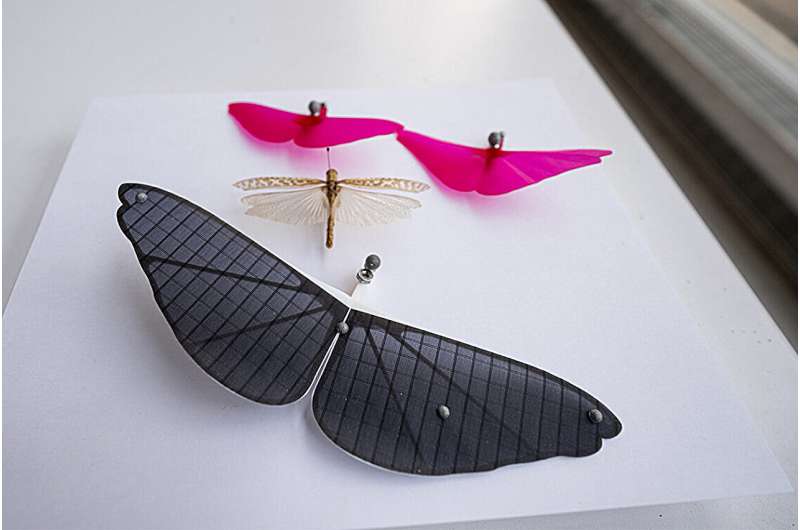
Researchers from Princeton University and the University of Illinois Urbana-Champaign have turned to grasshoppers for clues about energy-efficient flight and applied those lessons to small robotic gliders, tells Tech Xplore. The team began by observing the American grasshopper (Schistocerca americana), focusing on its hindwings. Unlike the leathery forewings that mainly protect the hindwings, the larger membranous hindwings unfold to support extended glides using minimal energy. This natural adaptation sparked ideas for engineering applications in untethered robotic flight.
A key observation was that grasshopper wings are not smooth when fully spread. They show a corrugated surface pattern. Initially, entomologists weren’t sure whether this corrugation helped or hindered flight. This study set out to answer that question and assess whether the pattern offers a performance advantage for gliding. The researchers built multiple glider prototypes with wings mimicking different aspects of the grasshopper hindwing structure, including corrugation.
The research team published its work in the Journal of the Royal Society Interface and highlighted how the grasshopper’s approach to flight could translate into robotic efficiency gains. Insects such as grasshoppers achieve extended glides with little muscle effort by exploiting natural wing mechanics. The robotic gliders leverage similar principles, with wing shapes designed to reduce drag and maintain stable, low-energy flight paths.
Lead researchers noted that gliding, as opposed to powered flapping, offers a low-energy way to cover horizontal distance. Grasshoppers deploy their hindwings fully when they want that mode of flight, converting potential energy into forward motion with minimal additional input. Translating such biological solutions into engineering design could inform the next generation of small aerial robots that need to travel without draining batteries quickly.
This work adds to a broader trend of biomimicry in robotics, where structural and functional traits from animals lead to innovations in mobility and efficiency for engineered systems.
