

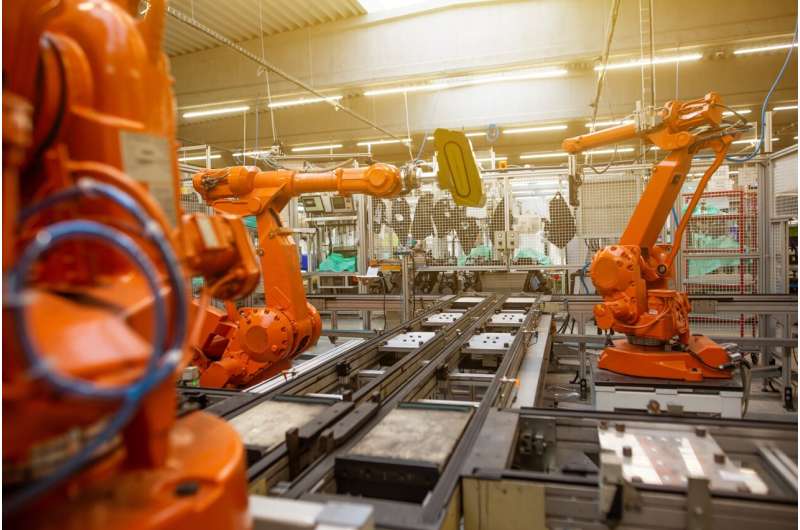
Labor shortages, supply-chain disruptions, and demand for customized products are pushing U.S. manufacturers toward more flexible automation. At Oak Ridge National Laboratory’s Manufacturing Demonstration Facility, researchers are developing intelligent manufacturing systems designed for high-mix, low-volume production rather than repetitive mass production, tells Tech Xplore.
The goal is not simply to replace workers. ORNL researchers see robotics and automation as workforce multipliers that allow fewer employees to manage more complex operations while improving productivity, consistency, and resilience. These systems use sensing, machine vision, digital twins, motion planning, and adaptive controls to respond to changing production conditions.
Several ORNL technologies demonstrate this approach. Additively reinforced thermoforming combines 3D-printed reinforcement patterns with thermoforming to produce lightweight polymer components while reducing tooling and secondary operations. Wire-arc additive manufacturing uses robotic systems, sensing, and adaptive control to manufacture large metal parts with less waste.
ORNL’s MedUSA system extends this idea by coordinating three robotic arms within one build area. The robots simultaneously deposit material, monitor the process, and adjust operations without colliding. The Future Foundries platform goes further by combining additive deposition, machining, and inspection into one workflow, reducing production time by up to 68%.
Other developments include additive manufacturing-compression molding for rapid composite production and a multiplexing extrusion platform that combines several extruders to enable high-output, multimaterial printing. The Rapid RUNNERS initiative applies near-net-shape manufacturing to large hydropower turbine components, potentially shortening production cycles that currently exceed a year.
ORNL’s vision is not a factory without people. Researchers expect humans and intelligent machines to work together, combining engineering judgment with robotic precision and endurance. By reducing reprogramming, changeover time, rework, and labor intensity, flexible automation could help U.S. manufacturers compete through speed, adaptability, and production capability rather than low labor costs.
