

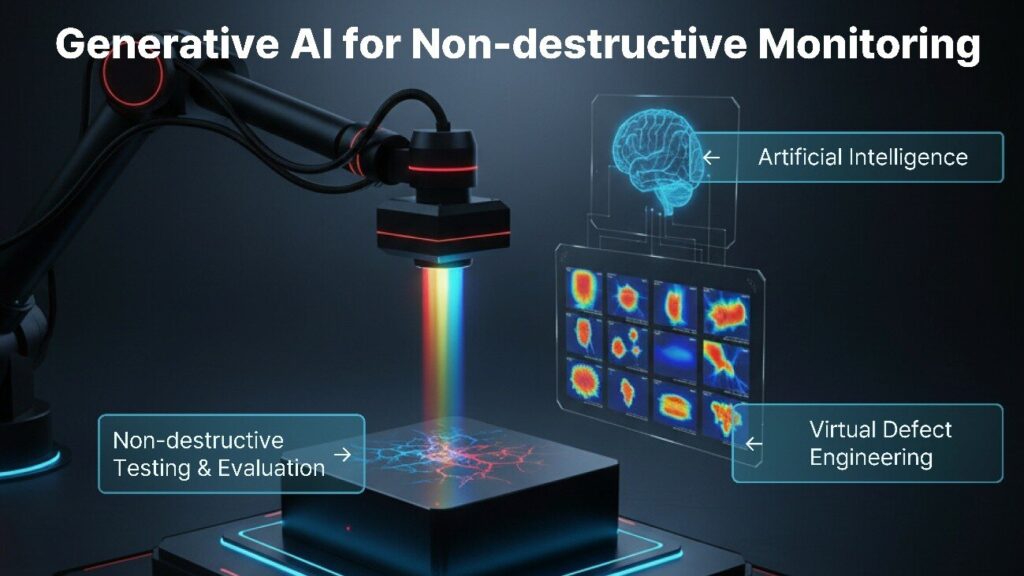
This recent article on Tech Xplore reports a breakthrough in structural-health monitoring: a new AI system called DiffectNet turns conventional sensor signals, such as ultrasonic or electromagnetic waves, into visual reconstructions of hidden flaws inside materials and structures.
Traditional non-destructive testing (NDT) often relies on sensors to detect internal defects such as cracks or voids, but these methods face limitations: sensor signals can be distorted by geometry, material heterogeneity, or complex environments, making accurate localization and sizing of defects difficult. The research team at Chung-Ang University, led by Prof. Sooyoung Lee, addresses this challenge by applying a conditional diffusion-model network (DiffectNet), which takes degraded sensor input and generates defect-aware high-fidelity ultrasonic images.
The system works by building on a generative-AI architecture: given raw sensor data and context about the inspection geometry and material, DiffectNet synthesizes realistic visual outputs that highlight internal anomalies. In effect, it acts like an “AI pair of eyes” inside a structure, surfacing defects that may be invisible to both humans and standard signal-processing methods.
Applications span reliability-critical industries: aerospace, power generation, semiconductor fabrication, and infrastructure inspection. For example, in a power plant, even a microscopic crack can have cascading consequences; AI-driven real-time monitoring thus becomes a safety enabler. Engineers can integrate this approach into automated inspection pipelines, combining traditional sensors with AI-enabled visualization to improve defect detection rates, reduce downtime, and possibly avoid destructive testing. The article emphasizes that this isn’t simply applying AI as a tool, but fundamentally redefining what defect-inspection systems can do.
This work highlights a shift: from interpreting raw sensor signals to interpreting AI-constructed imagery derived from them, enabling faster, more accurate diagnostics in complex materials and structure environments.
