

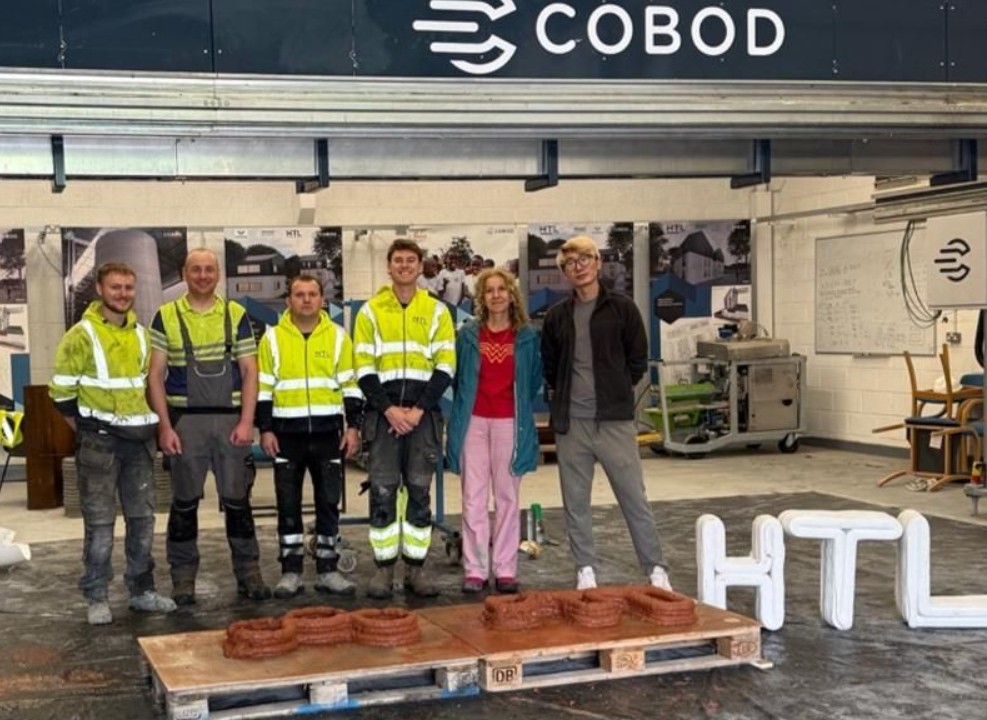
Researchers at Trinity College Dublin have successfully developed and 3D printed Ireland’s first cement-free geopolymer, demonstrating a promising alternative to conventional concrete for sustainable construction. Created by the School of Engineering, the material replaces Portland cement with a geopolymer binder that incorporates locally sourced industrial waste. The achievement highlights the growing role of additive manufacturing in reducing the environmental impact of the construction industry while supporting circular economy principles.
The material was tested in collaboration with Harcourt Technologies Ltd. (HTL), where researchers demonstrated that it could be mixed, pumped, extruded, and deposited layer by layer using commercial-scale 3D construction printing equipment. Unlike traditional concrete, the geopolymer contains no Portland cement, and more than 30% of its cementitious content is derived from bauxite refining residue, an industrial byproduct that would otherwise require disposal or long-term storage. This approach not only diverts waste from landfills but also reduces dependence on one of the construction sector’s most carbon-intensive materials.
According to the research team, the new material could reduce embodied carbon emissions by about 70% compared with conventional Portland cement concrete. Beyond its environmental advantages, the geopolymer serves as a versatile binder platform whose composition, flow properties, setting behavior, and early strength can be adjusted to suit different manufacturing processes and construction applications. These characteristics make it suitable for automated construction while enabling the production of complex geometries that are difficult or expensive to achieve with traditional methods.
The project is part of a broader collaboration supported by Research Ireland and industry partners including SISK, FLI Precast Solutions, McGrath Quarries, Techcrete, and Roadstone. Together, they aim to move the technology from laboratory research to commercial construction by addressing manufacturing, quality assurance, and large-scale deployment. The next phase of research will focus on scaling production, improving durability and mechanical performance, developing reinforcement strategies, and meeting regulatory requirements. If successful, the cement-free geopolymer could become a practical low-carbon alternative for future 3D-printed buildings and infrastructure.
