

Researchers at the Singapore University of Technology and Design (SUTD) have developed IterFlow, a lightweight artificial intelligence framework that helps autonomous vehicles and robots interpret movement in complex traffic environments. The technology improves how 4D radar estimates three-dimensional motion, potentially making autonomous perception more accurate and affordable, tells Tech Xplore.
Autonomous systems must distinguish moving vehicles, cyclists, and pedestrians from stationary objects while tracking their movements. Although 4D radar performs reliably in challenging environmental conditions, its sparse and noisy point clouds make accurate motion estimation difficult.
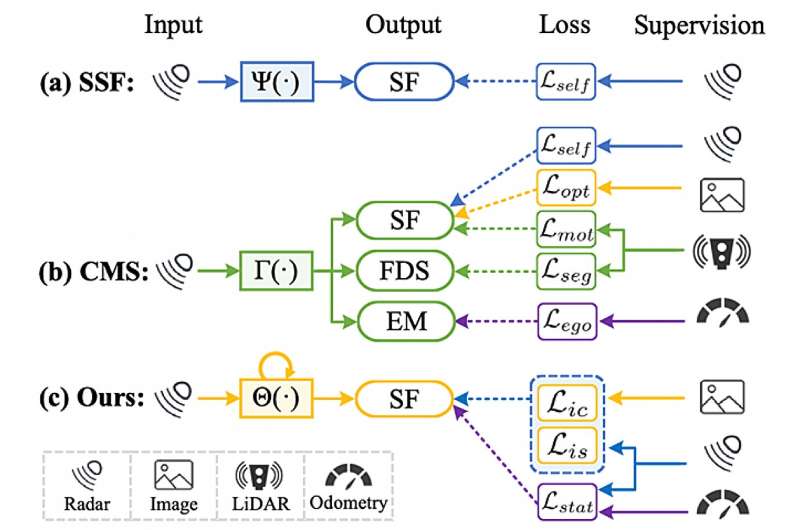
Led by assistant professor Zhao Na, the research team designed IterFlow to address these limitations without relying on expensive LiDAR-based supervision.
Instead, the framework uses RGB camera images and odometry data during training. Camera images provide object-level information through tracking and segmentation, while odometry captures the vehicle’s movement. Once trained, IterFlow requires only radar point clouds to estimate motion.
A key innovation involves instance-aware learning, which helps distinguish moving objects from nearby stationary backgrounds. Rather than assuming neighboring radar points share similar motion, the system applies consistency constraints to points belonging to the same object.
The researchers also introduced a ball query-based grouping method that considers points within a defined spatial radius. This reduces incorrect associations between distant points in sparse radar data.
Tests using the real-world View-of-Delft dataset showed that IterFlow outperformed CMFlow, an earlier radar-based motion estimation framework. It achieved these results using approximately 40 times fewer parameters and 30 times fewer giga floating-point operations, substantially reducing computational requirements.
However, the technology remains experimental. Its current PointNet++ feature extraction network supports only fixed-size point clouds, a limitation researchers intend to address.
For automotive engineers and robotics developers, IterFlow demonstrates that improved perception does not necessarily require more expensive sensors or increasingly complex AI models. Its efficient architecture could support future autonomous systems operating in challenging real-world environments.
