

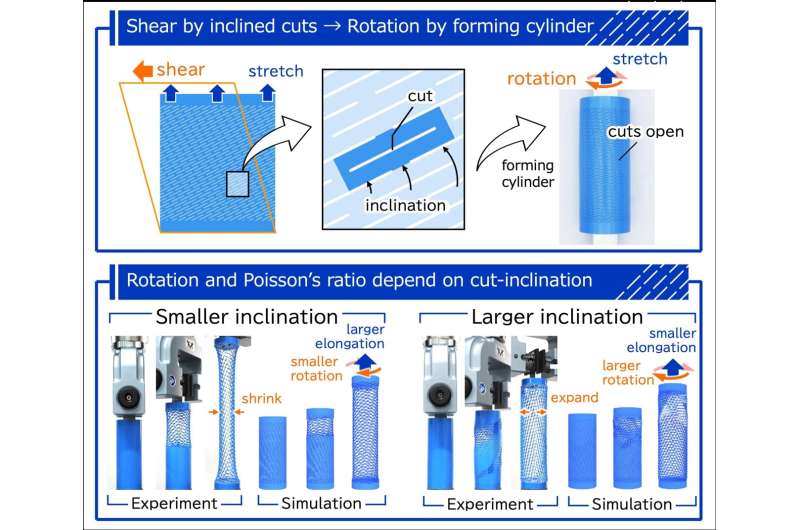
Researchers have developed a new kirigami-inspired design strategy that could significantly expand the capabilities of soft robots. The work introduces inclined cuts into flexible materials, creating structures that can achieve a wider range of controlled movements than conventional kirigami designs. The findings point to new possibilities for robotic systems that must navigate complex environments while remaining lightweight and adaptable, tells Tech Xplore.
Kirigami, the Japanese art of cutting paper to create intricate shapes, has become an important source of inspiration in engineering. Traditional kirigami structures rely on patterns of straight cuts that allow flat materials to stretch, bend, and transform into three-dimensional forms. These principles have been applied to fields ranging from flexible electronics and biomedical devices to robotics. However, conventional designs can limit the types of motion that engineers can achieve.
The new research demonstrates that introducing cuts at an angle changes the mechanical behavior of the material in useful ways. When the structure is stretched or actuated, the inclined cuts generate more complex deformations, enabling coordinated bending, twisting, and shape changes. By adjusting the orientation and arrangement of the cuts, researchers can tailor how the material responds to external forces.
This added level of control is particularly valuable for soft robotics, where movement depends on flexible materials rather than rigid mechanical joints. Soft robots are often better suited for interacting with delicate objects, adapting to uneven terrain, and operating safely alongside humans. The ability to program more sophisticated motions directly into the structure could reduce mechanical complexity while improving performance.
The study also highlights the growing role of geometry in modern engineering. Rather than relying solely on new materials or more powerful actuators, researchers are using carefully designed structural patterns to achieve desired behaviors. In this case, the geometry of the cuts determines how the material transforms under stress.
Beyond robotics, the approach could influence the design of deployable structures, wearable technologies, biomedical devices, and adaptive surfaces. By demonstrating the advantages of inclined kirigami patterns, the research provides engineers with a new tool for creating responsive systems that combine flexibility, efficiency, and precise control of movement.
