

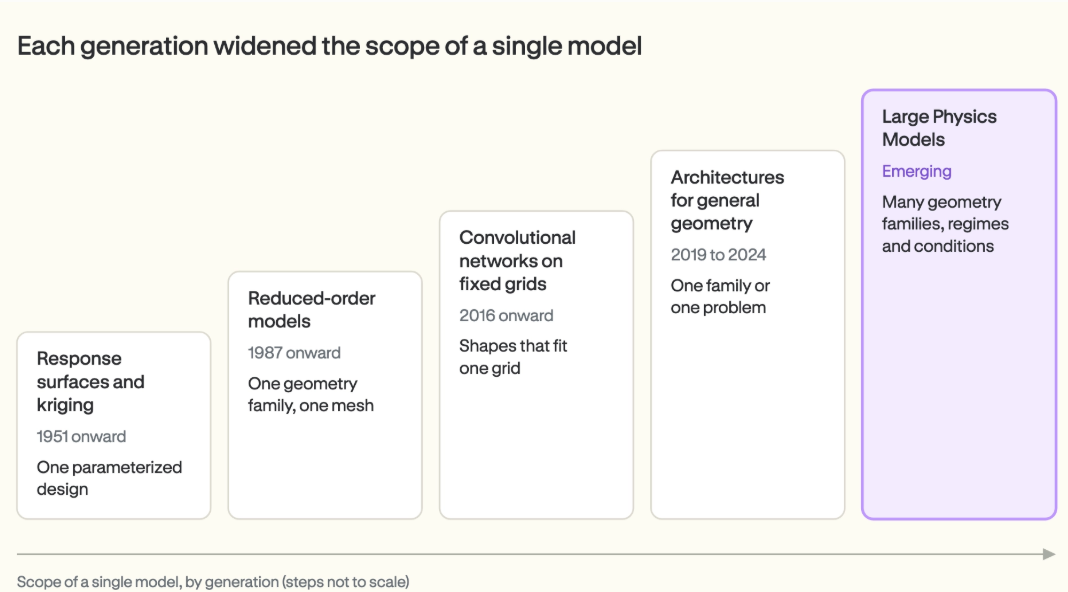
Engineering surrogate models have evolved from tools built for narrowly defined design studies into AI systems capable of predicting complex physical behavior across broad design spaces. Luminary describes this progression as the foundation for Large Physics Models, or LPMs, which use neural networks trained on extensive simulation libraries to predict engineering quantities and full physics fields in seconds.
Early response surfaces and kriging methods mapped a small number of design variables to scalar outputs such as drag or peak stress. Reduced-order models later extended prediction to complete fields, but remained tied to specific meshes and geometry families. Convolutional neural networks allowed geometry changes by representing shapes on regular grids, although the computational demands of fine 3D grids restricted their application.
LPMs aim to overcome these constraints by training across multiple geometry families, physical regimes, and operating conditions. Adding simulations can expand a model’s applicable range instead of requiring engineers to build a separate surrogate for every design space. Luminary reports that its SHIFT-Truck research showed validation loss declining according to a power law as the training dataset increased from 100 to 613 simulations.
Several AI architectures make this approach possible. Transformers use attention mechanisms to exchange information across large domains. Physics-informed neural networks incorporate governing equations into training, potentially reducing data requirements. Neural operators learn mappings between input and output fields without being tied to a single discretization, while graph neural networks capture localized physical interactions on simulation meshes.
Luminary’s LPMs can draw on thousands of high-fidelity simulations. SHIFT-SUV, for example, uses more than 1,000 DES simulations, while SHIFT-Wing uses more than 3,000 RANS simulations.
LPMs do not eliminate conventional simulation. Their training distribution defines their reliable operating envelope, and high-fidelity solvers remain important for validating predictions near its boundaries and supporting final engineering decisions.
