

Researchers are developing a wireless power system that could eventually recharge drones during flight using laser energy. The technology addresses one of the major limitations of unmanned aerial vehicles: batteries that restrict flight duration and require drones to land regularly for recharging or replacement, tells Tech Xplore.
Researchers led by Jianhua Han of the Civil Aviation University of China developed a lightweight receiver that converts energy from a green laser into electricity. The system uses a perovskite laser cell-thermoelectric tandem device designed to capture both laser energy and heat that would otherwise be wasted.
The perovskite layer converts incoming laser light directly into electricity. A thermoelectric layer generates additional power from the temperature difference between the hot, laser-facing surface and the cooler opposite side. Managing that heat, however, proved critical. During high-power laser testing, temperatures reached between 80°C and 90°C, significantly reducing efficiency.
To control heat transfer, the researchers incorporated specialized nanocrystals into the device. These materials act as a thermal barrier, slowing heat movement and helping maintain the temperature difference needed for thermoelectric generation. Under a green laser, the system converted 38.49% of incoming energy into electricity, placing it among the most efficient devices of its type under comparable conditions.
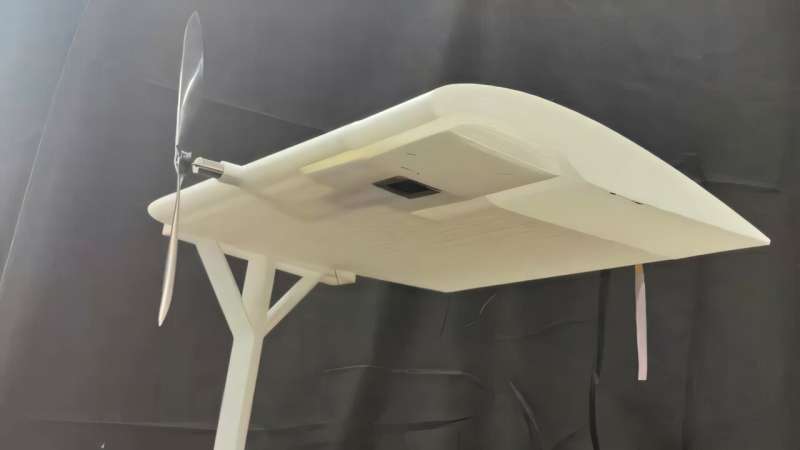
The team also integrated a prototype receiver beneath the wing of a stationary drone model. Air channels built into the wing allowed airflow from the propeller to cool the thermoelectric layer. When illuminated by the laser, the receiver successfully generated enough electricity to power the model’s propeller.
The technology has not yet powered a drone in actual flight. The researchers plan to test it outdoors on a lightweight drone. Major engineering challenges remain, including accurately directing a laser toward a moving aircraft and ensuring safe operation.
If those problems can be solved, laser-based wireless power could eventually extend missions involving disaster monitoring, forest inspection, deliveries, and other applications where longer drone endurance is valuable.
