

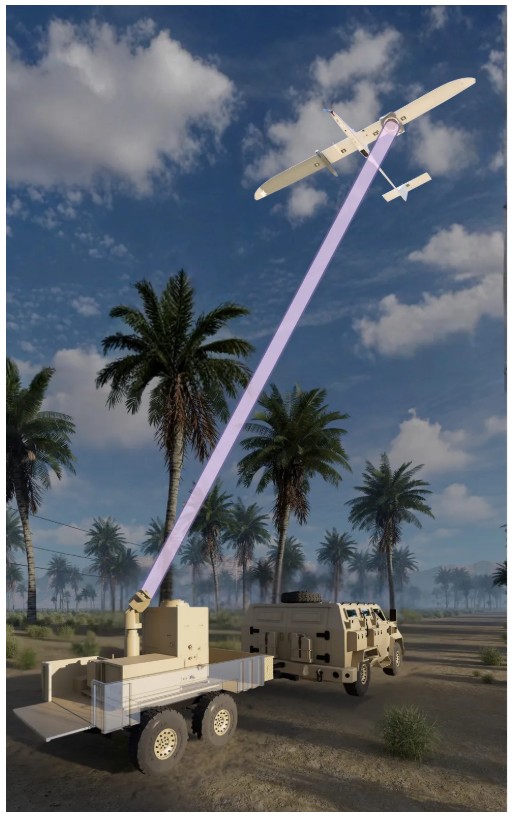
A team at PowerLight Technologies in Washington state has built a laser-based wireless power system designed to deliver continuous energy to drones in flight, a development that could let unmanned aircraft remain aloft indefinitely without landing to recharge, tells Live Science. The system pairs a ground-based laser transmitter with a lightweight receiver mounted on the drone. The transmitter locks onto cooperative targets and directs a high-intensity laser beam, while the drone’s receiver converts that light into electricity via a specialized photovoltaic converter optimized for monochromatic, powerful light.
PowerLight’s transmitter and software work as a tracking and control suite. Sophisticated algorithms maintain beam alignment with a moving drone, even at altitudes near 5,000 feet. The transmitter’s control software exchanges telemetry with the aircraft’s onboard systems, giving operators real-time information about power needs and delivery. Ground tests have validated tracking and delivery algorithms, and flight tests are scheduled for early 2026 to demonstrate real-world performance.
The receiver weighs about six pounds (2.7 kilograms) and houses both the photovoltaic converter and an embedded control module. This module not only converts laser energy into usable onboard power but also supports two-way optical communication with the ground station, enabling greater operational flexibility. The design reflects a broader interest in overcoming battery limits for unmanned aerial systems by transferring power through the air rather than relying on stored energy alone.
PowerLight is integrating its system with Kraus Hamdani Aerospace’s fully electric K1000ULE drone, intended for long-endurance military missions for the U.S. Navy and Army. The approach builds on the concept of wireless power beaming, a longstanding research goal, and could transform roles for drones in surveillance, logistics, and persistent operation scenarios. Full demonstration of sustained in-flight charging will be a key milestone for practical deployment.
