

Lasers are usually associated with generating heat, but a collaboration involving Minnesota startup Maxwell Labs, Sandia National Laboratories, and the University of New Mexico is testing whether carefully controlled laser light can cool computer chips. The approach, known as photonic cooling, could reduce the energy and water required to keep increasingly powerful processors within safe operating temperatures, tells Tech Briefs.
Cooling represents a major burden for data centers, accounting for roughly 30–40% of their energy use. Conventional systems typically rely on air or water to remove heat. Maxwell Labs instead proposes a photonic cold plate that directs laser light toward tiny hot spots on processors, including GPUs. These hot spots can measure only hundreds of microns, making them suitable targets for precisely focused light.
Laser cooling works only under specific conditions. A particular light frequency must interact with an extremely small, highly pure material. Maxwell’s design relies largely on gallium arsenide formed into microscopic structures that guide cooling light to localized areas. Because impurities can absorb laser energy and create heat, the semiconductor layers must be exceptionally pure.
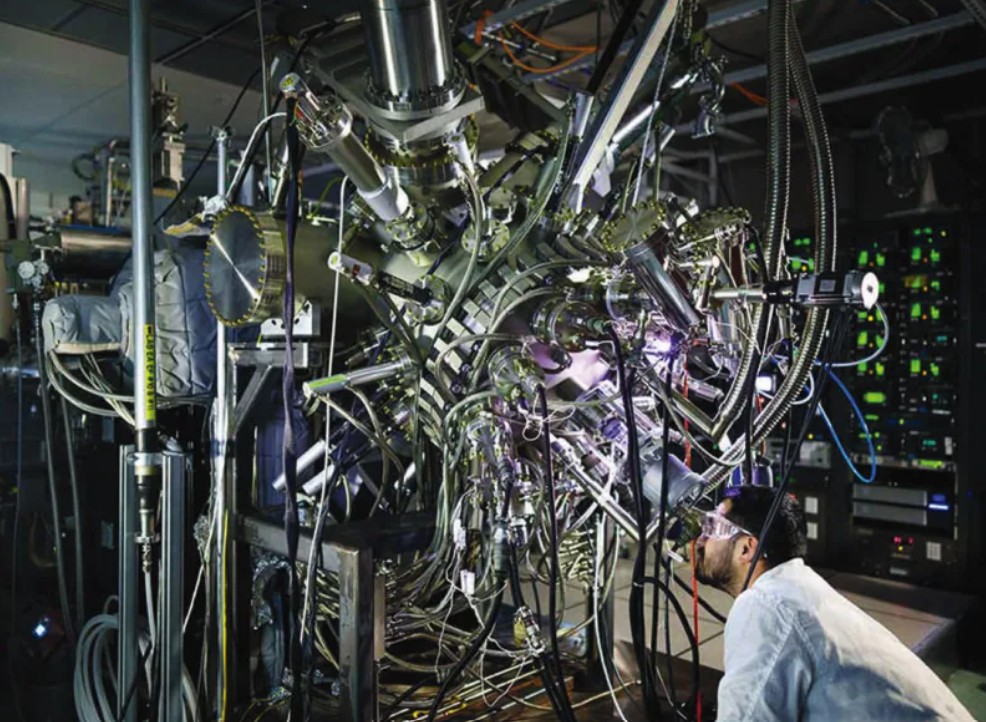
Sandia will contribute its expertise in gallium arsenide fabrication. Researchers will use molecular beam epitaxy to grow high-quality crystalline layers and manufacture experimental cold plates for testing. The work builds on earlier nanophotonics research involving Maxwell co-founder Alejandro Rodriguez and Sandia physicist Raktim Sarma.
If experiments confirm Maxwell’s models, photonic cooling could keep chips colder than water-based systems while enabling processors to operate at higher performance levels. The system could either supplement or potentially replace conventional cooling technologies. Maxwell also envisions recovering extracted heat as light and converting some of that energy back into electricity. Although the technology remains experimental, successful demonstrations could reshape chip thermal management and reduce the growing energy and water demands of data centers, supporting more efficient computing.
