

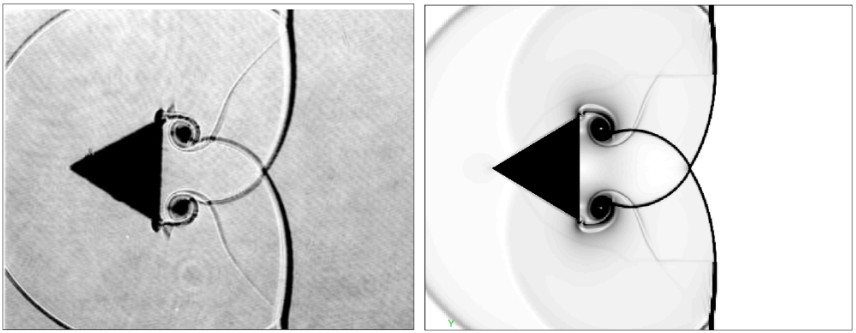
For decades, computational fluid dynamics in aerospace and defense has relied heavily on Navier-Stokes equation solvers built around structured or unstructured meshes. According to Dassault Systèmes’ SIMULIA blog, a different approach is now gaining momentum: the Lattice Boltzmann Method, or LBM. Originally viewed as a niche research technique, LBM is increasingly being positioned as a serious competitor to traditional CFD methods for aerodynamic simulation, particularly in aviation and defense applications.
Unlike conventional CFD approaches that solve fluid behavior directly through grid-based equations, LBM models fluid flow at the microscopic particle level. The method simulates how particle distributions move and collide across a lattice structure, allowing complex fluid behavior to emerge naturally from those interactions. Researchers argue that this particle-based strategy simplifies certain calculations while improving scalability for modern high-performance computing systems.
The article highlights the growing appeal of LBM for external aerodynamics and wind tunnel replacement workflows. Traditional CFD often requires extensive mesh generation and manual preparation, especially around complicated geometries. LBM reduces some of that complexity because the simulation operates on a more uniform lattice structure. This can accelerate model setup and make simulations easier to adapt during design iteration.
Dassault Systèmes also emphasizes the compatibility between LBM and GPU-accelerated computing. As aerospace simulations become increasingly large and data intensive, scalability has become a critical issue. LBM’s mathematical structure aligns well with parallel processing architectures, enabling faster computation across advanced hardware systems. This advantage becomes especially important for defense and aviation programs where engineers may need to evaluate thousands of design variations rapidly.
The article frames LBM as part of a broader evolution toward “digital rivals,” highly detailed virtual representations capable of reproducing physical wind tunnel behavior with increasing accuracy. Aerospace companies are under growing pressure to shorten development cycles while reducing physical testing costs. More advanced simulation methods could help achieve those goals by moving larger portions of aerodynamic evaluation into virtual environments.
While traditional CFD remains deeply established across industry, Dassault suggests that LBM is becoming an increasingly credible alternative rather than an experimental curiosity. The technology’s combination of computational efficiency, GPU compatibility, and reduced preprocessing complexity may help redefine future aerodynamic simulation workflows in aerospace and defense engineering.
