

Solid oxide fuel cells can efficiently convert hydrogen and other fuels into electricity, but their high operating temperatures remain a major engineering challenge. Most oxide-ion fuel cells operate above 500°C because their ceramic electrolytes require intense heat to transport ions effectively. Researchers have now developed Aurivillius-type materials that could enable these fuel cells to work at significantly lower temperatures, tells Tech Xplore.
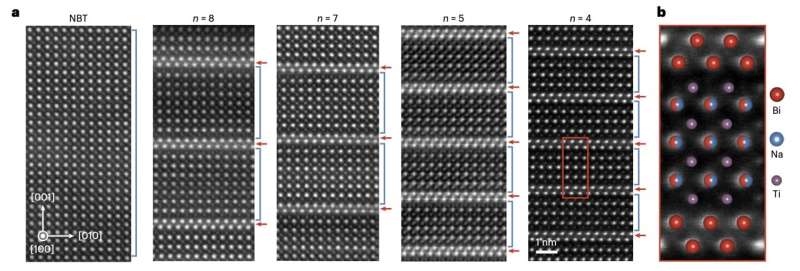
Researchers from the University of Science and Technology Beijing, Hainan University, and other institutions created a family of layered thin films designed to improve oxide-ion movement. The materials consist of sodium-bismuth-titanium oxide blocks separated by regularly arranged bismuth oxide layers.
The researchers produced four versions containing different numbers of perovskite-like layers using pulsed laser deposition. They then added small amounts of magnesium or strontium to modify the materials’ structures and control oxygen vacancies, empty lattice sites through which oxide ions can move.
A film doped with 4% magnesium delivered the strongest performance. Its layered atomic structure created periodic channels that allowed ions to move quickly, achieving ionic conductivity of 0.025 siemens per centimeter at 350°C. Atomic-scale imaging and calculations indicated that localized lattice stretching and dual-ion conduction pathways contributed to this performance.
The team then used the optimized film as an electrolyte in laboratory-scale solid oxide fuel cells. During testing, hydrogen was supplied to the anode and air to the cathode. The researchers conducted a 200-hour durability test at 350°C and evaluated maximum power density at 400°C.
The fuel cells reached a maximum power density of 0.726 watts per square centimeter at 400°C, demonstrating the material’s potential for practical applications.
Further development could allow Aurivillius-type electrolytes to support solid oxide fuel cells that operate at lower temperatures, reducing component degradation while simplifying system design and thermal management.
