

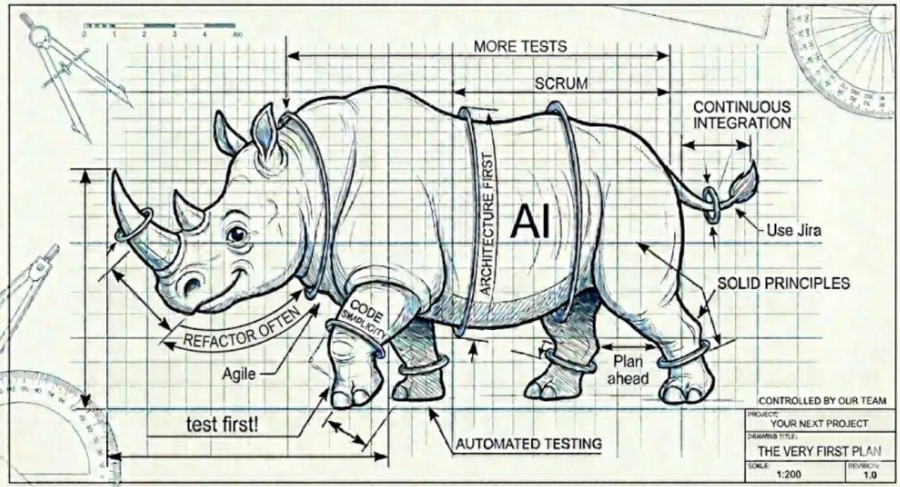
As artificial intelligence becomes increasingly common in software development, engineering software company LEDAS has adopted a measured approach to integrating AI into the creation of CAD, CAM, CAE, and BIM systems. Rather than viewing AI as a replacement for software engineers, the company describes it as a highly productive junior engineer operating under strict supervision and quality controls.
The Upfrontezine article highlights a divide among customers. Some see AI as a way to accelerate development and reduce costs, while others worry about security risks, intellectual property leakage, unreliable code generation, and licensing issues. LEDAS argues that both perspectives contain elements of truth. Large language models can significantly improve productivity, but only when used within a disciplined framework that minimizes risk.
The company identifies several drawbacks associated with AI-generated code. These include code hallucinations, where software appears correct but fails under certain conditions; potential exposure of proprietary algorithms through public AI platforms; inadvertent inclusion of copyrighted or GPL-licensed code; and architectural weaknesses that can emerge when AI attempts to design complex software systems. Such risks are particularly serious in CAD and engineering applications, where errors can affect simulations, manufacturing processes, and product reliability.
To address these concerns, LEDAS relies on locally hosted AI models that operate without internet access. Client code never leaves dedicated servers, and the company’s models are not trained on customer data. Additional safeguards include strict information-sharing protocols, automated monitoring of interactions, peer reviews, static code analysis, and extensive testing. According to the company, AI-generated defects occur no more frequently than those introduced by junior developers.
LEDAS has found AI most useful for repetitive and time-consuming tasks such as boilerplate code generation, unit-test creation, code documentation, API conversions, legacy code refactoring, and log analysis. However, critical responsibilities remain with human engineers. Architectural decisions, computation-kernel design, performance-critical code, and final verification are always handled by experienced developers.
The company reports faster development cycles, stable software quality, and no incidents of code leakage, demonstrating that AI can enhance engineering productivity when paired with rigorous oversight and human expertise.
