

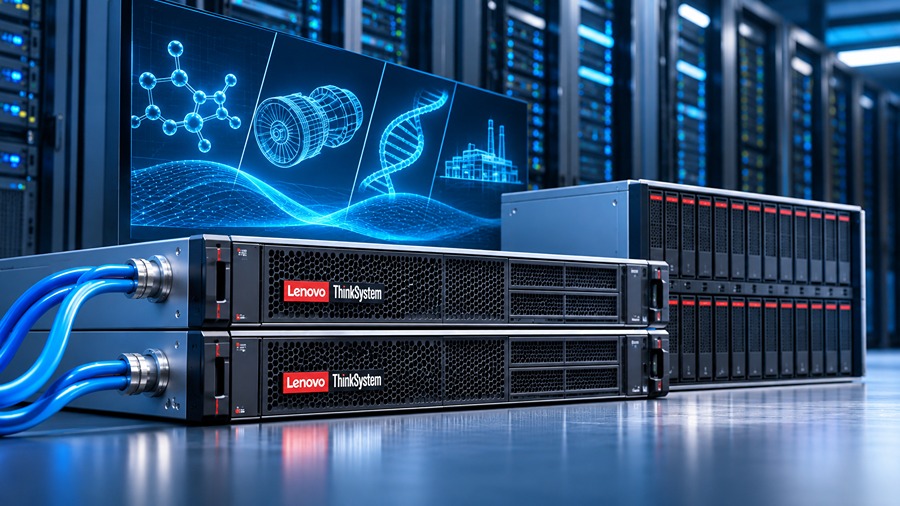
MORRISVILLE, NC, Nov 12, 2026 – Lenovo has announced new ThinkSystem servers powered by 6th Generation AMD EPYC SP7 processors, storage arrays and expanded services for artificial intelligence (AI) and high-performance computing (HPC). The portfolio also includes Neptune liquid cooling and high-speed interconnect options for deployments across customer data centers, hybrid environments and colocation facilities.
“AI and high-performance computing are converging around a simple customer need: the ability to turn increasingly complex workloads into real outcomes,” said Scott Patti, vice president, infrastructure solutions group, Lenovo. “That means getting more useful performance from every watt, overcoming growing power and cooling constraints, and moving faster from infrastructure deployment to operational AI. Lenovo is bringing together high-performance infrastructure, Neptune™ liquid cooling and expanded services to help customers do exactly that at scale.”
Servers, Storage and Interconnects
The infrastructure expansion includes two ThinkSystem servers, two storage arrays and an interconnect option.
- Lenovo ThinkSystem SC755: The dual-socket server uses Neptune liquid cooling to remove up to 100% of system heat through water. Lenovo claims up to 40% higher sustained performance than comparable air-cooled systems. Lenovo Dynamic Partitioning allows customers to convert two dual-socket systems into single-socket configurations and back, providing flexibility in allocating computing resources across workloads.
- Lenovo ThinkSystem SR755: The server is designed for large-scale virtualization, engineering workloads, financial modeling, electronic design automation (EDA) and agentic AI infrastructure. It emphasizes compute density and memory bandwidth. Lenovo also reports lower power consumption and better economics for demanding workloads compared with dual-socket configurations.
- Lenovo ThinkSystem DE6800 and DE6500: The storage arrays support high-throughput, latency-sensitive block storage workloads. The DE6800 is designed for applications requiring high storage throughput, while the DE6500 provides high-performance storage with simplified deployment and management.
- Cornelis CN5000 fabric validation: Lenovo has validated the Cornelis CN5000 fabric as a high-performance interconnect option for AI and HPC environments. The technology is intended to reduce data movement bottlenecks across compute-intensive systems.
“As AI and HPC workloads converge, organizations need infrastructure that delivers exceptional compute performance, energy efficiency and flexibility at scale,” said Dan McNamara, senior vice president and general manager, compute and enterprise AI, AMD. “The new Lenovo ThinkSystem platforms powered by 6th Gen AMD EPYC Server CPUs help customers accelerate demanding workloads – from engineering and scientific research to AI inferencing and agentic AI – while building a more efficient, scalable foundation for continued innovation.”
Expanded AI Infrastructure Services
Lenovo is expanding its Hybrid AI services to support infrastructure deployment, and configuration for enterprise AI environments and AI facilities.
- Hybrid AI Factory Services: Lenovo has added GPU deployment, configuration and optimization capabilities for hybrid AI infrastructure. The services include new multi-node support across RedHat AI Enterprises and NVIDIA AI Enterprise with NVIDIA Run. They support the deployment, management and scaling of workloads, including agentic AI and physical AI.
- Gigafactory Services: Lenovo is expanding its services for large AI deployments with new gigafactory services, including NVIDIA Infrastructure Services (NVIS) expertise for specialized deployment and cluster validation. The services cover projects from planning and construction through deployment and optimization.
- Colocation Services with Digital Realty: Lenovo can now facilitate access to Digital Realty’s global network of colocation facilities. Organizations can use the Digital Realty Innovation Lab (DRIL) to validate AI infrastructure, applications and workload requirements. Lenovo serves as a single point of contact for organizations seeking colocation capacity, with access to infrastructure, modular services and financing through Lenovo TruScale Infrastructure as a Service.
AI and HPC Customer Applications
Lenovo cited customer deployments involving scientific research, engineering simulations and digital content production. At the University of Florida, the fourth generation of the HiPerGator supercomputer uses Lenovo, NVIDIA and AMD technologies. DreamWorks Animation uses Lenovo Neptune in its data center. The company also cited sovereign AI research in Bavaria, Germany, and fusion energy simulations at Imperial College London as applications of its AI and HPC infrastructure.
Source: Lenovo
About Lenovo

Lenovo Group Limited, founded in 1984, is a tech company specializing in designing, manufacturing, and marketing consumer electronics, personal computers, software, servers, and related services. Serving industries such as education, healthcare, retail, and manufacturing, Lenovo offers a diverse product portfolio that includes laptops, desktops, tablets, smartphones, workstations, servers, storage devices, and accessories. The company markets its products under brands like ThinkPad, ThinkBook, IdeaPad, Yoga, Motorola, and Legion. Headquartered in Beijing, China, and Morrisville, NC, Lenovo operates in over 60 countries and sells its products in approximately 160 countries worldwide.
