

Editor’s note: The following is a transcript of a Future of Design and Engineering Software podcast with minor changes, deletions and corrections. You can see the whole podcast on YouTube.
Roopinder Tara — 00:07
Hello and welcome to FoDES, the Future of Design and Engineering Software podcast. My name is Roopinder Tara. On the show, we will have guests that will discuss tools and technology that engineers will find interesting and useful. Hi, how’s it going? Lewis, nice to meet you.
Lewis Valentine — 00:26
Nice to meet you.
Roopinder Tara — 00:29
Do you mind this being recorded?
Oh, yeah, that’s great. All right, good. Because then you can be on the podcast.
Lewis Valentine — 00:35
Yeah. Prerequisite there.
Roopinder Tara — 00:38
Exactly. I was very anxious to meet you, because I tell you, you made it sound like you could make your own kernel now.
Lewis Valentine — 00:49
So yeah, it’s definitely something you could do.
Roopinder Tara — 00:52
And you’ve done it.
Lewis Valentine — 00:54
Yeah.
Roopinder Tara — 00:55
You’ve done it. You’ve got your own geometry kernel that you have created.
Lewis Valentine — 01:00
It’s running right now.
Roopinder Tara — 01:03
You worked at Spatial. Okay. So you’re all familiar with kernels. So you just thought, what, I can do this myself?
Lewis Valentine — 01:11
Yeah. So I worked there for about 13 years, and I was in R&D, and then I was also a field-deployed engineer. So basically, I saw customer implementations; I saw how people work on the product; I saw how people thought about the product and everything. And at some point — I guess I started off, like, I was doing stuff in AI in February. I saw OpenClaw. I’m like, this is incredible; let me build with it. And one idea I had was, let me just try something in CAD. So I was like, let’s do a STEP reader with no SDK. I thought that would be simple enough — we should be able to read in the surfaces and kind of understand it and do triangles. That seemed like something. But Google couldn’t really figure it out, and I even gave it to Claude — Opus couldn’t figure it out. Just the face winding wasn’t working. As it went to put the triangles around into the holes and stuff and connect everything, it just wasn’t really figuring it out. And I didn’t want to look at it, because it’s really complicated — UV windings and a bunch of stuff that’s just very mathy. So I kind of set it aside for a while. And then Fable 5 came out, and it was just incredible. I gave it that task, which it just was able to solve, basically. And then on July 14th is when I really was like, let’s make a CAD kernel out of this, because it’s powerful enough to do it, it’s solving the bugs. And the way I’m doing it — I built this other product, FeatureBoard, which is really — it’s basically what people talk about with agents, they talk about workflows and skills. And I took those skills, and I said, I realize there’s problems: if you just give it files that are skills, and you say, here’s my huge workflow, it falls apart. So I said, let’s build it with OpenClaw, let’s dig into that and actually send constrained prompts — just send one prompt and then kind of close it off and do something else, and kind of move outside of the chat window and keep track of everything as metadata, basically. And hopefully that makes sense — it makes a lot more sense if you use it. It’s like Jira, but instead of you dragging the task around and having to talk about what you’ve done, you drag the task and the AI starts working on it.
Roopinder Tara — 03:13
I’m getting about 10 to 20 percent of this. I’m sure I’ll get more when I play this back. I’m a trained engineer, not a developer. So let me ask you to clarify a few things. You mentioned Fable.
Lewis Valentine — 03:28
Fable is an Anthropic model — a model released by Anthropic. And don’t worry, I can clarify a lot, feel free to interrupt with questions, that’s probably the best way to go. Because AI does let you just go so broad and so far and so fast — that’s where I’ve been mentally.
Roopinder Tara — 03:46
Just geometry kernels — you’ve made a whole CAD program, a whole solid modeler.
Lewis Valentine — 03:51
Yeah, so there’s one end of it: the solid modeler front end that runs in the browser, and it actually runs on your system, not mine, which is nice. Traditional CAD, they’re paying a huge cloud premium to do that, but I’m just sending it to you and trusting licensing and stuff like that to do its job.
Lewis Valentine — 04:09
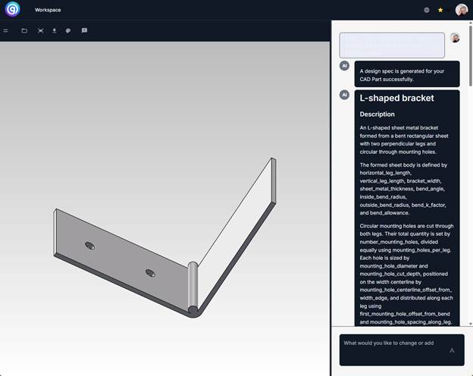
So there’s that side of it. There’s also what’s called the MCP plugin — MCP plugins are… it’s like a Google Chrome extension, but it’s for Claude, it’s for Cursor, it’s for Grok Build. All the model providers, they all have something like this that you can install, and it communicates with the AI and comes back and does work on your computer. So what this is — the plugin gives it tools that it then uses. So it’s a kernel that it can use. The Anthropic AI goes, and you just install the kernel and say, okay, build me a part. Like the bracket that you posted about — I just put that in with the extension installed, and it started to work on it, essentially.
Roopinder Tara — 04:50
Congratulations, by the way. You won the great bracket challenge.
Lewis Valentine — 04:54
I didn’t realize it was going on, actually — that’s what’s kind of surprising. My head has been spinning a little bit since realizing maybe this is actually producing one of the better text-to-CAD implementations.
Roopinder Tara — 05:04
I’m half joking [about the Bracket Challenge], because I just decided on a whim to give it the simplest thing I could think of. I’ve been asking CAD to do that over the last year and a half, but CAD has has invariably failed, because there’s so much to making a simple part that engineers know, but AI has to guess at — and guessing is not a thing that engineers can tolerate. So holes are in the wrong place, thickness is off — I think originally when I had gNucleus do it, they put a round where there should have been a fillet. They’ve since corrected that. But the point was, not so much that they could train on brackets, but that they could think like an engineer thinks — use material that an engineer would use.
Lewis Valentine — 05:55
Yeah, I think a lot of people have gone down this route of, they want to train using engineer data — on people who have used a modeling kernel, like SOLIDWORKS or Parasolid — and they want to see, how did the experts do that, and we’ll take that data set and use it. And I think the issue there is there are several inner layers. You have the engineer using SOLIDWORKS, and maybe they use it right, but they probably don’t — there’s probably a better way to do it, distributed amongst the millions of users and that knowledge on the internet and everything. And then there’s the actual implementation of the modeler onto the kernel — and everybody using anything has to have a kernel in the background — that implementation can have issues, and probably isn’t done correctly. I’ve seen AI review of code that basically grades AI code at nine out of ten, because it follows a lot of structure and convention that people don’t want to do, and human-written code is graded at like five. So — egotistically, we all want to be like, I’m the best coder, I’m so good at coding, that’s what I thought a few years ago. But at some point with this, I was like, it knows more than me, it knows more of the right things to do, and it’s producing higher quality code. I might not be the one to judge it, but it is.
Roopinder Tara — 07:08
So that means a lot to somebody who’s professionally coding. Would you say most — even coders in our world, geometry-kernel developers, or CAD developers — most of that work is now being done by Claude?
Lewis Valentine — 07:25
Anyone I’ve talked to — I’m suspicious about whether or not the kernels have gone into Fable. I think there’s some moat defense there, where they’ve been hesitant to do that. In terms of pace of development, I would say it’s obvious who is and isn’t using AI. If there’s not much development, they’re not using it. If all they produced is a connector, they’re not using it. The MCP implementation — it took about half a day of work to take the kernel. I just said, okay, today we’re doing an MCP implementation of the kernel, make it. And that’s kind of all I had to do as far as putting work into my system.
Roopinder Tara — 07:59
So I’m a little familiar with MCPs from the MCP server that Onshape created. I did a little research and an article on them. But you’re saying the work that Onshape had to do, PTC had to do, to make that MCP server — took them a little while. You said you can do that in a what?
Lewis Valentine — 08:23
Half a day. That was how much time we spent on it, to get the initial go-around.
Roopinder Tara — 08:30
Interesting.
Lewis Valentine — 08:31
Another thing that was quick — way faster than I actually expected — is last Friday I was looking at starting 3D PDF. Someone reached out to me about it, I didn’t have anything beyond what I had. I said, let’s start 3D PDF. And by that afternoon, I had 3D PDFs written out that would load up in Adobe Acrobat.
Roopinder Tara — 08:51
You’ve got a deep background in CAD. We had Peggy Xia on the show, and she’s got tons and tons of CAD experience, and so does her team. You do, too — you have a lot of CAD experience.
Lewis Valentine — 09:12
Yeah, and also my wife was the director of product at Spatial.
Roopinder Tara — 09:16
Oh, really?
Lewis Valentine — 09:17
Oh yeah.
Roopinder Tara — 09:18
That’s a fun little family.
Lewis Valentine — 09:20
Yeah, little CAD family. We tried to get out of the CAD business almost, and then it pulled us back in.
Roopinder Tara — 09:25
This is the most exciting time to be in CAD with all this that’s going on.
Lewis Valentine — 09:31
Manufacturing — people want to build stuff finally. There really was this “let’s not build stuff, maybe we’re building too much,” and now it’s like, can we do drones, flying cars, boats? There’s just so much. The robotic side is really cool.
Roopinder Tara — 09:44
Yeah, robots are cool. Look at — supersonic planes, you have small companies now that are making supersonic planes, and that used to be, Boeing could do that, or Lockheed could do that. Now ten men — I think Boom is more than ten men.
Lewis Valentine — 10:00
So I actually have an interesting demo about something Boom has posted on Twitter that I can show you, because I was gonna bring up Boom Supersonic.
Roopinder Tara — 10:07
Can you do that?
Lewis Valentine — 10:08
Yeah, you want to see it?
Roopinder Tara — 10:10
Yeah.
Lewis Valentine — 10:11
All right, let’s just do this.
Roopinder Tara — 10:14
Is this work you’re doing for Boom, or you just took it upon yourself?
Lewis Valentine — 10:17
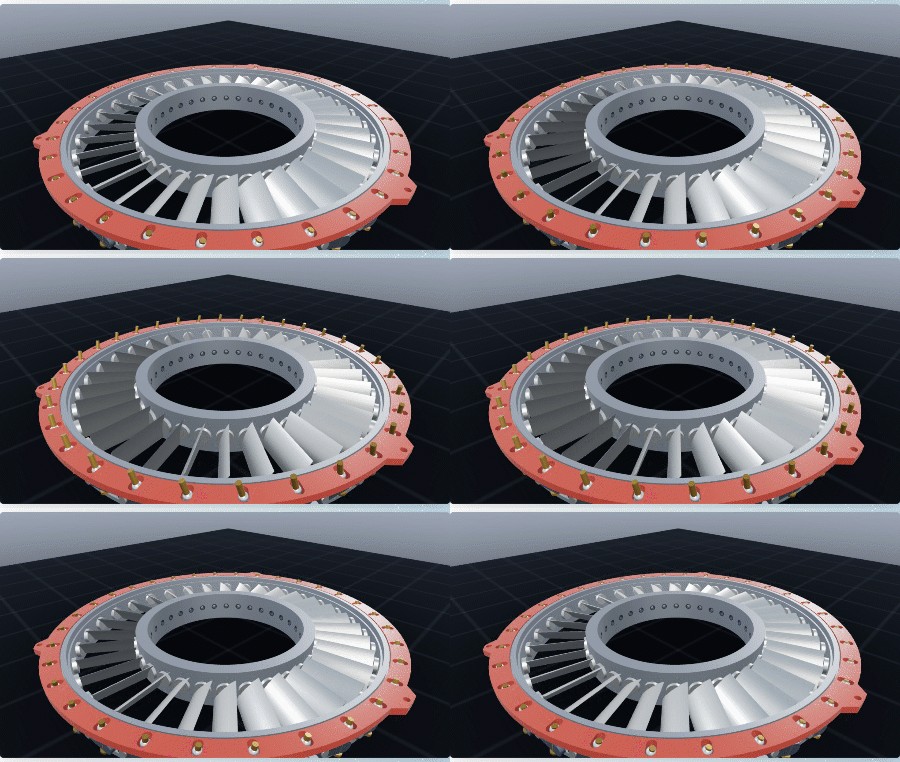
No, I just saw a Twitter post that Blake Scholl had made, where he posted a picture of a variable stator vane ring. I didn’t know what that was until I saw his picture — it just looked cool. Essentially, it was a giant part that’s part of the power plant — they’re building power plant stuff now, instead of supersonic planes. So I just took a screenshot of what he had posted and looked around to see if he had other screenshots — I think I got four.
Roopinder Tara — 10:42
Are they not going after the supersonic plane anymore?
Lewis Valentine — 10:48
No, they’re building power turbines. They’ve pivoted. Because the jet-engine turbine is so similar to a natural-gas turbine, they’ve pivoted to go after the money. And they have a lot of designs — although I think now they should probably reconsider how much they’re posting on Twitter. They probably didn’t know it’s possible to produce a design of their part from what he’s posted, which I don’t think anybody knew — I didn’t know until I tried it. It maybe took 30, 45 minutes to actually produce this, all the way to animation.
Roopinder Tara — 11:20
What did you give it to make this? What did you give your modeler?
Lewis Valentine — 11:24
I told it: here are four screenshots of something, I don’t know what it is, I want it modeled, and I want it realistic. So figure out what it is, figure out what that means, and realistically model it.
Roopinder Tara — 11:36
That’s it?
Lewis Valentine — 11:37
That’s it. Four screenshots, and it’s available as a STEP file. You can download it as GLBs, but also as a STEP assembly.
Roopinder Tara — 11:47
So it looks like it’s a working CAD model — you could move the vanes. Is this the CAD program?
Lewis Valentine
It’s a GLB animation, but made from the CAD model?
Lewis Valentine — 11:59
If you load up a STEP file that enables you to move it all together, it does need to be rigged together so it doesn’t collide. But yeah, we’re able to take a STEP model, create the full model in STEP, and then take the bodies outside of that, animate them, do collision detection, that sort of stuff.
Roopinder Tara — 12:16
You can do this because you’re a superhuman and you’re a developer and you’ve got all these skills.
Lewis Valentine — 12:22
No, just because of the MCP plugin and the screenshots. That’s it.
Roopinder Tara — 12:31
Okay, make it sound easy. I’m still a little skeptical. Do I have to install the MCP plugin myself?
Lewis Valentine — 12:38
Yeah, so you just install it in Claude, and then say what you want to design or do, or something. We could do something right now if you have an idea, or if you want to send me a file, or just have me prompt something in the background and I can pull it out of the oven like Martha Stewart — at some point it’s ready.
Roopinder Tara — 12:55
All right, I’ll give you something — I just gave it some SketchUp data. I won’t tell you what I think of it yet, but okay.
Lewis Valentine — 13:03
Let me throw it into Claude real quick with my screen share off, and I’ll set it at the end of the chat there.
 Roopinder Tara — 13:09
All right, so I’ll share my screen. Could you do anything with that, Lewis?
Well, let’s find out.
Roopinder Tara — 13:14
Okay.
Lewis Valentine — 13:15
I think what’s kind of crazy — have you used Fable 5.1?
Roopinder Tara — 13:19
Yeah.
Lewis Valentine — 13:19
It just came out so quickly, and I basically turned around and have been slamming stuff into it. I’m not sure how much better it’s made things yet, but it gives me a lot of hope to see just how well it’s doing everything.
Roopinder Tara — 13:33
Is it working through the steps right now, or is it done?
Lewis Valentine — 13:37
It’s working through it, it’ll take a little bit — I think mainly Claude during the day takes a while.
Roopinder Tara — 13:41
Sorry, sorry to use up so much of your tokens on this.
Lewis Valentine — 13:44
No, I finally figured out how to really get more tokens in a way that’s not completely breaking the bank — but I also have to do usage and stuff.
Roopinder Tara — 13:53
Are you funding this, or are you running on revenue?
Lewis Valentine — 13:57
We’re not running on revenue yet, we’re just in our seed round. But I really want customer data and customer issues, because I think we’ve got the leverage and everything set up to just work bugs, work tickets — and that’s not something CAD engineers are used to. You’re used to waiting really long time periods to get your bugs fixed.
There’s a runaround going on in the CAD industry for a while now, where somebody will say, I’ll fix your bug — look up, you sign, two years later it’s still not done, and you’re like, what is it gonna take? And the answer is, it’s maybe never gonna happen. Something else came up. And then something else came up, which is other money.
Roopinder Tara — 14:35
You know what — I’m starting to do a little experimenting with Canva. I’m sure you’ve heard of Canva. Let me finish this quick thing about Canva. Canva is the second — they say the second-biggest user of AI, the second-biggest website devoted to AI, Canva. Have you used its graphic program?
Lewis Valentine — [14:35]
No, I haven’t.
Roopinder Tara — 14:35
Oh, you gotta try it. You can do everything Photoshop does, and maybe even more, but it’s remarkably easy to use, it’s online, and it does wonders with AI. I’m thinking of getting rid of my whole Adobe stack, because Canva is great — and that’s what I’m hoping happens with CAD, because I could ask Canva in plain English to make something, and it will.
Lewis Valentine — 15:29
Yeah, that’s some of the features I baked into FeatureBoard to start with — like Photoshop, essentially, but it’s all kind of metadata of your project and everything you’re working on. For a podcast, it’d be like, we have this new guest — that would be a ticket, and you’d work it, or produce media for it. It was a way to integrate all that into a gallery — a way to edit the media in place and stuff. So I’m not surprised people are doing that and seeing a lot of success, because the new model — you’re powered up with the model, but then you’re able to do more.
Roopinder Tara — 15:59
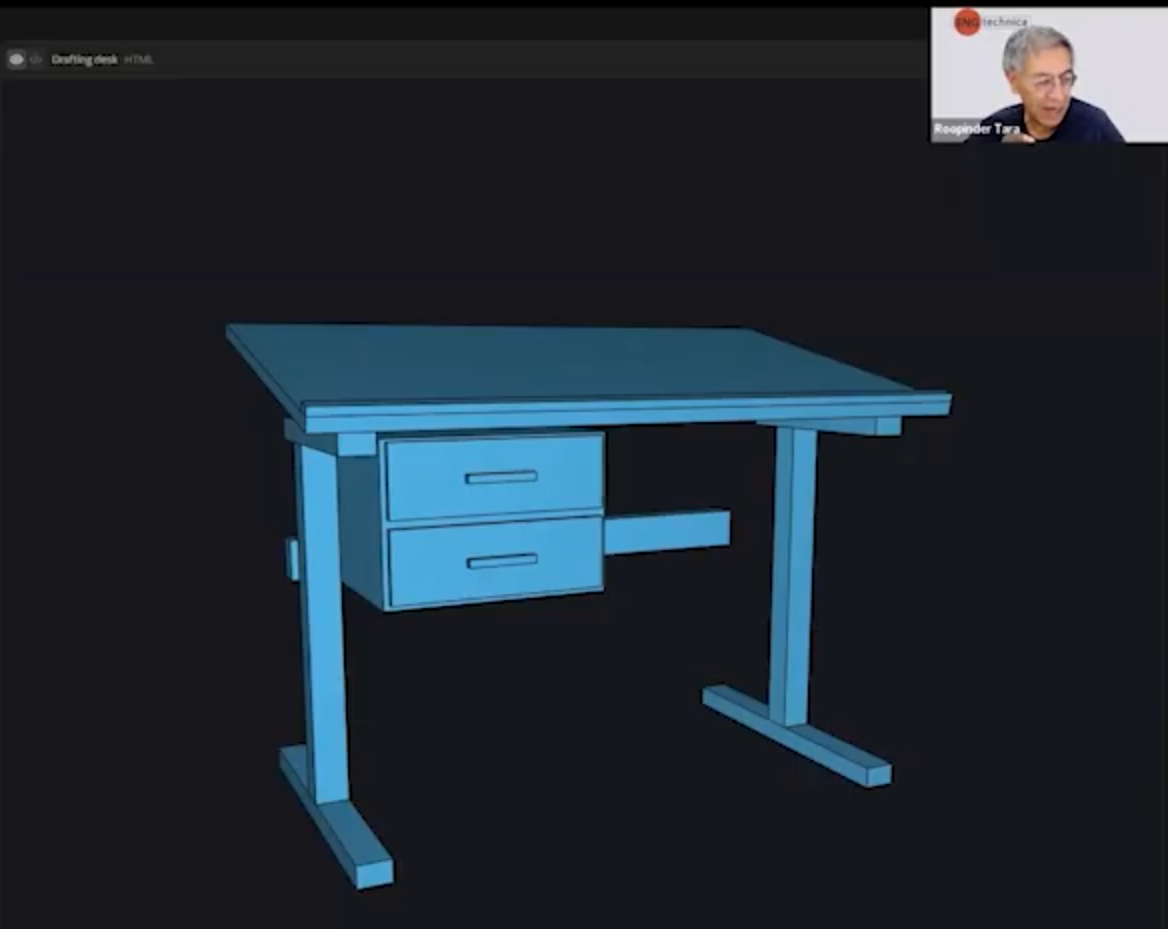
All right, now back to this. Lewis, you’re a genius, look at this. Is this an editable STEP file?
[Editor’s note: So impressed was I that I posted Lone AI Developer Blows Away CAD Company the same day.]
Lewis Valentine — 16:08
Yeah, it’s a STEP file.
Roopinder Tara — 16:09
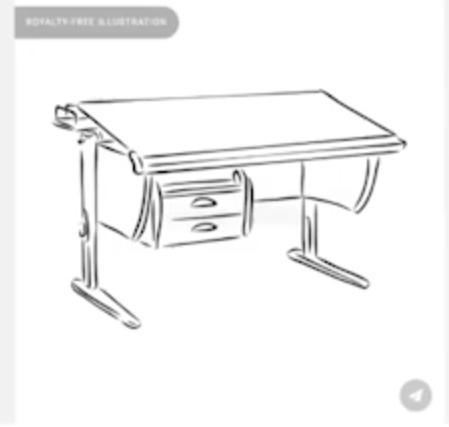
Okay, but right away you did what SketchUp couldn’t do. SketchUp generated more or less a 3D model of that — I’ll call it a wavy, organic-type desk shape — and you made it straight. You made it like I would make a desk in my workshop. This is what it would look like, not some crazy wavy shape with no straight edges. So this is an editable file, I could bring it into my CAD program and it’d be editable.
Lewis Valentine — 16:37
Yeah. And it’s giving me a viewer too — see, real quick, yep, STEP file, drafting-desk.step.
Roopinder Tara — 16:43
Can you send it to me?
Lewis Valentine — 16:45
Yeah, let me drag it into the chat.
And now — specifically with this kind of stuff, I haven’t gone toward assembly work yet — I feel like right now, sheet metal — I was really glad that you had a bracket, because sheet metal stuff is something I’ve been looking at. And it’ll work better the more I’ve actually pointed it at — like, for example, this sort of assembly stuff. In terms of that, there’s part of the tool that’s a database of manufacturing information, and I just haven’t gone and looked, let’s put a table together, that sort of stuff yet — very specific, in terms of the market segments I’ve gone and populated that database of information for.
Roopinder Tara — 17:27
But it’s something — I’m sure you couldn’t have trained on — desks.
Lewis Valentine — 17:32
No, I didn’t — but I think I could get a better result if I did. Let’s make it more realistic.
Roopinder Tara — 17:42
It’s pretty realistic. There’s some problems — like the stability.
Lewis Valentine — 17:47
Yeah, we can start — a few clashing issues and stuff. But as far as an initial go-around — now, one thing, as I’m telling it, be more realistic about what you’re doing — there’s some amount of design-for-manufacturing that’s really valuable, that it’s been put so close to the CAD thing. In terms of, we’re not gonna show up at a sheet-metal company or whoever’s making this with a design like this — beforehand you go and enter some information about how you’re gonna try to make it, and actually get an increased result.
Roopinder Tara — 18:21
Yeah, I’m blown away. This is pretty good — this is already better than what I’ve seen so far. And I’ve seen a few things, I wouldn’t say I’m covering them all, there’s a lot going on in this space, but we’ve got to say that’s really good.
Lewis Valentine — 18:34
I wasn’t quite even sure. It’s cool to me, because text-to-CAD is just one of the things we’re doing, essentially.
Roopinder Tara — 18:41
Yeah, no, I’m sure there could be improvements made — because a woodworker making this would see, it’s not complete. I don’t know whether it’s dovetailed the drawers, for example, or things like that.
Lewis Valentine — 18:54
It may not have the support — but we haven’t Booleaned it yet.
Roopinder Tara — 19:01
Well, look, you got a support in there, you got a support in the back. How did it know to do that? That’s not even shown in the sketch.
Lewis Valentine — 19:08
Yeah, I said other stuff is free-floating, so it understood from that. Okay, yeah.
Roopinder Tara — 19:17
Okay, so you sent it to me so I can play with it. What format is it in? It’s in STEP?
Lewis Valentine — 19:23
So STEP’s kind of the need that I’m using. I’m thinking that STEP AP242 and STEP XML are going to become formats that everybody uses, because you don’t want the vendor lock-in, and you’re gonna be getting away from the existing proprietary stuff. It’ll be pretty easy to go to something that you know everyone else will be able to read.
Roopinder Tara — 19:41
What else you got?
Lewis Valentine — 19:43
So the why for this is kind of interesting — a lot of people would say you can’t make your own kernel because of the customer data, it’s all intellectual property, blah blah blah. But the reason I went for the MCP was actually to generate test data for the kernel — just like AI car players are doing for self-driving. They want synthetic training data, because a car in the center of the road driving perfectly is useless data — totally useless data. What really is important is if somebody’s about to step out into the street — that data is very valuable, and there’s very little of it. So they’ve come up with: generate the data, take a normal frame and insert an elephant about to enter the roadway, and see what it does with that data. Does it drive better? And it does.
Roopinder Tara — 20:26
So the advantage, of course, is you could generate a lot more images than you could ever do in real life.
Lewis Valentine — 20:32
Yeah, their training set — they call it the fat tail — they just have so few of these rare events that they’re not really gonna be able to train for it. But they want a car that can handle all the rare events that could happen.
Roopinder Tara — 20:44
All the edge cases are not there, and those are the ones that are gonna cause you disaster.
Lewis Valentine — 20:50
Yeah. And so that was the idea behind why to do this. Let’s see here, what else?
Roopinder Tara — 20:55
So you did that — you just generated a whole bunch of models?
Lewis Valentine — 21:00
Yeah, and as it generates it, it even logs bugs. So when making that variable-stator-ring model, it was like, I’m having trouble piercing holes and stuff, and it comes up with extremely detailed reasons to log bugs.
Roopinder Tara — 21:12
Let me see if I got this right — you create an MCP that allows you to make lots of different types of models using your CAD program. And then it just makes all these models, like desks or brackets or cars or motors, whatever — and then you use that to train it.
Lewis Valentine — 21:36
To train it, but also to log bugs and then work the bug. So when it logs it, it tried to work it — one thing that’s interesting is it’ll try to use my kernel, and I have an incomplete kernel, it’s still able to do stuff. It tries out functions, and I’ve told it to be really nice about it — it’s going to be debugging itself, write really good debugging information that helps you out. Then it tries to do it, it’s a failure, it tries to route around it, and it’s able to seemingly model around those failures.
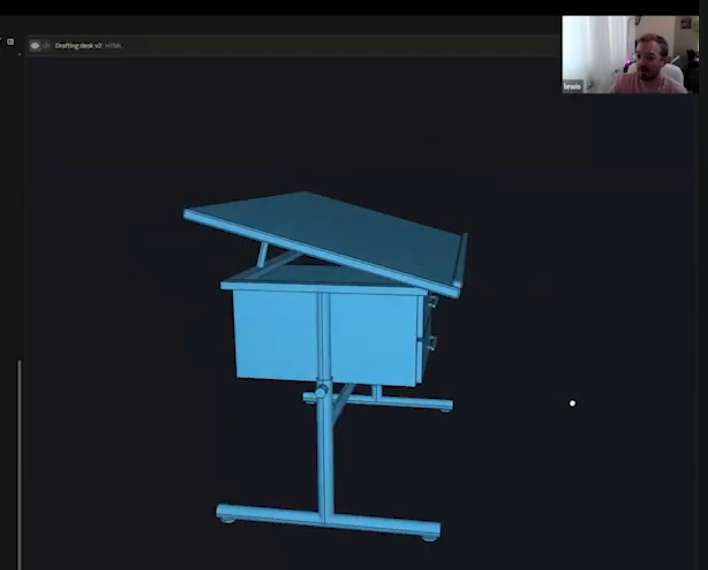
So here’s our super-realistic one again, where I just said, let’s make it super realistic, get some pictures of some desks. And now we have supports, looks like a hydraulic sort of system there, and we really figured out a way to attach the drawer here.
Roopinder Tara — 22:24
How did it get the outer dimensions? How did it make the dimensions?
Lewis Valentine — 22:30
It’s gonna have dimensions — I think because I’ve told it realistic, it’s probably gonna be — it looks like 400 by 500 millimeters on the drawers. So that sounds pretty realistic.
Roopinder Tara — 22:42
Is one of the limitations that it’s making prismatic shapes only, because that’s what the modeler does?
Lewis Valentine — 22:50
No, we’ve got NURBS and tolerance shapes and everything going on. This shape, obviously, is a little — whatever — but the scoops in the vanes [on the variable stator ring], for example, those are non-uniform surfaces.
Roopinder Tara — 23:02
How does it work — has your modeler worked okay enough on the rounds and fillets? Because that’s always the problem.
Lewis Valentine — 23:13
Filleting has been interesting. I was able to get a fillet showcase, or a blend showcase, basically going — a bunch of different stuff. There’s a lot of defined blends, there’s some C1, C2 continuity. I’m basically working through the issues on it — that was one of the first benchmarks I selected for the kernel: let’s see if we can get past Open Cascade on blends, essentially, with a single customer in mind where blends are an issue. For them, it was variable-radius blends. There’s something — a proprietary kernel, out of the box, if you just give it a cube and say blend variable-radius blends on these cubes, it won’t work. You have to write the order in which the cubes are blended, the edges are blended, you have to do some thinking yourself, you have to make sure you’re doing the same thing that every other kernel does. So there’s stuff like that where blending — there’s what it means in the background of the kernel, and then there’s your implementation of blending. But I was able to get a huge portion of that basically completed. There’s really complicated blending scenarios that we’re able to handle, and we’re just working through the group of them.
You can build your own thing, maybe don’t even need my thing now — I’m hoping — everyone else is struggling with this, I figured it out — maybe it’s just easier to use my thing and get onto yours. So I’ve set my pricing really low. For this tool right now, you can license it — it’s $200 a year, and I think that’s probably going to be the final licensing. And then the SDK component itself, where you can make your own application, I’m pricing at about $10,000 a year with no royalties. People are currently paying five, six, seven figures for this. I think they have a million reasons to switch, and I can definitely get all their bugs done, that’s no question to me. This is where we’re at today — I started this on July 14th, really, it was a STEP reader on July 14th. And to give you some other — and I know at the start we said slow down, and I know we’re just picking speed right back up.
Roopinder Tara — 25:06
I think with the podcast, I could play it back at 0.7 speed.
Lewis Valentine — 25:10
So on GitHub, in July we had about 1,300 commits, I think — about 1,270-something. This month, in September — in the last three days, we’re up to 1,400 commits. So in three days, we’ve done more than we did in the entire month of July.
Roopinder Tara — [25:10]
What’s a commit?
Lewis Valentine — 25:10
A commit is basically — we’ve said here’s a bunch of code, it solves a problem, there’s a detailed description and list of the problem, it’s basically like a ticket solved. I would say that’s probably more in a couple of days than most traditional companies did all year, with financial engineers — look at what we’re producing.
Roopinder Tara — 25:56
All right, so what you’ve done, and what other companies do — I’ve been hard on companies for dragging their feet on AI, because I think all that AI can do, all that engineers want AI to do, it’s not doing. And now, after hearing this, I think you would agree.
Lewis Valentine — 26:15
Yeah, I think somehow they’ve got thousands and thousands of engineers, but there’s something — people don’t want to automate their own jobs away, they don’t have any equity in the work they’re doing, and the work they’re doing will destroy their job. It’s kind of like the billionaire in the bunker at the end of the world — well, you’re paying people, but money doesn’t mean anything anymore. So it’s very easy for everyone to throw you out, because you’ve assembled all these people who contribute so much, and you contribute nothing except getting the whole situation together.
Roopinder Tara — 26:47
Oh, I recognize the bracket.
Lewis Valentine — 26:49
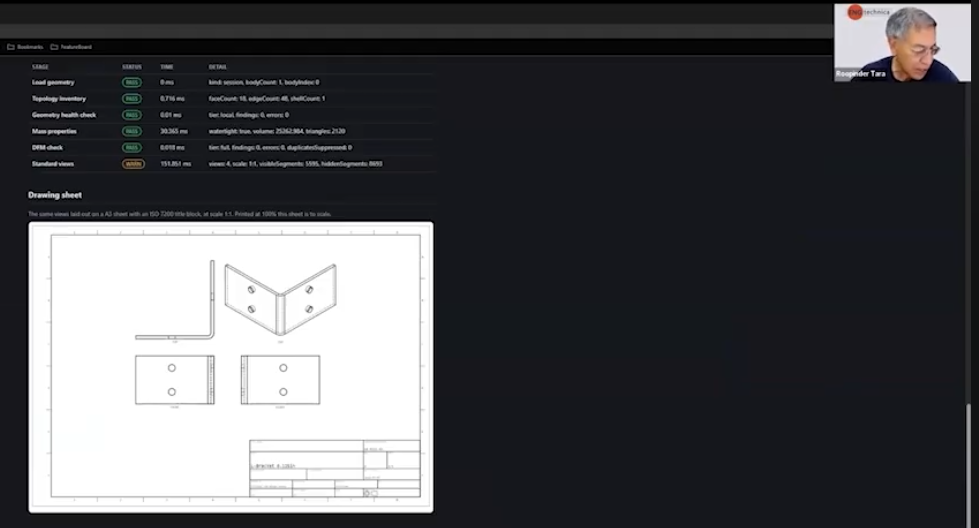
So I took your bracket, and I basically said, do a quick manufacturing check.
Roopinder Tara — 26:54
Okay.
Lewis Valentine — 26:55
And it basically does that design-for-manufacturing thing I was talking about, where it goes through, looks at, creates errors and warnings, does a few stages — volume, wall thickness, volume checks, a bunch of other stuff — and then generates technical drawings, discusses the bounding box of the thing, the volume, the surface area, some of the dimensions we were discussing, and then actually creates full-on technical drawings that would include a bill of materials, so you can just send this to a machine shop. The extension of this — one thing I’m thinking about is essentially wiring into the MCP a connection to certain quoting tools. Right now there are certain manufacturers — sheet-metal manufacturers — that give you the option to give them a part and manufacture it, but they give you ten pages of documents to produce a part they can manufacture. What this can do is do all those checks. That’s what we did — we took the ten pages, we took our stuff, and said, make it work together. So you can basically go all the way to manufacture — you can have a design you want to look at, you can have an approved manufacturer, and you can even have a quote from that manufacturer, and then you could take that quote and decide, oh, that’s too much money, let me redesign — we can even angle for a lower quote. People talk about designing for simulation, but we could design for the right final thing, which is: problem solved for the cheapest cost possible, given safety constraints, how many nines you want in terms of safety and reliability.
Roopinder Tara — 28:33
It knows how to make a bracket based on manufacturing principles, like what people would expect in sheet metal — one bend thickness, or one-and-a-half thickness. It can make a drawing out of it. It’s making a lot of correct assumptions, close to correct, at least visually. Does it go as far as — if it’s a two-inch by two-inch bracket, does it know I’d have to use number-eight screws or something like that?
Lewis Valentine — 29:07
I have been thinking about that — just thinking of the desk, on this call, I’ve been thinking I should put in some stuff about how we connect things, because I haven’t even asked it to make sure it has a real connection that could physically support it. But it depends on materials, like we have a metal bracket mounted into metal versus concrete versus wood, and whatever we’re trying to design for determines the size of the screws, the size of the holes, all that stuff.
Roopinder Tara — 29:37
So I think that’s going to be standard holes for the screw that’s appropriate for that, which any engineering intern would know. Almost — I went too far there, an intern wouldn’t know that, but an intern would pick it up on the job fairly quickly. AI is not even close to being there yet. I’m thinking we mentioned engineers’ expectations of AI before — they want AI to be at least as smart as a smart intern, and learn as fast as an intern would. But I don’t see an AI do that yet — it doesn’t learn that quickly. So is your next step the next level of detail, perhaps — if it’s furniture, then it needs this kind of joint, or rabbets and stuff?
Lewis Valentine — 30:29
I think — there’s assemblies in general, I haven’t gotten to that point. I do have assembly stuff, but in terms of simulating an assembly, that’s one part I know people aren’t doing, because I’ve put together too many children’s toys in the last few years, and I have really big hands, which doesn’t help me with anything. Sometimes I get stuff where it’s just impossible. And now I know too — like, oh, they designed it and they didn’t sweep it around and stuff, I can tell. I think there’s some amount that would just be another kind of add-on database, as well — of sort of fastener information, as far as, when we have materials, this is what we do, if we don’t have material information, here’s a good standard for everything you might be doing.
Roopinder Tara — 31:12
But you mentioned children’s toys — I wonder if you could train it on all the IKEA assembly instructions.
Lewis Valentine — 31:19
That would be something — we need robots to do that.
Roopinder Tara — 31:22
Yeah, but IKEA stuff is, I think, very well designed — shoddy materials, but the designs are really good, and they’re quick assembly, relatively quick, I should say. There are always manuals available on how to service machine parts, or machine products, machine parts that go into products that are featured — you could always get help from there. So I always want to question CAD people who say, we can’t work, there’s not enough model data to do what you want, Roopinder. Because I always ask them, hey, why can’t I have it make me a motor, why can’t I electrify a car, for example? And they go, oh no, there’s not enough data. And I always think, but there is — 3D Warehouse has a million parts in it. SOLIDWORKS has its own part library that’s fairly public, I would say — not exactly public, but somewhat. There’s tons and tons of parts and assemblies out there to train on, you don’t have to use your entire customer database. I think there’s enough stuff out there. What do you think about that?
Lewis Valentine — 32:34
Yeah, some of the things you mentioned are sources of data I’ve been using. I don’t want to get too specific, because then everyone else can go grab them. But manuals are something I’ve thought about — there’s a lot of stuff that’s old and people don’t care about, who cares how you assemble a Ford Pinto these days, the repair manual, people scanned and put somewhere, and you write — if you want to get information out of it about at least what existed. That’s the thing, when they say there’s no data — everything around you is a real manufactured part.
That should be able to get you a manufacturable part.
Roopinder Tara — 33:05
I’ll give you an example from my personal history. When I got out of school, I knew everything about engineering theory, and I knew nothing about production or machining. It was a real challenge for me to figure out how to put even the simplest product together, because I knew nothing about captive fasteners, for example. A lot of them in our products, and I didn’t learn about that in school. They didn’t teach you what gets brazed, what gets welded, when you use sheet metal, what standard hardware to use — I didn’t even know any of that. So how did I learn? I got as many product catalogs as I possibly could — the mailroom people were tired of how much mail I would get. Back then you’d fill out those little bingo cards — you’re too young to remember this — you fill out these cards, they circle the number, and the magazine would know to send you their product literature. So I would get stacks and stacks of product literature. I would go through the Thomas Register catalogs, just look at what exists out there. And that’s all information that now can be scanned or is already digital. So AI is wonderful at learning — scanning, learning, taking in all this data, remembering where it is, processing it. So I think that engineering intern I spoke of before could be an AI, it just has so much more to deal with now. The only information it can’t take in is what I call the Japanese-woodworking style — in Japan, when you learn woodworking, nobody tells you anything, you spend the first year sweeping the floor for sawdust, and you learn by osmosis, by watching and observing. AI can’t get that — we’ll never be able to do Japanese woodworking that way, because none of that exists digitally.
Lewis Valentine — 34:50
Maybe not. But maybe just the finished part — things are getting so — I saw somebody make a video of a thing, it was for manufacturing lines, something sending a thing down a line, and it was just to flip a can upside down. Whatever reason, you need to flip it upside down, put something else on, flip it. And I saw someone post, from their own — a designer, they were just like, here’s the part.
Because they did it by sweeping the can through a block — and then you look at it and you’re like, yeah, that’ll work, based on just even what they have physically. So there’s some amount — I’ve seen the Japanese stuff where they do really intricate dovetailing, a lot of that. But — now that you’ve made it, I can grab it and I can pull it apart, and it’s not usually, how did you do this, it’s more like, oh, I don’t want — how did you do it quickly, is more the question.
Roopinder Tara — 35:40
Okay, so you’re saying the AI could intuit how it was assembled or machined or cut, or whatever — it could actually — like a human?
Lewis Valentine — 35:47
Let’s say you gave me a STEP model of assembled Japanese furniture — I could say, well, try to come up with a simulation that doesn’t clash, a tool path that pulls it apart.
Roopinder Tara — 35:57
Yeah, there you go.
Lewis Valentine — 35:58
I think that — I don’t know, have you heard of the Hugging Face incident that’s been going on?
Roopinder Tara — 36:03
Oh, the Hugging Face? They just got bought.
Lewis Valentine — 35:58
But then the whole thing where they were hacked by OpenAI and everything.
Roopinder Tara — 36:03
Yes, yes.
Lewis Valentine — 36:04
The how and why and what of that — but the main takeaway for me is, you set this thing on a path, like, mine is: make a CAD, it will get there. It’s a question of how much compute and stuff, but it’s really successful when you give it something like that. And if it’s possible, even seemingly if it’s impossible, it’ll try to figure it out.
Roopinder Tara — 36:31
So, this bracket — how do you put a cost on how many tokens that is, this bracket I’m looking at right now? Is it expensive to come up with, in terms of tokens?
Lewis Valentine — 36:44
No, I’d say this is pretty inexpensive compared to the development cost. This is — everywhere, on a subscription.
Roopinder Tara — 36:50
The advantage of this is, once it’s a STEP file, I can bring it into CAD and make modifications, and I’m not using any tokens — but to actually create the point at which this is possible, how many tokens was that bracket model?
Lewis Valentine — 37:04
Probably less than 100,000. I have a lot of token-tracking stuff built in, but I’d say the actual tools on our end, as end users, are generally inadequate unless you’re using the API endpoints. If you’re a customer in Claude, it’s more apt to compare the usage, I’d say — it’s less than one percent of your usual weekly budget.
Probably less than one percent — maybe something like that variable stator ring could get up to five or ten percent, because it’s got so many different things going on, and part of it is, we’re gonna go, hey, this isn’t the way I think it is — like I got one that had really thin vanes, really wide essentially in the middle, and then another ring, and I was like, that doesn’t look like what he posted, which was a narrow thing and then big vanes and then the outside. So there’s some of that, where it remodeled it three, four, or five times to actually get there.
Roopinder Tara — 37:59
Okay, and then you’re just using up tokens to do that. Okay, all right. So we covered brackets, we covered desks now.
Roopinder Tara — 38:10
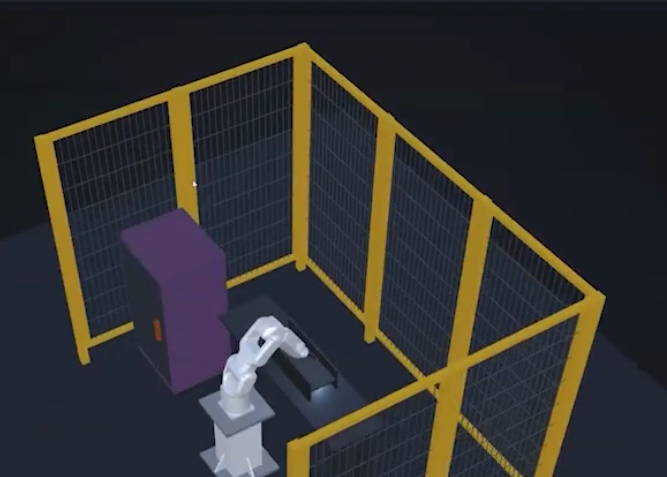
I got a lot more tests, really. You got a robot in a cell?
Lewis Valentine — 38:16
I got offline programming, actually. This is a fully programmed one that’s going and doing welds along the seam, and it’s not gonna collide with anything. This is all in our CAD, the whole thing’s designed in our system, including all the rendering effects and everything, and we can go through that. But what’s even more cool is the offline-programming version of it — we can sample seams on this, and we apply and teach the points in real time.
Roopinder Tara — 38:46
Can I actually see the ripples of the fillet weld? Is that what I’m looking at?
Lewis Valentine — 38:51
Yeah, so you’re seeing this is where it’s gonna try to put in a seam, and we can change it from crescent to figure-eight to zigzag to straight.
[VISUAL: Weld-pattern options shown on screen — crescent, figure-eight, zigzag, straight.]
You built this MCP tool for — yeah, so this stuff is in the MCP, and this is on the website as a model, this is just a demo using our tools to demonstrate this. Something I would have done at Spatial, in turn — nothing this complicated, but in terms of demonstrating that it’s even possible to select an edge and sample along the edge, that’s about what a demo looked like a year ago. Now it looks like the robot’s there, following constraint-design solving — when we pick the seam and teach the seam, it adds the point. So here I’m gonna teach the seam, and on the right, it’s checking the poses, that we’re even able to reach them. If I propose a bad work angle at 23%, it can’t reach it, and it tells me.
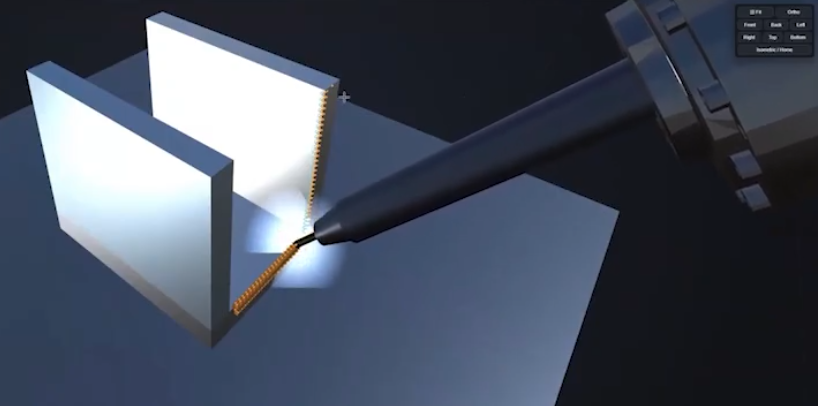
And then what we’re gonna do is play it — oh, I gotta hit there, because we already did the bottom one, we’ve got to go through the bottom and then come back up to that one. We can do dot order, or minimal travel, we can make the point smaller or bigger, and speed up this animation. But essentially, you could use this to drive a robot simulation.
Roopinder Tara — 40:07
You’re actually simulating the radiance, the light coming out of that weld — that is pretty cool. I know it’s probably more efficient when you turn that off and just look at the code generation.
Lewis Valentine — 40:25
So the next thing would be, you take this to G-code, or like people do, where they put different parts on top of it.
And then it’ll flip up and try to avoid collisions here.
Let’s see, we’ll see that happen — and it went up to that top point, it inserts a few points so it doesn’t slam into anything in between going from that last one to the first one.
Roopinder Tara — 40:49
So it’s aware the tip could hit something?
Lewis Valentine — 40:52
I think because I put in the other one first, it’s gonna do that one, then come back around, or something. But essentially, that’s the idea.
Roopinder Tara — 40:59
Okay. So you just built it because you thought, oh, this would be cool — but are there customers requesting these?
Lewis Valentine — 41:07
There are customers that use this functionality from existing SDKs that I know about, that I work with. So that’s one reason I’ve targeted some of these segments — I have extreme specific knowledge about what the workflows are, what the workflows require, and if I can deliver on this, that’s their needs — they don’t need the rest of the kernel, really, this kind of customer. Let me clear the points — I don’t know why it’s — but that sort of thing. That’s why I’ve targeted this.
So that’s one — we could also check, I guess we did already do the desk.
Roopinder Tara — 41:47
So, again, this was not planned. You didn’t give it desk training.
Lewis Valentine — 41:57
No desk data — which is even what I would say would help a little, especially since I first started with, when I said give me pictures of desks, I think that’s what we started with, as far as populating the data.
Roopinder Tara — 42:04
Okay, so I’ve got — I’d have more challenges, but I’ll save them for another time. But I’ve been writing about generative design — most of my rants have been about generative design, which — now the CAD companies are saying, oh, that was the original AI that we had, it was generative design. And I almost never liked anything created by generative design, for manufacturability reasons, or just aesthetic reasons, or whatever — none of their parts actually worked for me. But they would always tout it as a do-all, end-all for engineers, because engineers were in their boxes, they couldn’t create new shapes, they couldn’t think of anything beyond the standard shapes they had. And that always rankled me, because sometimes engineers, like me, we know what a good shape is to use in a design. We know cables are good on suspension bridges, or spokes are good in wheels, or I-beams are good to support loads. I don’t want them to make these blobby-looking structures, twig-and-shape, those weird shapes. I don’t want it to start from scratch and make things out of molecules when I know these shapes work for me. And I always thought — AI, now I’m thinking, well, AI could take what generative design is starting to make, and finish the job for them. Okay, it’s starting to make a cable, or a rod, or a round tube — finish the job, like AI does for rendering, it says, oh, the renderer is almost there, finish the picture. I want it to finish the part that it’s starting to make, because I think generative design may be a good start, but it’s almost never a good finish. I want one of you guys — not you, but CAD companies — to figure out how to finish the part with AI, and finish it with a standard shape. Like the desk — the CAD company hasn’t gotten it working, I just tested it on SketchUp, they should know a desktop can’t be wavy, it has to be flat, any idiot knows that, but it doesn’t know that. Can’t you just finish the job? What I think — I wouldn’t call it common knowledge, but yeah, it is.
Lewis Valentine — 44:27
Yeah, if you’ve ever tried to write on somebody’s back, you know why a desk is flat — or you got the bad desk that was half broken, in part because you were late.
Roopinder Tara — 44:35
Constant source of annoyance. I never want a wavy desk. That’s my beef, that’s what I’m writing about. But the person who figures out how to make CAD think like that — use just standard shapes and optimize parts — I’ll give you another challenge, then I’ll let you go, because you’re not making any money talking to me. One of my challenges: for years I wanted a CAD program that would optimize my bike frame. I have a road bike that I love, I’ve ridden it 20,000 miles, rode it across the country, and I spend more time on it than anything else, including my desk chair. All the time I think, this is a really perfect design, diamond shape, tubular construction, can’t do any better than that. So I asked all these generative-design companies, Autodesk in particular, make me a better bike than I’ve got. And I asked nTop — have you heard of nTop, the engineering software?
Lewis Valentine — 45:33
Yeah, oh yeah.
Roopinder Tara — 45:36
Yeah, okay, I asked them, and Brad Rothenberg said to me, oh yeah, sure, I’ll do that for you, Roopinder, I’ll make a better bike. And I never heard from him again on that subject. Oh yeah, that’s an easy problem for optimization — use round tubes, but put them in a way that uses the least length of round tubes.
Lewis Valentine — 45:59
That’s — give me a picture of what you’re starting with, and I definitely think that’s something where we can just compare the volumes, and that’s gonna give us a really good idea of what works. I definitely have stuff for simulation and that sort of thing. I’m curious what people can do there — maybe it’s something I’ll bring over and show them, we’ll see. You can have a story about it — there’s an AI-optimized bike, send it to this guy, we can get it on the podcast, and it’ll all work out. I’ll send it to — I’ll definitely get it to you.
Roopinder Tara — 46:31
Sounds good, that could be good fodder for our next call.
Lewis Valentine — [46:31]
Yeah, that’d be great.
Roopinder Tara — 46:31
All right, well, listen, Lewis, it’s been wonderful, thank you so much, I’m so glad we talked.
Lewis Valentine — 46:40
Yeah, thank you for having me, it’s been really great.
Roopinder Tara — 46:43
It’s been an eye-opener. I don’t want to get news out of this out there — honestly, I think somebody should — they should start looking for funding.
Lewis Valentine — 46:51
Yeah, so I incorporated this week, it actually came through today. And I’m — I think there’s enough there in the $200-a-year version that if you’re buying SOLIDWORKS for whatever, thousands of dollars, you could keep it for now, that’s fine, and just get started over in my thing and import it. That could save you a lot of time — you could finish up in my thing, that might save you a ton of time. I mentioned 3D PDF, but I did proprietary formats too — the initial Parasolid reader-writer implementation took 40 minutes, without using anybody else’s reader or writer. I want to be very explicit about that — everyone else uses it the other way, we use first principles. There’s a way to read the files, build your own writer, go back and forth between those, and get to the final solution. Within a few hours, I had the parts opening in third-party readers. But the initial implementation — because I was like, how hard is interop, should I do interop, maybe I can just have everybody make parts in my thing, they could screenshot their parts even for interop — what I wanted to mention is that it’s that fast.
Roopinder Tara — 47:54
Oh, I think I read somewhere you can read 80% of SOLIDWORKS files now, something like that.
Lewis Valentine — 48:00
Yeah, that’s what I was seeing — I think we got it up to 90% already, out of about 3,000. Now, since I’ve gone and gotten another gigabytes of files, which takes the whole day for my computer to crunch — I put a thing online about it, but the data in there is pretty out of date and not really updated yet. I’m gonna be doing it in public, in terms of, out of my file set, 80% of the fillets work, or whatever, and we’re just gonna get those numbers up and up. Interop is also there — we can open Parasolid parts, and we can open X_T, X_B, and we can open SAT files as well. There’s a whole page of the formats we support. So really just crunching — attacking every part of what you need to be a player in this space.
Roopinder Tara — 48:44
I had Ralph Grabowski explain to me how the translators, the readers, work — long-standing CAD journalist. This was back when everybody was trying to decode Autodesk’s DWG files. He said, you just have to make a component — look at a data file, add a component, see what that does to the data file, and the difference is that part.
Lewis Valentine — 49:13
Yeah, that’s the traditional way to do it. I’m saying we found a different way, because to add a component to the data part, you have to have a licensed copy of the product or some component, and that’s been a whole thing — people have gotten around it by doing all the work in another country. We did it a different way, so it doesn’t require that. I’ll just describe it quickly — you take the existing corpus of data and you build a reader, and somehow there’s a way of looking at that data where you’re gonna get cylinders and spheres and stuff that makes sense. If you can get files that people have described well, you start reading those files — now you’ve got a reader. Now you start trying to build your writer — build a writer that writes something the reader can read. Now it can read your writer’s files and the existing files. Now you can do what you’re talking about — you have a writer, you can play with it, and you keep trying to read the data, back and forth, writing, reading, writing, reading, until it’s working. So we’re pulling 80, 90 percent of that out right now. Some of it won’t work, obviously, because of different versioning and stuff, and we’ve got to figure that out — that’s probably the weirdest one, a different version of SOLIDWORKS is gonna have a completely different file structure, and we have to figure that out from first principles, in terms of — it basically produced what’s called a grammar. If you know anything about that from computer science — programming languages are like those, in terms of, here’s how it’s defined, you can say this, and this says how many cylinders there are, it’s a decomposition of the structure of the language.
Roopinder Tara — 50:43
Do you get any sleep?
Lewis Valentine — 50:46
It may seem like I’m working 24/7. I put in FeatureBoard what Claude makes overnight. It’s working by itself. I’ve done a lot of stuff to put my workflow into Claude, and then lately it’s been running around to different computers in the house, being like, is this still working, is it still running, okay. But then I can just dump my ideas all at once when they strike me — write your idea down, but then it goes and it’s like an engineering team working on them. So actually, I’m doing the primary child care — we just started preschool, so I’ve got this tiny break, but I’m cooking all the meals in the house.
Roopinder Tara — 51:29
One child, preschool.
Lewis Valentine — 51:33
Yeah. So I’m actually slotting this in between a lot of other stuff, I only have to be on the computer in short bursts. Playing badminton in the backyard, and I just know it’s cranking tokens and I’m getting real engineering work done. It’s pretty nice sometimes.
Roopinder Tara — 51:52
Don’t burn yourself out by the time you get all the funding you’re gonna get. Somebody’s gotta put some money into this, because I think this is pretty cool. Honestly, the stuff that some of the startups I’ve seen are making, especially the text-to-CAD stuff you talked about — it’s just, who gave them money?
Lewis Valentine — 52:14
They just have a wrapper, a lot of what I’ve seen. I’ve thought about it too, I’ve thought about reaching out to those people, but then I’m like, what do they actually have that I’m interested in that’s gonna help my product? Obviously a kernel would help them, but what’s on top of SOLIDWORKS? That’s been — I’ve never seen, no matter what implementation I’m looking at, I’ve seen no insight into that. They don’t really talk about it, it’s more like, look what I built, look what I built. And for me it’s like, but the kernel’s already there — did you just expose the tools? How hard is that? What’s the insight to get more engineering product out of it?
Roopinder Tara — 52:53
Anyway, all right, one last thing, I promise I’ll let you go. What is this foundational model that everyone’s talking about? What are your thoughts about a foundational CAD model — one that doesn’t even have a kernel, it’s just a neural engine?
Lewis Valentine — 53:04
That’s technically possible. I think mechanical people don’t know what they don’t know. I went to school for computer science, and I know that natural language processing is computation. Noam Chomsky — he’s actually famous, not for his writings on socialism and stuff like that, but for finding what’s called Chomsky’s hierarchy of language, where state machines, which are like regular expressions, are a small portion, and then there’s a bigger portion of context-free language, and then there’s recursively enumerable languages. His thing was that a language is defined by the automaton that we can build to accept the language — accepting means you go, this is English, this is not English. If somebody puts Japanese in front of you, you can go, that is Japanese, that is not Japanese. Or even C — the language used to write compilers, a compiler checks that language, that language is recursively enumerable, because C is very complicated. A regular expression is less complicated, it’s a limited language, and it can do less — it can’t count certain things in certain ways, so there are very real physical limits there. So to bring that back to mechanical people — everything is language, computation is language, problem-solving is language, algorithms are language. We want to be number-brained, but numbers are language. So there’s this whole — well, it’s a large language model, people go, but can’t it do this, it can do everything, that’s what language is, language is computation. There’s some part of this I knew would work, because STEP files have defined, in language, what all this stuff is — I’m like, what do you mean I can’t read that and write out triangles, that has to be possible. Just mathematics — people say it can’t do math, but math is a language, physics is a language, so it can do math. I’ve got an 18-page math manuscript related to the Collatz conjecture — a Lean-proven mathematical — not conjecture, but proven mathematical fact about the structure of it, honestly. I can’t read it, it’s so indecipherable, but the Lean testing shows that whatever facts about math it encapsulated are true. It gave me a little research summary — part of it is, it advanced something a textbook offered as a computation and said, oh, this would be interesting. It did that computation, proved that it did that computation, and established a new lower bound on something related to the Collatz conjecture. It can do math — people posted it during the World Cup, they solved some unsolved problems. So it works. And then there’s people using AI right now to tell people that it doesn’t work.
Lewis Valentine — 55:40
Which is — so one of the other things I built with FeatureBoard was this Chrome extension. You might like it, it’s called AI Slop Radar. It’s in the Google Chrome Web Store. What it does is it takes your social media — it works on a few specific sites, Reddit, LinkedIn, and Twitter — and it breaks it down into, oh, this is a person saying something, and asks Google’s Nano model — it’ll help you install it in the browser for you — asks that small model, so-and-so said this, is this AI slop or not? There’s a little blurb and everything, and it judges it, and if it is AI slop, it blocks it immediately, you just don’t even see it.
I told it, take some statistics — the top posts, Reddit has gotten crazy, absolutely crazy, to where the account posting has a million karma, or post karma, which is how many times other people have upvoted their posts. And I give comparables — the PBS News Hour has a Reddit account that posts every time they have news, it has less than a million karma. Major League Baseball’s official account, that posts the highlights of America’s most popular sport and tries to get people to watch it, one and a half million. The top 20 posts, all on Reddit, have accounts made in the last year or two or five with millions of karma, and they’re posting about stuff — anti-AI is a popular one. There’s some decisive ones, like flock cameras — I can tell you everything about that online is fake and promoted by Iran and China. I can prove this, because on one day on Reddit, I’ve got the data in a corpus, a bunch of these accounts we could identify as fake just by looking at the account and asking who’s posting this and what else do they post. Then the next day on X, same thing — accounts that are popular, followed by tons of people. I asked about them, because I was like, that’s weird — yesterday it was all fake. This one guy had appeared on Russian state television in 2014, sponsoring the invasion of the Donbas. I was like, oh, that’s who’s behind this. It was really weird stuff — Russian state actors going on Russian TV are putting posts on your social media, and they’re doing a really good job of it. They’re winning.
Roopinder Tara — 58:14
Of course, you know that Reddit material is being used by Claude and by ChatGPT for their knowledge base.
Lewis Valentine — 58:23
Yeah, so they’re trying to get in there too. I can show you real quick, because it’s kind of interesting — here it is, just scanning right now. And I’d say, right away, one to 21 — I use some stuff to browse it — the top 20 posts on Reddit are all automatically removed, just by the users we’ve identified as bots. We’ve been able to instantly see that. And then, let’s see here.
Roopinder Tara — 58:49
It’s called the Slop Filter.
Lewis Valentine — 58:50
Can I get — so, AI Slop Radar.
Roopinder Tara — 58:55
Tell me this — are you real?
Lewis Valentine — 59:08
Yeah. If I had the Slop Detector going on — it might not like some of what I post, because some of it is real funny, where — is somebody trying to sell me a product? In that case, don’t give me what they’re showing. Just, LinkedIn self-promotion fits that very closely, or on Twitter people will post something like a cryptic — the best sale is when you turn your back and close your eyes — just something about B2B sales that’s unverifiable, their opinion, no facts provided. It would tell me, yeah, they provided that, we don’t like that.
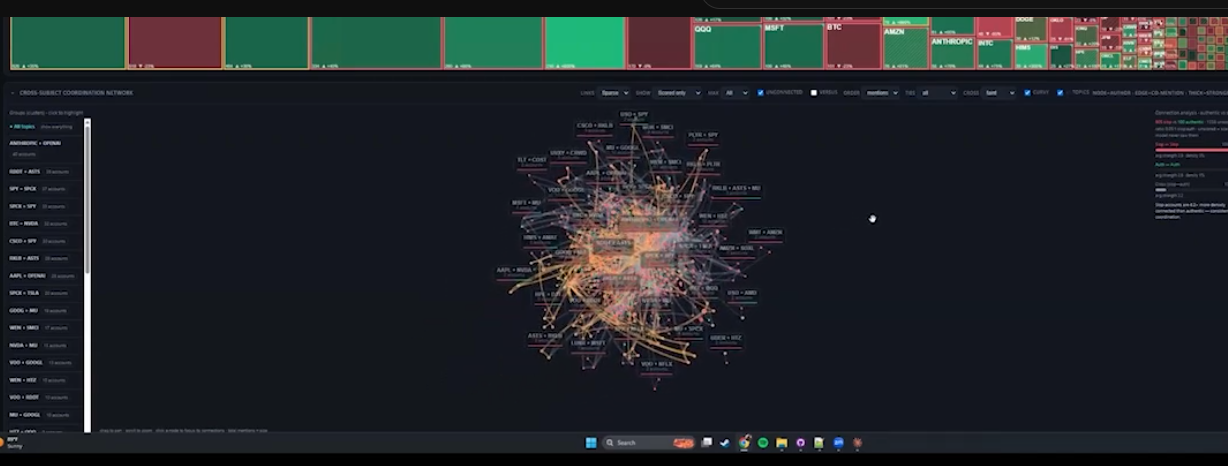
So this is it visualized — this is what people are talking about on Wall Street Bets.
Green nodes for Reddit accounts believed real, red for accounts believed fake.
And the connections between them are, for example, somebody who talks about a specific stock ticker — this is a great example, because it’s so constrained, the tickers. If you were to post on the internet about stock tickers, you’d probably post one to three — the stocks you’re really excited about, that’s how much a human can be excited about. But a bot is posting basically every single ticker on the internet — or, there’s some of them that are financial, part of these groups that post about the same two or three stocks. It kind of tips their hand. If you have a bot trying to influence people to buy hamburgers, it’s gonna bring up that brand and hamburgers too much compared to other people — or with these stocks, they form networks where 15 of them all talk about the same two stocks for two weeks, then they all talk about three other stocks, in far greater proportion than other people. I have a heat map here of how often things are discussed, and you can track it. That’s interesting — you can look and see, the S&P 500 index fund that people talk about is not really talked about enough, compared to these stocks that people are clearly pushing. So I’d say some of it’s organic, there’s a lot of people who want to do it, but I’d say this Reddit-stocks one is maybe a little suspicious — the other one ranks them on the probability that they’re fake. Something suddenly being talked about is actually a really bad sign on the Internet, that it’s fake. But you might find this stuff interesting — more so, realistically, I’ve just stopped going, I’ve stopped looking. I built a thing to give me — I’ll shut that off real quick — I built a daily feed that scans through it all automatically for me, so I don’t have to read the bogus stuff, filters it all out, and gives me back basically everything people are talking about, with briefs built by the Google Nano thing. Then you can go through and look at it a little differently.
Roopinder Tara — 01:02:14
So I’m curious — I’m trying to remember how we first made contact. How did you find out I was a real person? Was that your AI tool here?
Lewis Valentine — 01:02:26
No, my wife had heard of your podcast. But there was some amount of, is this really Roopinder — not many people have gone and used my website.Here’s an example of what I’m pulling about the users here that we can check.
VISUAL — Screen shows the tool’s user-verification panel.
Roopinder Tara — 01:02:42
Okay.
Lewis Valentine — 01:02:43
What’s the info about each user, do they seem real? And then I even started putting in links, so — it’s really not a good sign if somebody’s a moderator of anything. They’re the moderator of three subreddits — no posts. I’d say this is probably a bot, just because they’re the moderator of a few subreddits that don’t make sense together.
Roopinder Tara — 01:03:06
Do you agree it’s in Reddit’s best interest to have bots, because it just increases their traffic?
Lewis Valentine — 01:03:14
It’s 85% bots right now. There’s gotta be a reckoning.
Roopinder Tara — 01:03:20
Yeah, there’s gonna be the same thing with social media — YouTube, Facebook, short videos, they’re fake.
Lewis Valentine — 01:03:27
Yeah, I showed her — I go to r/gymnastics, and I opened it up, and the top post was — the reason they need to make an innocent post elsewhere before they go make their influencing decision, to kind of mask it. And the top comments — half the comments on the gymnastics posts are by bots, and that’s who you’re interacting with. I think, hopefully, they’ve stopped interacting with it as much. But yeah, there will be some reckoning, I think, once people figure it out. I thought this is ripe for some YouTuber to take a look at, or someone like you — make a video of, oh, it’s all fake, and you can try it with the plugin, or just open it up and look and go, oh my god — and then you see who’s trying to influence you, and you really don’t want to do whatever it is they’re saying. Alrighty, yeah, just wanted to show you that — it’s fun to do.
Roopinder Tara — 01:04:19
I think we’re gonna get some of this down. I’m thinking we have to keep the conversation going — I’m sure we could have enough material for a show probably tomorrow, at your rate, but wait a little while. This is great, Lewis, it’s been very thought-provoking and quite rewarding.
Lewis Valentine — 01:04:35
Yeah, it’s been great talking to you as well.
Roopinder Tara — 01:04:37
All right, you have a good rest of the day.
Lewis Valentine — [01:04:37]
All right, thanks for having me.
Roopinder Tara — 01:04:37
Okay. All right, talk to you later. Bye-bye.
Roopinder Tara — 01:04:45
Thank you for listening to FoDES, the Future of Design and Engineering Software show, brought to you by ENGtechnica. I hope you’ve learned of a new application or technology that will help you with your job. If you have an application you think would be of interest to other engineers, please let me know by emailing me at Roopinder at engtechnica.com, or message me on LinkedIn.
