
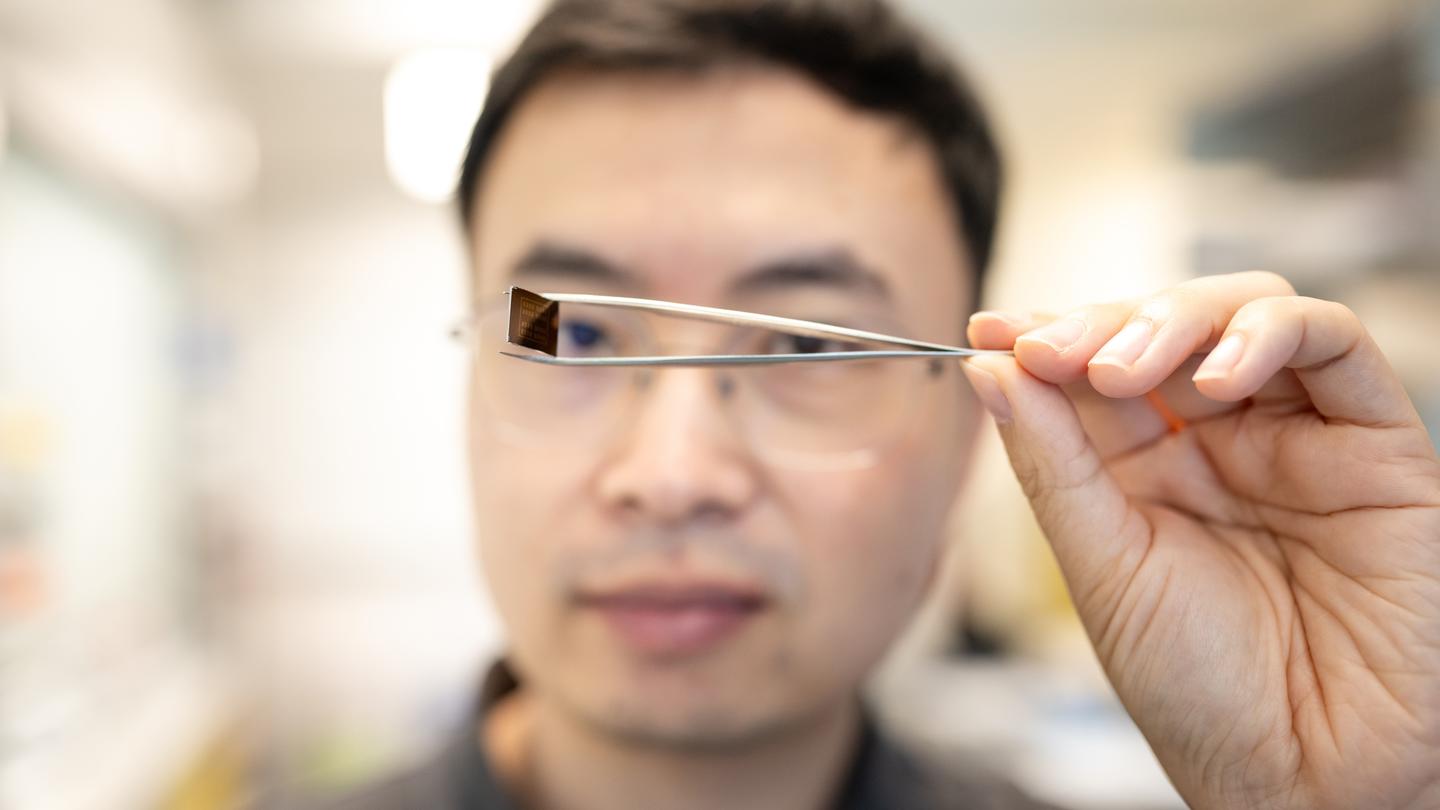
Princeton University researchers have developed an ultrathin semiconductor that can repeatedly change its electronic and optical properties when exposed to different wavelengths of light. The advance could support more adaptable sensors, optoelectronic devices, and computing systems while offering an alternative to continually shrinking conventional semiconductor components.
Modern electronics have improved largely by packing increasingly smaller semiconductor devices onto chips. As this approach approaches physical limits, researchers are exploring materials whose capabilities can change after fabrication. The Princeton team aims to make semiconductors responsive to their environment rather than permanently fixing their behavior during manufacturing.
To create the material, researchers combined a semiconductor only a few molecules thick with light-responsive molecules. These molecules change their structure when illuminated with different wavelengths. These structural changes alter the semiconductor’s conductivity and optical response, allowing researchers to program its properties with light, erase them, and then reprogram them.
Importantly, the material does more than switch between two states. Researchers can gradually adjust its response and reverse those changes, providing greater control over its electronic behavior. This tunability could eventually enable electronic components whose functions can be modified after they have been manufactured.
The team, led by Princeton electrical and computer engineering professor Saien Xie, has produced a uniform, one-inch-square piece of the semiconductor. Using the material, researchers created arrays of programmable electronic switches, demonstrating its potential for larger integrated systems. Their next goal is to connect these switches into circuits, an essential step toward practical electronic devices.
The research points toward electronics that could be dynamically reconfigured for different tasks instead of being designed with permanently fixed functions. Such adaptable materials could become increasingly important as conventional semiconductor scaling becomes more difficult and engineers search for new approaches to improving electronic performance and efficiency.
