

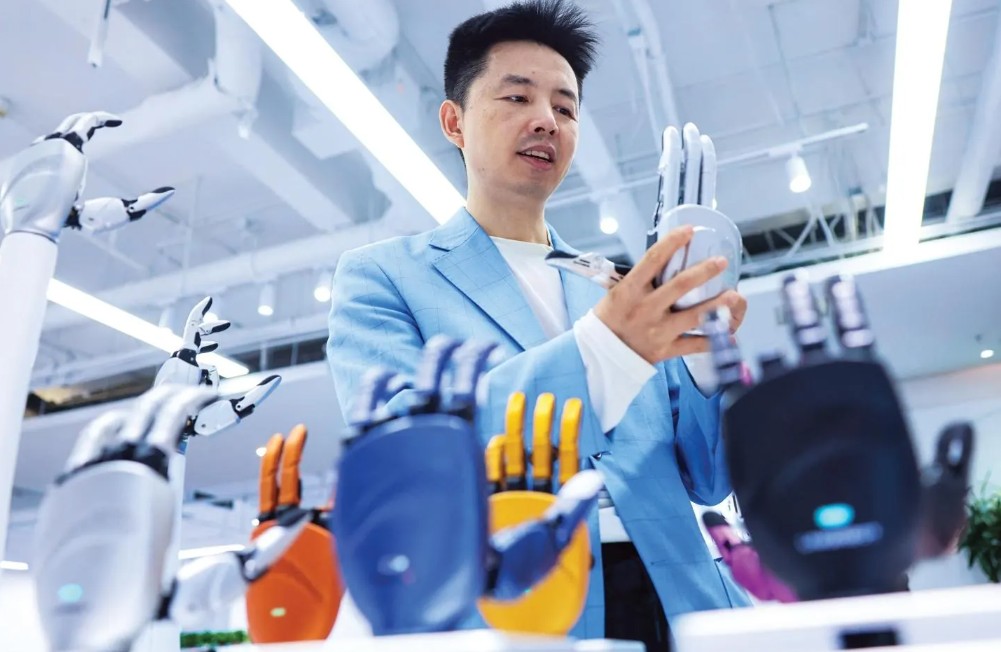
Beijing-based Linkerbot is tackling one of humanoid robotics’ toughest engineering problems: creating affordable robotic hands that can approach the dexterity of human hands. Cofounded in 2023 by chairman and CEO Alex Zhou, the startup reached a $3 billion valuation after a Series B+ funding round in April 2026, tells Forbes.com.
Dexterous hands are critical because humanoid robots need precise movements, adaptable grips, and sensory feedback to handle everyday objects. Elon Musk has acknowledged that while Tesla’s Optimus has progressed in walking, developing humanlike hands remains particularly difficult. Linkerbot aims to close this gap by combining AI development with large-scale Chinese manufacturing.
The company currently offers six hand models priced from 6,666 yuan to 99,999 yuan, or roughly $980 to $14,700. Its advanced L30 can independently move its fingers and knuckles for precision tasks such as manipulating tweezers. Linkerbot manufactures nearly all its components internally, helping control costs and accelerate product development. A new Beijing production line is part of its plan to eventually manufacture as many as 100,000 hands annually.
Software is another part of Linkerbot’s strategy. Its LinkerSkillNet database contains more than 500 hand skills, including chopping vegetables and threading a needle. Employees collect motion data using specialized gloves and robotic arms, then convert those movements into reusable blocks of code. The company is also developing Linker Genesis, an AI model designed to let users control robotic hands through verbal instructions.
Linkerbot’s customers include manufacturers and universities, while Samsung and Siemens are among its overseas customers. Competition, however, is intensifying as numerous Chinese companies enter the dexterous-hand market.
Zhou ultimately wants Linkerbot to become a major component supplier across robotics rather than simply another humanoid manufacturer. Its success will depend on whether it can combine lower prices, mass production, and increasingly capable software while robotic hands continue moving closer to human-level dexterity.
