

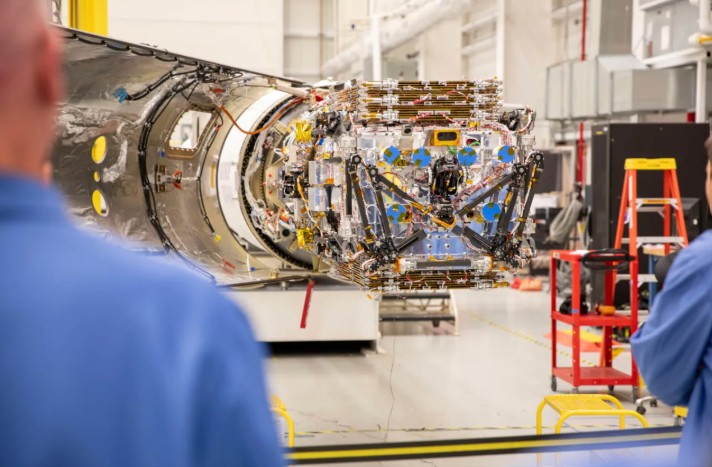
Katalyst’s LINK spacecraft was launched on July 3 with an ambitious goal: rescue NASA’s aging Swift Observatory by boosting it into a higher orbit and extending its operational life. The mission was expected to demonstrate the potential of commercial on-orbit satellite servicing while preventing the telescope’s gradual orbital decay. Instead, LINK has encountered a series of technical failures that now threaten the success of the mission, tells Design News.
The spacecraft is experiencing electrical power issues that have disrupted systems responsible for maintaining its orientation in space. According to NASA, two of LINK’s three reaction wheels are no longer functioning, and its cold gas thruster system has also suffered a partial loss of capability. These failures have left engineers working to stabilize the spacecraft before it can continue its journey toward the Swift Observatory.
Katalyst has made progress by using a Hall effect thruster mounted on a two-axis gimbal to reduce LINK’s spin rate from approximately 9 degrees per second to 4 degrees per second. The company is also collaborating with NASA to develop a new guidance, navigation, and control system tailored to the spacecraft’s current condition. Engineers are remapping available actuators, adjusting control algorithms, and validating the revised system through simulations before deploying it in orbit.
The setbacks are particularly significant for the Arizona startup, which secured a $30 million NASA Small Business Innovation Research Phase III contract in 2025 to develop the robotic servicing mission. LINK was intended to prove that commercial spacecraft could successfully repair or reposition satellites already operating in orbit, opening new possibilities for extending the lifespan of valuable space assets.
The mission has faced challenges since shortly after launch, including communications and attitude control problems that temporarily appeared to be resolved through software updates. However, the recent recurrence of system failures has pushed the planned rendezvous with the Swift Observatory to late August, assuming no additional issues arise.
Launched in 2004, the Swift Observatory studies the universe in visible, ultraviolet, X-ray, and gamma-ray wavelengths. Its rapid response to transient events has enabled observations of supernovas, black holes, neutron stars, comets, and other high-energy cosmic phenomena. Although Swift is not in immediate danger, continued delays could shorten the productive life of one of NASA’s most valuable space observatories.
