

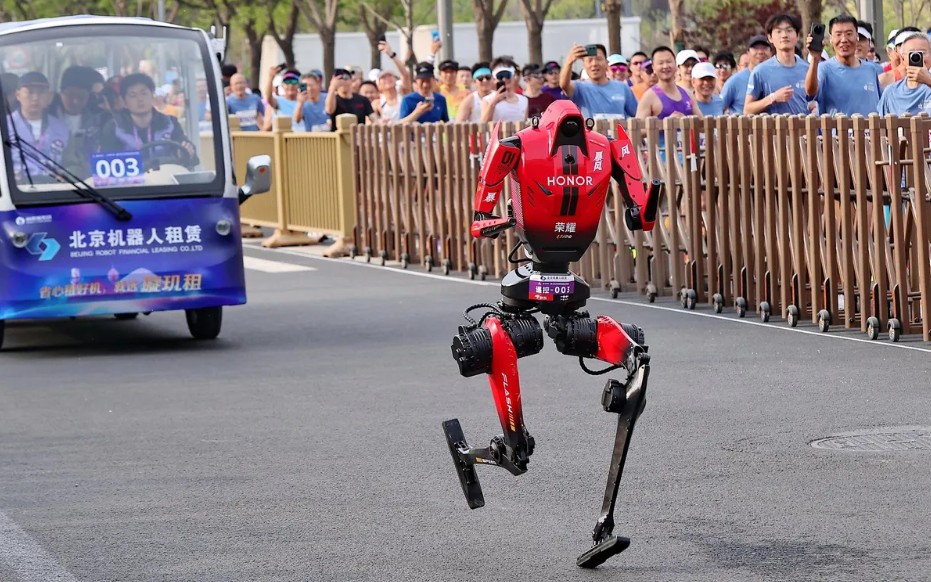
Honor’s Lightning humanoid robot attracted global attention after completing a half-marathon on April 19, 2026, in 50 minutes and 26 seconds. The achievement surpassed the human half-marathon world record by seven minutes and improved on the best robot performance from 2025 by nearly two hours. However, the accomplishment was not the result of a revolutionary new technology. Instead, it stemmed from a series of carefully optimized engineering decisions focused on the specific demands of high-speed running, tells IEEE Spectrum.
The article explains that running places unique requirements on a robot’s motors and drivetrain. During each stride, motors must generate substantial torque to propel the robot upward and forward while also rapidly repositioning the legs for the next step. These competing demands create a tradeoff in gear ratio selection. High gear reductions improve torque production but reduce responsiveness, while lower reductions improve agility but increase energy consumption and heat generation.
Using a physics-based model, the author estimates that Lightning’s drivetrain was optimized for sustained running at approximately 7 meters per second. While its overall power consumption remained relatively modest, the robot’s knee motors still generated around 150 watts of waste heat each, enough to create serious overheating problems during a long-distance race.
Honor addressed this challenge through an advanced liquid-cooling system. Cooling channels extend deep into the motors, and each of the robot’s four lower-limb drive motors is equipped with an independent cooling circuit. This design continuously removes heat that conventional air cooling could not dissipate, making prolonged high-speed running possible.
The analysis also explains why competitors such as Unitree and Agibot struggled to match Lightning’s performance. Many commercial humanoids are optimized for walking and general-purpose operation rather than endurance running. Their gearing choices favor efficiency during everyday tasks but generate substantially more heat when pushed to marathon-level speeds.
The article concludes that Lightning’s success illustrates the importance of engineering tradeoffs. Larger motors, specialized gearing, and liquid cooling make the robot an exceptional runner but less efficient for routine walking and general-purpose work. Rather than representing a universal breakthrough, the achievement demonstrates what is possible when a humanoid robot is optimized for a single demanding task.
