

Local AI is emerging as an alternative to cloud-based artificial intelligence for architecture, engineering, and construction firms. AEC Magazine explores how open-weight models running on workstations can automate BIM and coding tasks while giving firms greater control over intellectual property, project data, and computing costs.
Hardware remains a key constraint because large AI models require substantial GPU memory. HP’s ZBook Ultra G3a and Z2 Mini G1a use AMD Ryzen AI Max PRO processors with unified memory shared among the CPU, GPU, and NPU. The ZBook can be configured with 192 GB of memory, with up to 160 GB available to the GPU, allowing large models to run alongside applications such as Autodesk Revit.
Model Context Protocol, or MCP, is central to these emerging workflows. MCP servers connect AI models with CAD and BIM applications through their APIs. In Revit, users can ask natural-language questions about models or instruct AI agents to edit parameters, generate grids and levels, annotate views, create drawings, and potentially build parametric families. AI agents could also automate QA/QC by checking models and documentation against project requirements and company standards.
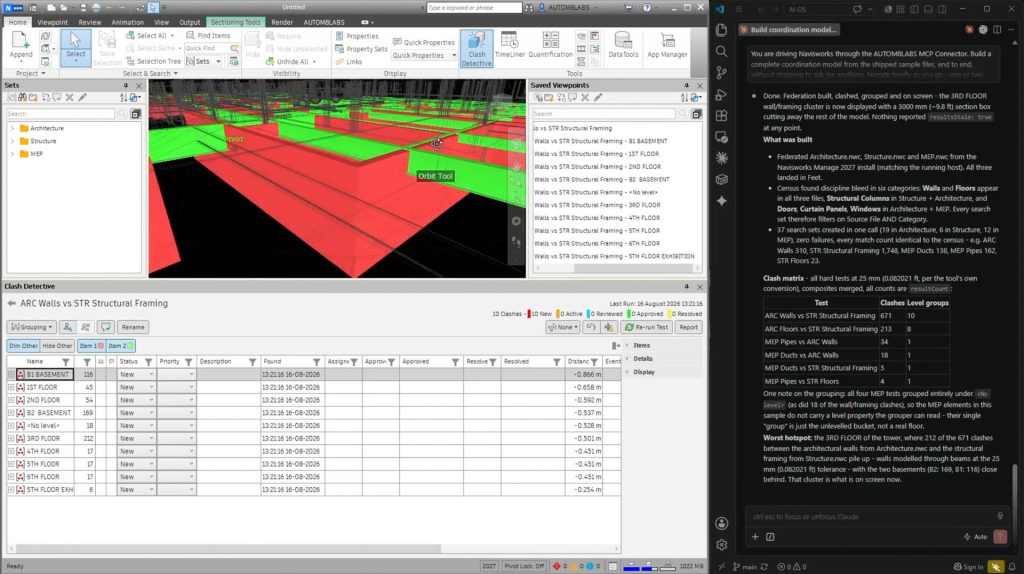
The same approach can extend to Navisworks, where AI could initiate clash tests, organize results, and export unresolved issues. However, the article stresses that current systems cannot reliably generate complete detailed building models, making human review essential.
Local AI also supports programming. Open-weight coding models can generate Dynamo, Grasshopper, Python, and pyRevit tools without sending proprietary information to cloud services. Local models can similarly search, summarize, and compare specifications, contracts, proposals, and internal standards.
The article presents local AI not as a replacement for cloud AI but as another computing option. By combining open models, MCP, and high-memory workstations, AEC firms can integrate AI directly into established desktop workflows while maintaining tighter control over sensitive data and costs.
