

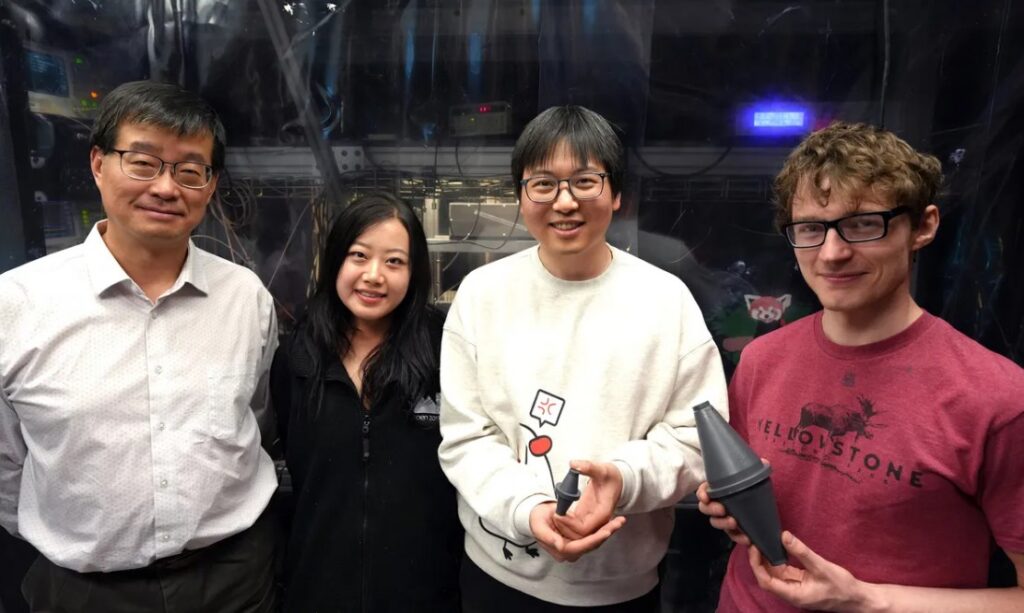
Scientists are proposing an ambitious use for the Moon’s permanently shadowed craters: transforming them into sites for the most stable lasers ever constructed, tells IEEE Spectrum. According to a study published in the Proceedings of the National Academy of Sciences, researchers led by Jun Ye of JILA suggest that these frigid lunar environments could support an optical atomic clock capable of establishing a lunar time standard and enabling advanced navigation and communication systems across cislunar space.
The concept takes advantage of the Moon’s unique environment. Unlike Earth, the Moon lacks an atmosphere and tectonic activity, eliminating many sources of vibration and disturbance that limit laser stability. The permanently shadowed craters near the lunar south pole offer even greater benefits. With temperatures around 50 kelvin, they rank among the coldest locations in the solar system, minimizing thermal fluctuations that can affect the mirrors used in precision laser systems.
At the heart of the proposal is a silicon cavity, a highly engineered block of silicon positioned between mirrors. The cavity allows only specific frequencies of light to resonate, creating an exceptionally stable optical reference. Researchers estimate that a cavity placed in a permanently shadowed crater could be passively cooled to about 16 kelvin by radiating heat into space. At this temperature, silicon neither expands nor contracts in response to minor temperature variations, helping maintain extraordinary frequency stability without the cryostats, vacuum pumps, and vibration-isolation systems required on Earth.
Such a laser could serve as the foundation of the first extraterrestrial optical atomic clock. Similar to how GPS satellites rely on atomic clocks to provide positioning data on Earth, a lunar time standard could support GPS-like navigation for orbiting spacecraft and surface rovers. The stable optical frequency could also synchronize telescopes distributed between the Moon, Earth, and satellites, enabling long-baseline interferometry for deep-space imaging and gravitational-wave research.
The proposal remains conceptual, but it aligns with NASA’s Artemis plans for the lunar south pole. Researchers suggest that future missions could transport a preassembled silicon cavity to the Moon, where astronauts or robotic systems would install it inside a permanently shadowed crater. If realized, the project could provide critical infrastructure for future lunar exploration and scientific discovery.
