

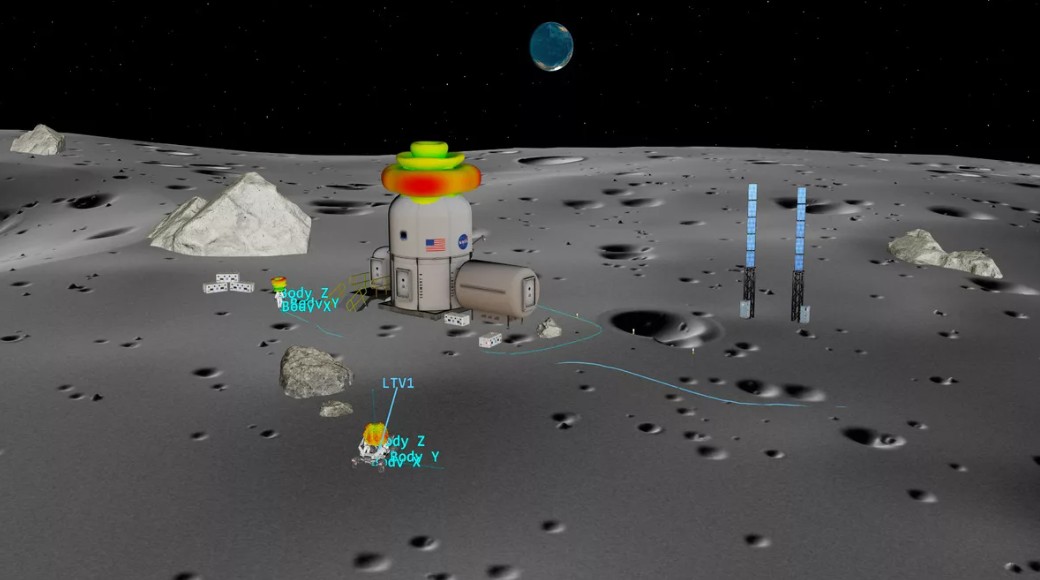
Synopsys is helping build an RF digital twin of the Moon to test communications systems for future Artemis missions. Developed with Cesium, part of Bentley Systems, Keysight, and NASA’s Glenn Research Center through the Lunar 3GPP project, the virtual environment combines detailed lunar topography, RF modeling, mission dynamics, and hardware validation.
Reliable lunar communications present challenges that differ sharply from those on Earth. The Moon has no atmosphere to cause oxygen or water vapor absorption, but radio signals still encounter spreading losses and interactions with lunar regolith. Terrain is particularly important because ridges, craters, and boulders can block line of sight or create multipath interference. The digital twin uses high-resolution data collected by NASA’s Lunar Reconnaissance Orbiter to model these effects.
Engineers can simulate communications among spacesuits, rovers, landers, surface infrastructure, and orbital relays. Antenna models are placed on detailed representations of these assets and tested as they move through realistic scenarios. This allows teams to study how terrain, orientation, movement, and vehicle structures affect signal quality rather than evaluating antennas only as isolated components.
The project also connects simulation with physical testing. Synthetic data from the lunar model is fed into Keysight RF test equipment and real communications hardware. Because simulations can run in milliseconds, engineers can rapidly examine different terrain positions, trajectories, antenna orientations, and relay configurations. Teams can even hear simulated voice connections deteriorate when a rover passes behind a ridge and recover when line of sight returns.
The larger goal is to identify weaknesses before deployment. With no opportunity for conventional site surveys or repeated field testing on the Moon, digital twins give engineers a practical way to test communications architectures, refine designs, and reduce mission risks while changes can still be made on Earth.
