

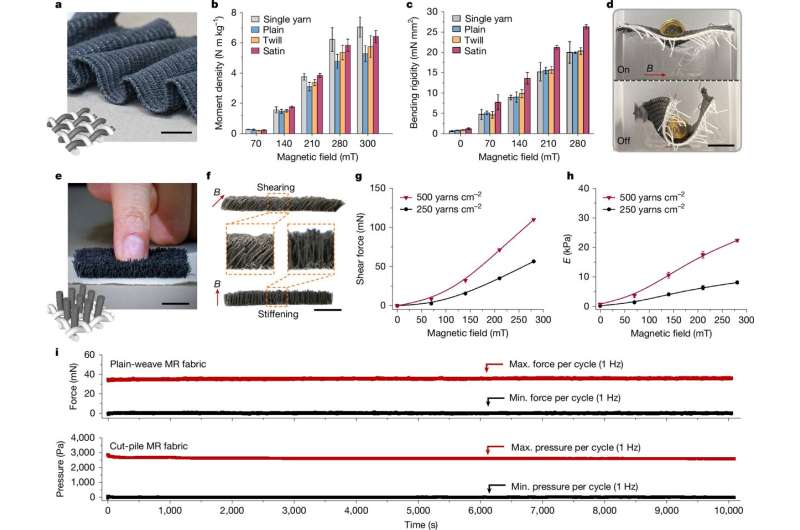
In a new study, scientists have created smart fibers composed of low-density polyethylene (LDPE) infused with soft magnetic particles (carbonyl iron), tells Tech Xplore. These fibers measure just 57 µm in diameter and are produced through melt-spinning, a process that allows an unusually high load of magnetic particles while maintaining flexibility. These thin fibers are then twisted into helical yarns, seven fibers per yarn, to provide directional response to applied magnetic fields rather than just simple “on/off” stiffening.
Because of the helical structure, the yarn responds to the vector of the magnetic field (both magnitude and direction) instead of responding only to scalar stimuli. This brings finer control and enables fabrics that can bend, stretch, stiffen, or alter surface texture. Two distinct fabrics were created: a woven textile optimized for bending and stretching, and a cut-pile fabric resembling a soft brush. From the woven version the researchers developed a fabric patch with ventilation slits that open/close under a cyclic magnetic field, potentially for adaptive thermal regulation in garments. The cut-pile version forms the basis of a soft robotic gripper: the thousands of magnetic fibers stiffen and conform around delicate items, enabling robots to pick up soft fruits, potato chips, or even worms, objects that standard rigid grippers would crush or drop.
Beyond robotics, the team also demonstrated a haptic glove for virtual reality in which magnetic actuation of the fibers stimulates realistic tactile feedback by stiffening or pressing the fabric against the skin during virtual interactions. The next challenge for commercialization lies in enhancing durability, wear-comfort, and safety so the fabrics can be used in everyday clothing or tactile wearables.
This research bridges actuator materials and textiles in a way that could reduce reliance on bulky external motors or pneumatic systems. By embedding actuation directly into the fabric, future devices may become lighter, more conformable, and more capable of handling fragile loads or providing nuanced human-machine interaction.
