

Automakers are increasingly replacing assemblies of stamped parts with large high-pressure die-cast aluminum components to reduce vehicle weight, part count, and manufacturing costs. However, conventional CAE methods can overlook important manufacturing variations that influence how these castings behave during crashes, tells Machine Design
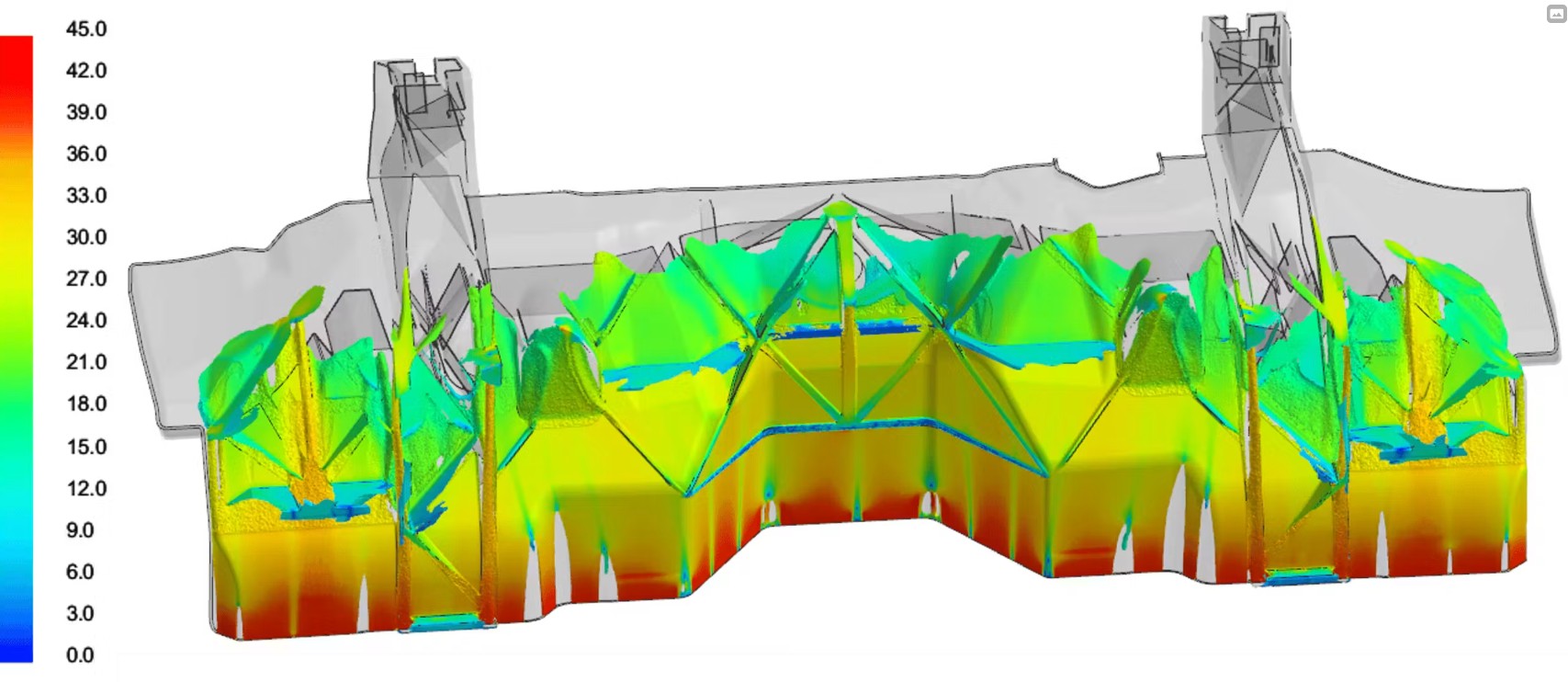
Traditional structural simulations typically assign one stress–strain curve to an entire component. HPDC parts, however, develop location-dependent properties during manufacturing. Differences in flow length, turbulence, and temperature can create oxide films, porosity, and variations in ductility. As a result, elongation to failure, which is critical for crash-energy absorption, can vary significantly within one casting. Uniform material models may therefore underestimate deformation or miss potential failure locations.
The article presents a three-step workflow for bringing manufacturing effects into CAE earlier. First, engineers use CAD geometry to perform simplified casting simulations based on characteristics such as local thickness, transitions, edges, and draft angles. This screening identifies areas where excessive flow length, oxides, or porosity could develop without requiring complete tooling information.
Next, predicted defect fields are mapped to local material properties, including elongation, strength, and failure strain. Finally, engineers use this nonhomogeneous material model in full-vehicle crash simulations.
The methodology was applied to a Hyundai dash underbody. Compared with a conventional homogeneous model, the manufacturing-aware simulation revealed two additional failure areas and predicted greater dash intrusion. Areas initially predicted to experience less than 20 mm of intrusion instead showed 30–50 mm.
The approach does not replace detailed casting-process simulation. Instead, it provides an early, computationally efficient way to identify risks before tooling. By connecting manufacturing and structural analysis sooner, engineers can modify geometry, reinforce vulnerable areas, or adjust casting conditions before costly problems emerge. The same methodology could also benefit safety-critical cast components in aerospace, heavy equipment, and defense applications.
