

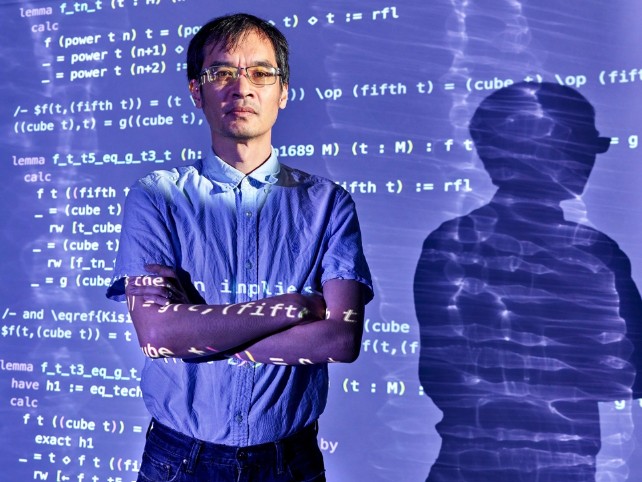
Artificial intelligence is rapidly transforming mathematics, prompting researchers to reconsider what it means to be a mathematician in an age when machines can solve complex problems, verify proofs, and even generate original mathematical insights. Rather than replacing mathematicians, the technology is beginning to reshape how mathematical research is conducted and the kinds of problems humans choose to pursue, tells IEEE Spectrum.
The article explains that recent AI systems have progressed far beyond routine calculations. They can assist with theorem proving, suggest proof strategies, verify lengthy mathematical arguments, and identify patterns across enormous collections of mathematical knowledge. These capabilities allow researchers to automate time-consuming tasks while focusing their attention on higher-level reasoning, intuition, and the formulation of new questions. AI is becoming a collaborative research partner instead of merely a computational tool.
Leading mathematicians, including Terence Tao, envision a future of Big Mathematics, where teams of researchers work alongside AI systems to tackle problems that would be impractical for individuals alone. This collaborative model could accelerate discoveries across fields ranging from number theory to geometry and topology while enabling larger, more interconnected research projects.
The growing capabilities of AI also raise philosophical and professional questions. If machines become increasingly proficient at proving theorems and generating ideas, mathematicians must reconsider where human value lies. Many researchers argue that creativity, judgment, intuition, and the ability to identify meaningful problems will remain distinctly human strengths. Others see AI as a catalyst that could democratize mathematics by making advanced research tools available to a broader community of students and scientists.
The article concludes that mathematics is entering a period of profound change rather than decline. AI is unlikely to diminish the discipline; instead, it is expected to expand its scope, allowing mathematicians to investigate more ambitious questions while redefining research practices. As intelligent systems become integral to mathematical discovery, success will increasingly depend on effective collaboration between human insight and machine intelligence, shaping a new era of scientific exploration.
