

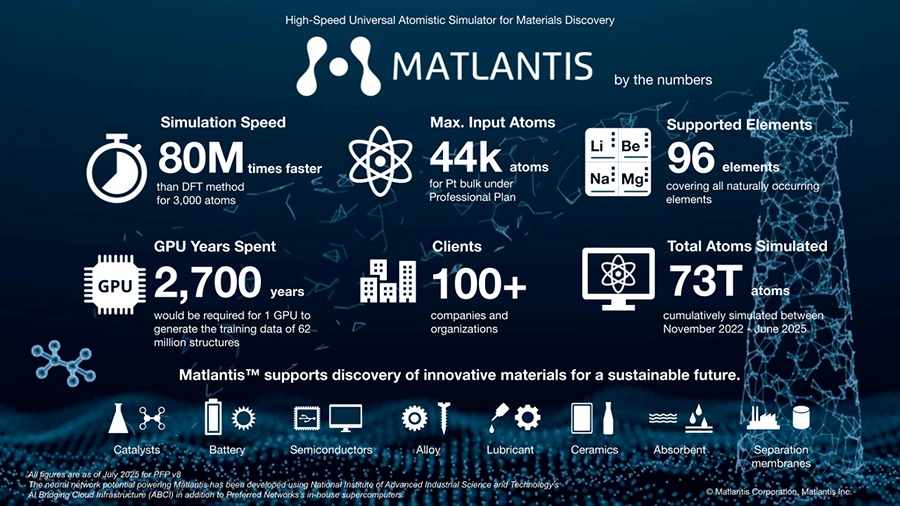
CAMBRIDGE, MA, July 21, 2025 – Matlantis has released Version 8 of its universal atomistic simulator, incorporating updates to its AI engine, PFP (Preferred Potential). The new version is designed to improve simulation accuracy and accelerate materials research across sectors. Alongside the release, the company has opened a new office in Cambridge, MA to support adoption and collaboration in North America. The update advances predictive performance in materials science using machine learning-based simulation.
PFP Version 8 is the first universal Machine Learning Interatomic Potential (MLIP) trained using datasets built with the r2SCAN functional (restored-regularized strongly constrained and appropriately normed). Previous PFP versions, up to Version 7, used datasets generated with the PBE (Perdew-Burke-Ernzerhof) functional, a method also used by other MLIPs. The PBE functional has limitations in simulation accuracy, particularly in how well simulations reflect experimental results for material behavior.
PFN introduced the r2SCAN method to address the accuracy limits of the PBE-based approach. Creating training datasets with r2SCAN requires three to five times more computing time than PBE. PFP Version 8 is trained on both r2SCAN- and PBE-based datasets, enabling Matlantis users to achieve about twice the simulation accuracy compared to the previous version, without increasing computation time.
“This update represents a significant breakthrough,” said Daisuke Okanohara, CEO of Matlantis. “In 2021, we were the world’s first to launch a commercial simulator using a universal MLIP, and now our simulator, Matlantis, is the first globally to incorporate r2SCAN that ensures high simulation accuracy. We believe this will further pave the way for the era of computer-based materials discovery. We will continue to support researchers in North America and the rest of the world to discover innovative and sustainable new materials.”
Matlantis, a joint investment by PFN, ENEOS, and Mitsubishi Corporation, has been used by more than 100 organizations since its launch in July 2021. The platform provides a machine learning interatomic potential that covers 96 elements(from hydrogen to curium) and delivers DFT (density functional theory). It delivers DFT (density functional theory) – level accuracy with faster computation, supporting atomistic simulation at industrial scale.
Matlantis enables research teams to:
- Perform simulations from the first day of use:
Matlantis is a cloud-based software-as-a-service (SaaS) platform. Users access it through a web browser and can begin materials research immediately. Its machine learning interatomic potential (MLIP) is trained on massive datasets, so users can focus on material discovery without building ML models.
- Search a wide variety of undiscovered materials
Matlantis serves as a universal atomistic simulator and supports materials used in batteries, semiconductors, and catalysts. Users do not need to switch AI models based on the type of material being studied.
- Accelerate materials discovery
Matlantis enables researchers to run simulations in hours instead of the years of DFT calculations. This process allows computational results to guide experimental design, shifting R&D workflows from post-experiment validation to predictive insights.
- Achieve higher simulation accuracy than ever before
By using training datasets built with the r2SCAN method, Matlantis simulates material properties with accuracy compared to other machine learning interatomic potentials within the same timeframe. This reduces the gap between simulation results and experimental data.
“With PFP 8.0 we finally have a universal machine learning interatomic potential that keeps the best DFT‑level fidelity while spanning most of the periodic table,” said Matlantis technical advisor prof. Ju Li, Ph.D., widely recognized for his work on atomistic modeling and materials research. “That accuracy‑plus‑speed combination lets engineers generate phase diagrams or screen multi‑component systems in hours or several days rather than weeks or months – work that directly informs alloy design, battery materials, and other high‑value applications. Establishing a U.S. office means we can collaborate even more closely with industrial and academic partners here, shorten feedback loops, and bring new Matlantis capabilities to market faster.”
Dr. Katsushisa Yoshida, director, deputy head of research center for computational science and informatics, Resonac, said: “We are excited to hear about the major update to Matlantis and the opening of their new U.S. office. We greatly look forward to how the evolution of this platform will further accelerate our own materials development.”
PFP 8.0 is developed using PFN’s supercomputer and AI Bridge Cloud Infrastructure (ABCI) 2.0 and 3.0 provided by Japan’s National Institute of Advanced Industrial Science and Technology (AIST) and AIST Solutions Co. Ltd. The use of ABCI 3.0 is supported by the ABCI 3.0 Development Acceleration Program.
Source: Matlantis
About Matlantis

Matlantis, founded in June 2021 and based in Tokyo, with a U.S. office in Cambridge, MA, offers a cloud-based atomistic simulation platform for materials research. The platform uses machine learning interatomic potentials, known as PFP, trained on large datasets to simulate atomic behavior across 96 elements. It delivers results faster than traditional density functional theory methods, supporting research in batteries, semiconductors, catalysts and advanced materials. The company is jointly backed by Preferred Networks, ENEOS and Mitsubishi Corp. More than 100 companies use Matlantis to support R&D in areas such as catalysts, batteries, semiconductors, alloys, lubricants, ceramics and chemicals. Its expanding client base and geographic presence indicate demand for AI-driven tools in materials science.
