

BOSTON, MA and TOKYO, Japan, July 20, 2026 – Matlantis has released version 9.0.0 of Matlantis PFP, the core technology behind its atomistic simulation platform. The release launches the r2SCAN calculation mode, previously available as a beta feature in version 8.0.0, and sets it as the default calculation mode for the platform.
Key Updates
- r2SCAN Calculation Mode Officially Released
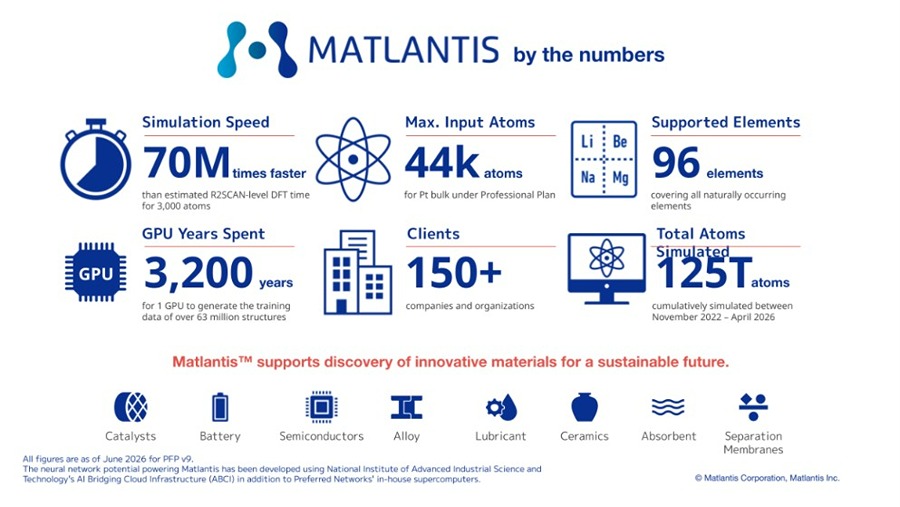
The r2SCAN calculation mode supports the same 96 chemical elements as the PBE mode, including newly added lanthanides and actinides. The expanded support is for material systems that were previously difficult to model, including rare-earth magnets and optical communication materials.
- Support for Material Structures
PFP v9.0.0 broadens support for structures used in industrial R&D, including:
・Surface reactions and adsorption structures
・Coordination complexes
・Molecular crystals
These additions enable applications in:
・Catalysis
・Gas adsorption and separation
・Thin-film growth
・Organic semiconductors
・Pharmaceutical Research
- Agreement with Experimental Data for Key Material Properties
Validation results for v9.0.0 show that the r2SCAN calculation mode matches experimental values than the PBE mode for:
- Crystal and surface stability
- Melting point
- Water viscosity
The improvements apply to materials development work involving catalysts, batteries and separation membranes.
- r2SCAN Becomes the Default Calculation Mode
Starting with v9.0.0, r2SCAN is the default calculation mode when users do not specify a calculation method. The PBE calculation mode remains available and can still be selected manually.
Source: Matlantis
About Matlantis

Matlantis, founded in June 2021 and based in Tokyo, with a U.S. office in Cambridge, MA, offers a cloud-based atomistic simulation platform for materials research. The platform uses machine learning interatomic potentials, known as PFP, trained on large datasets to simulate atomic behavior across 96 elements. It delivers results faster than traditional density functional theory methods, supporting research in batteries, semiconductors, catalysts and advanced materials. The company is jointly backed by Preferred Networks, ENEOS and Mitsubishi Corp. More than 100 companies use Matlantis to support R&D in areas such as catalysts, batteries, semiconductors, alloys, lubricants, ceramics and chemicals. Its expanding client base and geographic presence indicate demand for AI-driven tools in materials science.
