

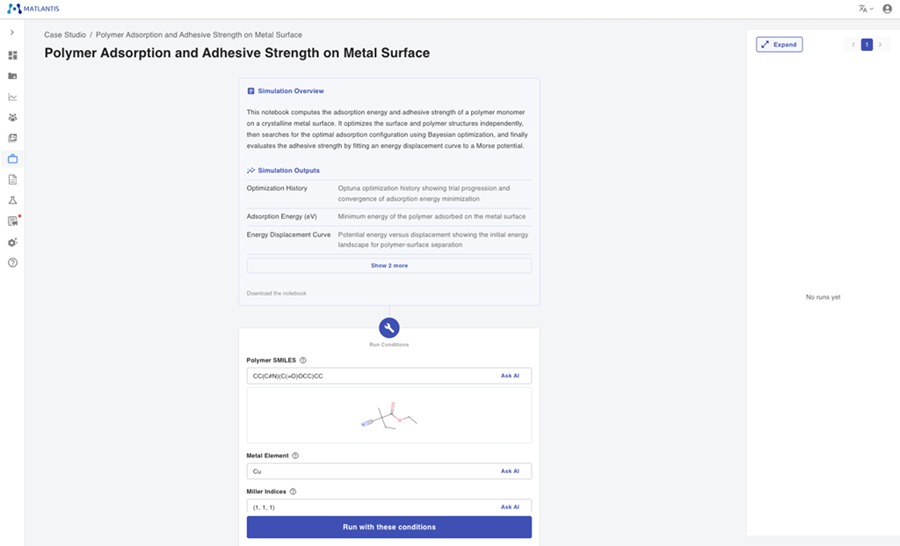
CAMBRIDGE, MA and TOKYO, Japan, Sep 18, 2026 – Matlantis and Resonac are testing “Matlantis Case Studio”, an AI-assisted interface that lets chemists run atomistic simulations without programming. Users select existing computational cases, modify calculation conditions through AI dialogue and execute calculations within Matlantis. An alpha version is scheduled for release soon.
AI for Materials Research
Matlantis Case Studio applies AI to computational materials research by giving chemists access to atomistic simulation workflows. The feature is for researchers who have limited experience with computational science or programming.
Testing at Resonac Research Sites
Preferred Networks is participating in the program with Resonac. The work has involved Resonac’s Computational Information Science Research Center and Isesaki Plant since October 2025.
Computational scientists and chemists at Resonac tested successive prototypes, with feedback incorporated into later versions. The companies completed four demonstration experiments during the program.
Masato Fukushima, executive officer and CTO, Resonac Holdings Corporation said: “To advance and accelerate materials development, it is becoming increasingly important to organically connect experimentation and computational science and use both mutually. However, because the use of computational science requires specialized knowledge and operation, barriers to its use have remained for many experimental chemists. In this joint demonstration, starting from researchers’ actual research processes and needs, we worked to realize an environment in which experimental chemists themselves can formulate and test hypotheses while making use of computation.
With Matlantis Case Studio, we expect the cycle of quickly verifying ideas conceived by researchers through computation and reflecting the results in the next experimental plan to be incorporated more naturally into research activities. By developing computational science from a technology used only by some specialists into a research foundation that more researchers can use on a daily basis, we hope to expand the possibilities for new materials design and contribute to improving R&D productivity and accelerating innovation.”
Matlantis Case Studio Workflow
Matlantis Case Studio starts with existing computational examples tied to specific materials and physical properties. Users select a case related to their research and modify it before running the calculation.
The workflow includes:
- Case selection: Users choose existing cases based on relevant materials and physical properties.
- AI-assisted setup and execution: Users adjust calculation conditions through interface controls and AI dialogue before running the simulation.
- Results and history: The software summarizes calculation results in natural language and stores execution histories for review and comparison.
Daisuke Okanohara, representative director, Matlantis commented: “Matlantis is at a stage of evolving from a ‘tool for computational specialists’ into a ‘platform that can be used by all researchers, including experimental chemists.’ This joint demonstration with Resonac is highly significant for Matlantis in that we were able to design and validate the direction of that evolution together with a user company actually working at the forefront of materials development. By incorporating Resonac’s on-site knowledge, we will evolve Matlantis into a form that can also be used naturally by experimental chemists. Starting with Matlantis Case Studio, we will bring the possibilities of AI for Science to more researchers and further broaden its use.”
Use by Experimental Chemists
The prototype gives chemists a way to run atomistic calculations during materials research without writing code. It also allows computational cases to be reused for different research requirements.
Alpha Release
The alpha version of Matlantis Case Studio will initially be offered to companies that participated in the demonstrations.
Matlantis and Resonac plan to continue testing the feature, expand its functionality and examine workflows connecting computational research.
Source: Matlantis
About Matlantis

Matlantis, founded in June 2021 and based in Tokyo, with a U.S. office in Cambridge, MA, offers a cloud-based atomistic simulation platform for materials research. The platform uses machine learning interatomic potentials, known as PFP, trained on large datasets to simulate atomic behavior across 96 elements. It delivers results faster than traditional density functional theory methods, supporting research in batteries, semiconductors, catalysts and advanced materials. The company is jointly backed by Preferred Networks, ENEOS and Mitsubishi Corp. More than 100 companies use Matlantis to support R&D in areas such as catalysts, batteries, semiconductors, alloys, lubricants, ceramics and chemicals. Its expanding client base and geographic presence indicate demand for AI-driven tools in materials science.
About Resonac Corporation
Resonac Holdings Corp., formerly known as Showa Denko, is a chemical and industrial materials company based in Tokyo. Founded in 1939, the company operates in petrochemicals, electronics, aluminum products, inorganic materials, mobility and innovation materials. Its offerings include semiconductor materials, specialty chemicals, functional resins, graphite electrodes, aluminum foils and advanced industrial products. Resonac serves industries ranging from automotive and electronics to semiconductors and infrastructure. The company was formed through the 2023 merger of Showa Denko and Showa Denko Materials, formerly Hitachi Chemical. For the 12 months through mid-2025, Resonac reported about $9.1B. Its diversified portfolio positions it as a key supplier to the global semiconductor and electronics supply chain while maintaining a presence in broader manufacturing markets. Headquarters are located in Tokyo.
