

An article in the 3D Printing Industry blog examines a new computational framework developed by researchers at Imperial College London for designing nonlinear mechanical metamaterials. The work aims to improve how engineers create advanced structures whose behavior is determined more by geometry than by the material itself.
Mechanical metamaterials are engineered architectures designed to produce unusual physical properties such as programmable stiffness, controlled deformation, energy absorption, or negative compressibility. These structures are increasingly explored for aerospace systems, robotics, biomedical devices, and impact-resistant materials. However, designing metamaterials with nonlinear behavior has remained difficult because their mechanical responses change dramatically under different loading conditions.
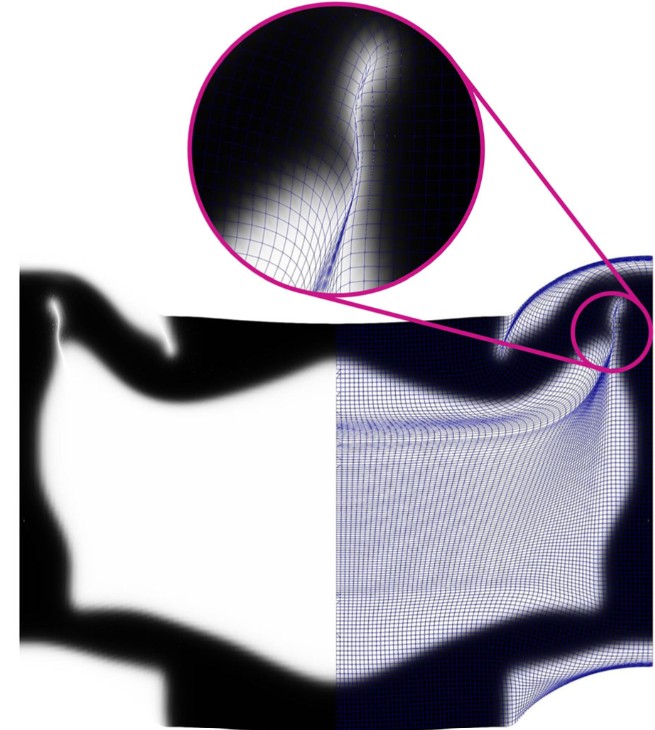
The Imperial College team addressed this challenge by developing a topology optimization framework capable of designing metamaterials that respond predictably even under large deformations. Traditional optimization methods often assume linear behavior, which limits their usefulness for applications involving bending, instability, buckling, or shape transformation. The new framework instead incorporates nonlinear mechanics directly into the optimization process.
According to the article, the researchers combined finite element analysis with gradient-based optimization methods to generate structures capable of achieving targeted mechanical performance. The approach allows engineers to tune properties such as stiffness, deformation pathways, and load distribution while maintaining manufacturability for additive manufacturing systems.
The framework was tested through numerical simulations and experimental validation using 3D-printed prototypes. Researchers demonstrated that the optimized metamaterials could exhibit highly controlled nonlinear responses while remaining structurally stable. This opens possibilities for designing components that adapt dynamically to external forces or environmental conditions.
The article highlights the growing role of computational design and additive manufacturing in advanced materials engineering. As 3D printing technologies mature, engineers are increasingly able to fabricate intricate lattice structures and geometries that were previously impossible to manufacture using conventional methods.
The research ultimately represents a broader shift toward programmable materials and AI-assisted engineering workflows. By integrating nonlinear mechanics directly into topology optimization, the Imperial College team has created a design approach that could accelerate the development of lighter, smarter, and more responsive engineered systems across multiple industries.
