

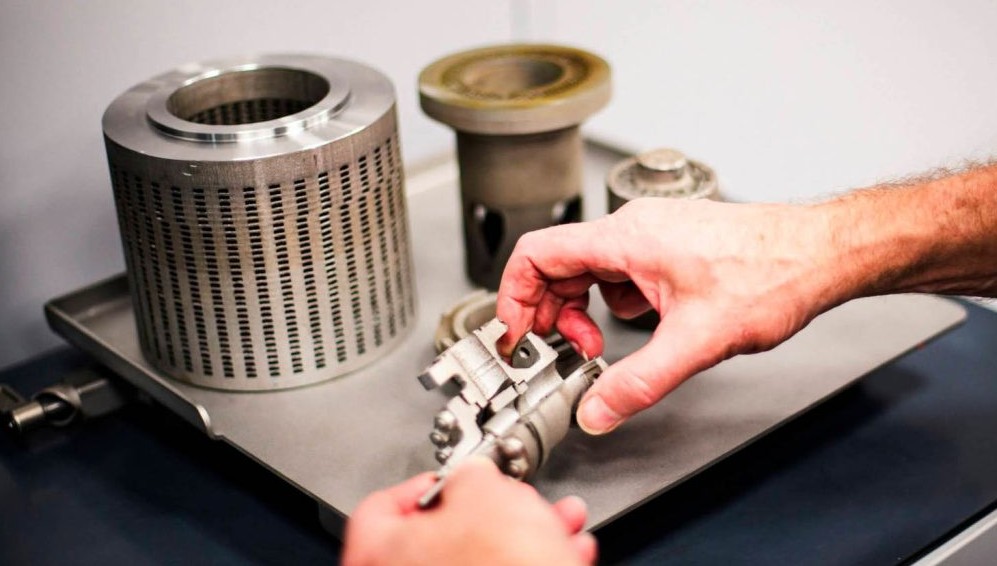
Metal additive manufacturing is transforming the production of complex valve components used in the oil and gas industry. This Develop 3D article examines how British valve manufacturer Kent Introl has adopted 3D printing to simplify production, improve efficiency, and expand its manufacturing capabilities.
Part of the Koso Group, Kent Introl manufactures valves for demanding subsea and surface applications. These components must withstand extreme pressures, high temperatures, and corrosive environments while meeting stringent safety and quality requirements.
Traditional valve trim manufacturing involves producing numerous metal discs containing intricate fluid channels. These discs are electrochemically machined, inspected, vacuum-brazed, and finished to create assemblies that regulate fluid pressure and flow. The process requires hundreds of operations, increasing production time, material waste, and opportunities for errors.
To overcome these challenges, Kent Introl introduced a Renishaw RenAM 500Q Flex metal 3D printer. Using laser powder bed fusion technology and four 500-watt lasers, the system produces complex valve trims as single components, eliminating multiple manufacturing and assembly stages.
The company has qualified stainless steel S316, Inconel 625, and Inconel 718 for production. Five employees have received specialized training to operate the equipment.
Quality assurance follows the company’s TRAV principles: traceability, repeatability, accuracy, and verification. Comprehensive material records, process monitoring, and build histories support compliance with demanding industrial standards.
Computational fluid dynamics (CFD) simulations also play an important role. Physical flow testing has demonstrated results within 1% of CFD predictions, validating the performance of printed components.
After more than three years of experience, Kent Introl is extending its additive manufacturing expertise beyond oil and gas through its AddLab division.
The initiative enables other industries to access qualified metal printing capabilities while helping Kent Introl diversify revenue. It demonstrates how additive manufacturing can reduce production complexity, accelerate design experimentation, and support reliable manufacturing of safety-critical components.
