

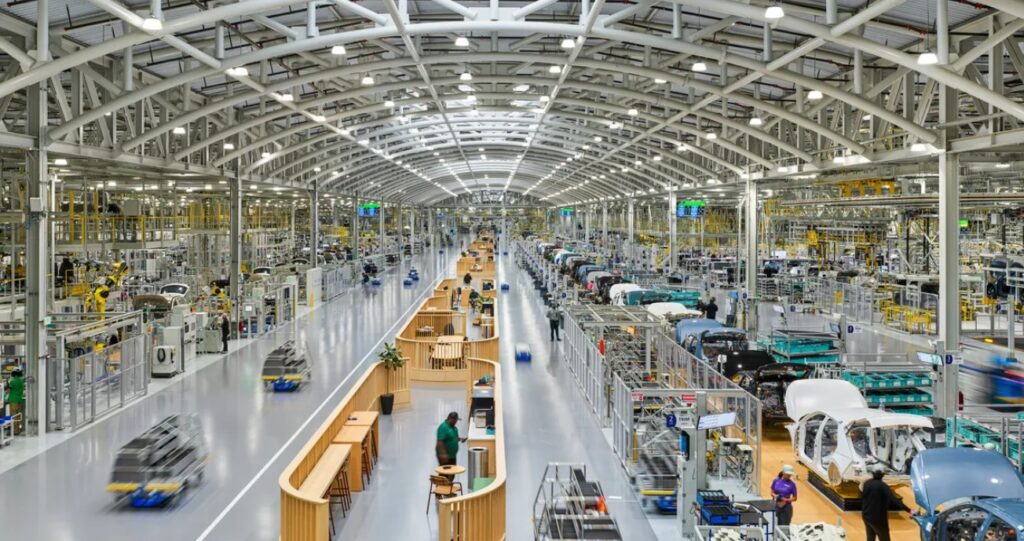
Hyundai’s Metaplant, officially known as Hyundai Motor Group Metaplant America (HMGMA), represents a major investment in U.S. manufacturing, approximately $7.6 billion for the initial factory, with total planned investments reaching $12.6 billion in Georgia. Located near the port of Savannah, the facility covers about 697,000 m² (more than 7.5 million ft²) and aims for an annual production capacity of up to 500,000 electric vehicles for Hyundai, Kia, and Genesis brands, tells IEEE Spectrum.
What makes the Metaplant stand out is its high level of automation and digital integration. On-site, hundreds of industrial robots handle welding, stamping, and body assembly. Automated guided vehicles (AGVs) navigate the factory floor, moving parts and finished vehicles autonomously, integrated with AI-based logistics and just-in-time supply-chain management. Human workers, referred to as “Meta Pros,” occupy roles focused on craftsmanship and quality, while the repetitive heavy work is handled by machines.
On the sustainability front, Hyundai sets ambitious targets: solar roofs that cover part of parking lots, hydrogen-fuel-cell trucks delivering parts, and a goal of sourcing 100% of the plant’s energy from renewables. The factory is also supported by a large battery-production joint venture with LG Energy Solution, ensuring the EV supply chain is logically co-located.
The Metaplant highlights key trends: building an EV factory from scratch allows for optimized line layout, digital twins, scalable production, and lean logistics. It also underscores the shift in manufacturing from human labor to smart systems and from internal-combustion legacy to electric-vehicle future. However, the facility’s success also depends on workforce training, resilient supply chains, and policy support in a competitive global market.
Hyundai’s Metaplant is not just a factory; it’s a blueprint for next-generation mobility manufacturing in the United States.
