

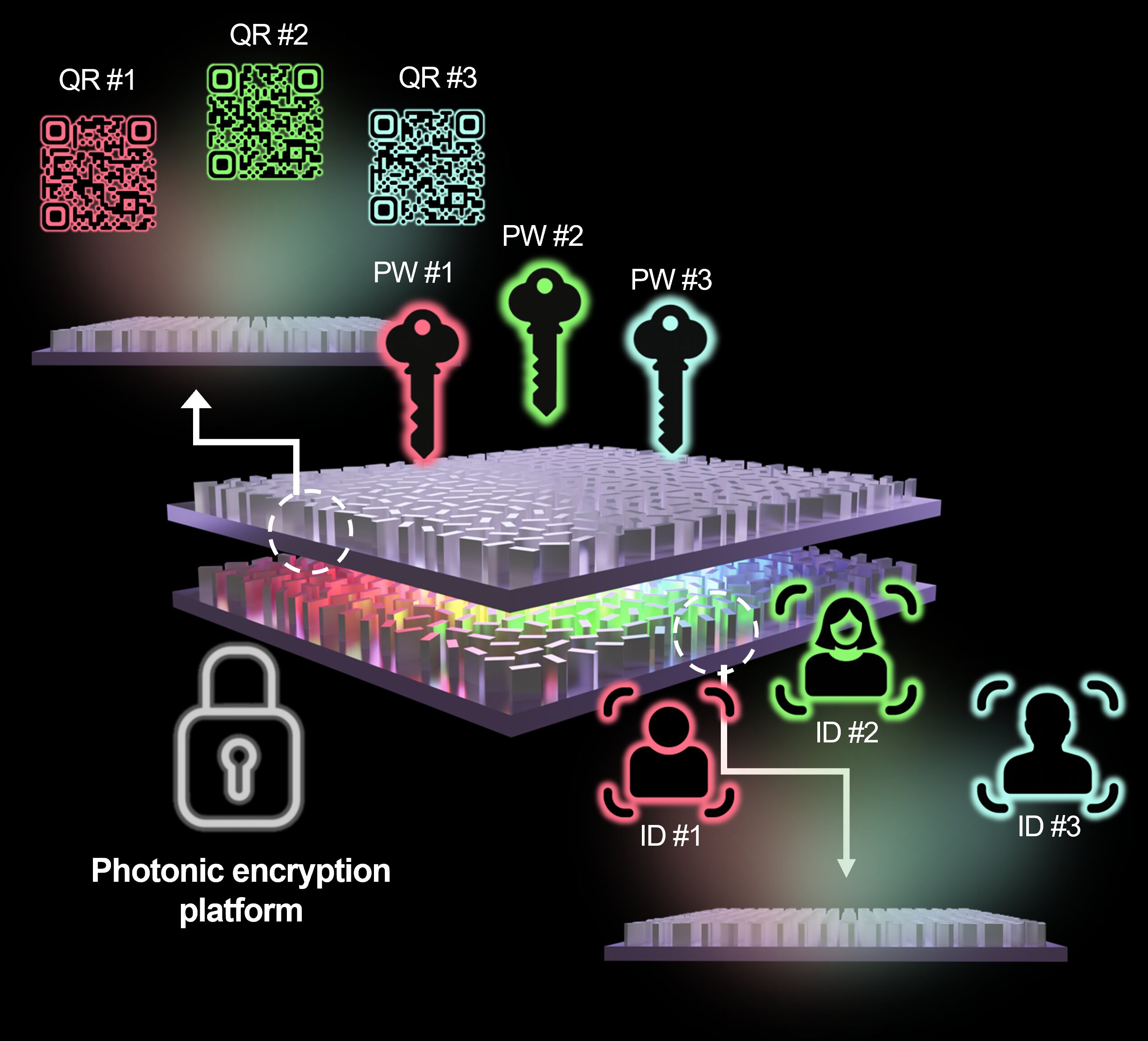
Researchers at Pohang University of Science and Technology have unveiled a novel metasurface hologram platform that secures information using the physical properties of light itself rather than conventional electronic cryptography, tells Tech Xplore. Unlike typical holograms that display a single image, these metasurface holograms are engineered to encode multiple distinct data channels that are accessible only under precise optical conditions.
At the heart of this technology are stacked ultrathin metasurfaces, that is, engineered arrays of subwavelength structures that manipulate light waves in specific ways. Each layer can reconstruct different holographic outputs when illuminated with particular wavelengths. For example, a single layer might produce an identification image under one color of light and a QR code under another. This alone expands the data capacity of a single device beyond conventional holography.
The real security advantage emerges when multiple layers are aligned at precise separations and illuminated with specific wavelengths. Only when both the light color and the interlayer spacing match predetermined values does an encrypted hologram, effectively a physical password, become visible. If either element is slightly off, the hidden information remains inaccessible. This coupling of optical parameters creates a security mechanism that resists electronic hacking because the key is embedded in physical light behavior rather than removable digital code.
In theory, increasing the number of wavelengths and metasurface layers produces an exponential growth in information channels. This scalability could allow a single compact device to store vastly more secure information than traditional systems.
Potential applications range from anti-counterfeiting features in identification and passports to secure optical communication channels and military or diplomatic document protection. By relying on the innate physics of light propagation and interference, the metasurface holograms represent a fundamentally different approach to optical encryption that could redefine secure data storage and transmission.
