
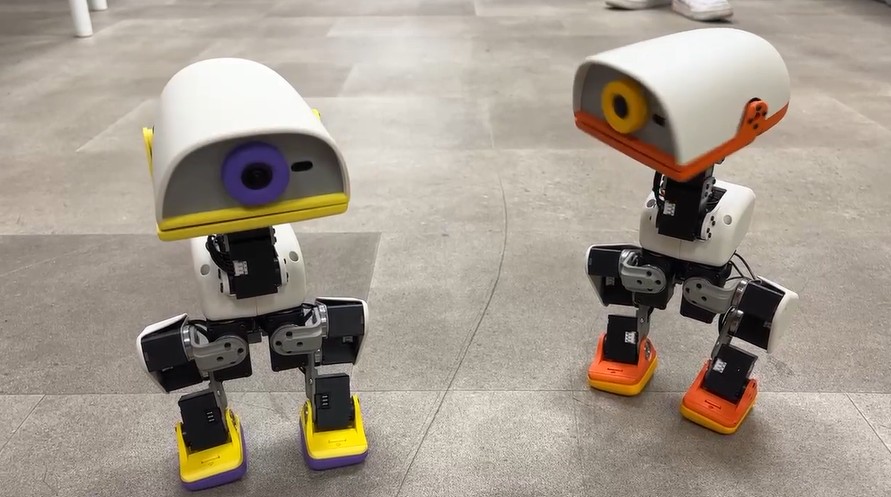
Hugging Face’s Microduck may look like an interactive robotic toy, but its design illustrates a significant change in robotics software development. Instead of relying primarily on manually programmed walking trajectories, the small robot learns coordinated movement through reinforcement learning and simulation, says Hardware FYI.
Microduck uses 15 Dynamixel XL330 servos, with 14 controlling movements included in its learned policy and one operating its beak. Each compact servo integrates a motor, gearbox, encoder, driver, position control loop, and bus interface. Conventional position feedback still controls individual actuators, but a reinforcement-learning policy coordinates targets across the robot’s body at 50 Hz.
The walking behavior is first developed using thousands of simulated versions of Microduck. Engineers then transfer the resulting reinforcement-learning policies to the physical robot through a process known as sim-to-real. This approach shifts much of the engineering effort away from manually designing gaits and tuning trajectories. Instead, developers must create sufficiently accurate simulations so behaviors learned virtually continue to work on real hardware.
Microduck also illustrates the changing economics of small robotics platforms. The robot sells for $399, yet its 15 Dynamixel servos would cost about $412 if purchased separately at retail prices. More than 10,000 preorders would require over 150,000 servos, equivalent to roughly 70% of the actuator supplier’s annual sales.
Hardware FYI also highlights other engineering developments. Formula 1’s 2026 regulations restrict materials and manufacturing methods such as beryllium additive manufacturing, nitinol shape-memory alloys, and certain metal-matrix composites. Other topics include the commercial challenges facing battery startups and Sony’s software-based improvements to PlayStation Spectral Super Resolution.
Microduck stands out because it demonstrates a broader robotics trend: simulation and reinforcement learning are increasingly taking over motion-design tasks that engineers once programmed manually.
