

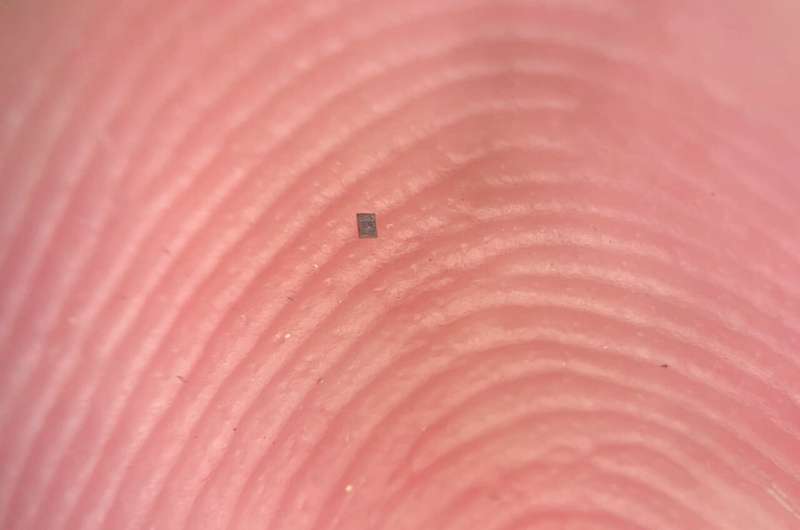
Researchers have built what are now the world’s smallest fully programmable, autonomous robots, each tiny enough to be barely visible without magnification. These microrobots measure roughly 200 × 300 × 50 micrometers, smaller than a grain of salt, and represent a big jump in robotics research at microscopic scales where machines could one day work inside biological systems or assemble small devices, tells Tech Xplore.
The project is a collaboration between engineers at the University of Pennsylvania and the University of Michigan. Unlike earlier microworld robots that needed external fields, wires, or control systems, these new bots are self-contained and truly autonomous, carrying onboard computing and sensing systems. They are designed to operate without external tethers, magnetic guidance, or joystick control, navigating their surroundings based on programmed instructions and local inputs such as temperature changes.
Power comes from light. The micro devices harness ambient light to run their systems, eliminating the need for heavy or bulky batteries. With that light-driven power and microscopic computers, the robots can be programmed to move in complex patterns, respond to local environmental cues, and even adjust their motion based on temperature variations. That ability to sense, compute, and act independently is what sets them apart from earlier microrobotics efforts.
One experimental behavior researchers highlighted is a communication method that resembles the “waggle dance” of honeybees, where temperature changes and movement patterns can be used to share information among bots. This suggests future swarms of such robots might coordinate with each other in complex tasks.
The research opens new possibilities in medicine, such as monitoring cell health inside the body, and in microscale manufacturing, where tiny autonomous agents could help build or inspect devices at scales once impossible for robots. As the field of microrobotics moves forward, that blend of independence, programmability, and sensing at tiny scales could redefine what robots can do in environments humans can’t reach.
