

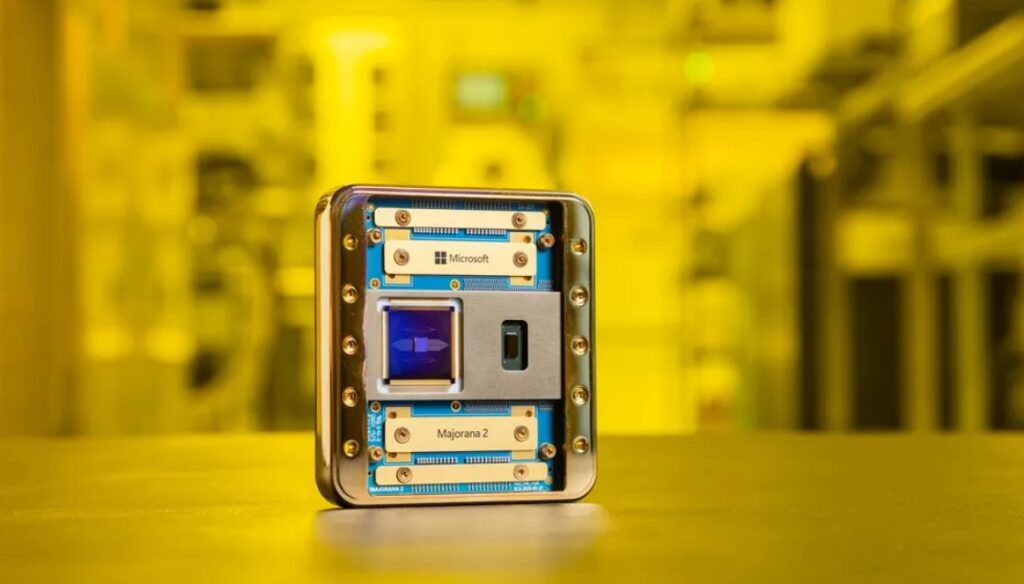
Microsoft has unveiled Majorana 2, an experimental quantum computing chip that it claims is 1,000 times more reliable than its predecessor. The processor features a four-qubit array with an average coherence time of 20 seconds and, in some cases, up to one minute. This represents a dramatic improvement over the millisecond-scale coherence times typically achieved in quantum processors and could accelerate Microsoft’s goal of delivering a commercially viable quantum computer by 2029, tells this article from Live Science.
Like the earlier Majorana 1 chip, the new processor is based on topological quantum computing, an approach rooted in physicist Ettore Majorana’s theory that certain particles can act as their own antiparticles. Microsoft’s design uses topological qubits built around Majorana zero modes, exotic quantum states that are expected to be naturally resistant to errors. These qubits store information through the parity of electrons within specially engineered semiconductor-superconductor structures.
Majorana 2 introduces significant material changes aimed at improving stability. Researchers replaced aluminum with lead in the superconducting layer and modified the semiconductor stack by combining indium arsenide with indium arsenide antimonide. These changes doubled the topological gap, strengthening protection against environmental disturbances such as electromagnetic interference and radiation. According to Microsoft, the result is a substantial increase in qubit reliability and coherence.
Artificial intelligence also played a central role in the chip’s development. Microsoft used its Discovery platform and AI agents to optimize material compositions, analyze decades of experimental data, and automate complex measurements. Researchers said AI dramatically reduced the time required for experimentation by identifying promising material configurations and adjusting experimental parameters in parallel.
Despite the reported progress, the announcement has generated skepticism within the scientific community. Critics argue that Microsoft has not yet conclusively demonstrated the existence and control of the Majorana zero modes necessary for topological quantum computing. Others note that the company’s latest findings remain in preprint form and have not undergone peer review.
Independent researchers have welcomed the engineering advances while urging caution. Many believe the reported improvements are noteworthy, but stress that validation through peer review and independent replication will be essential before the results can be fully accepted. The debate reflects the broader race to build a fault-tolerant quantum computer, where multiple competing technologies are advancing simultaneously in pursuit of scalable, error-corrected quantum systems.
