

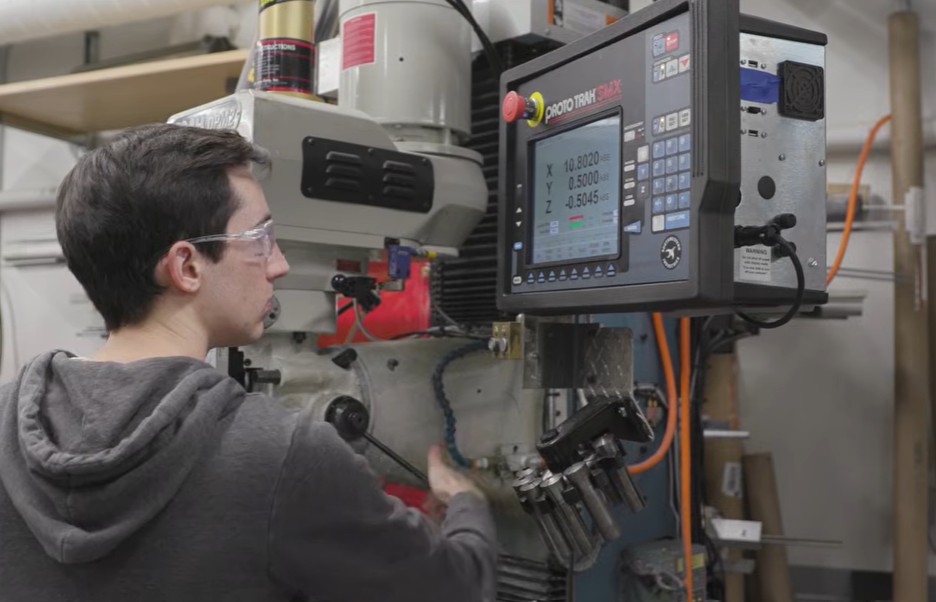
Precision and repeatability are essential to transforming engineering prototypes into reliable, safe, and cost-effective products. At the Massachusetts Institute of Technology (MIT), mechanical engineering professor Alex Slocum teaches these principles through an engaging approach that combines technical rigor with hands-on experimentation, tells MIT News.
Slocum, the Walter M. and A. Hazel May Professor of Mechanical Engineering, leads course 2.70, Fundamentals of Precision Product Design. His teaching philosophy emphasizes that understanding physical laws enables creativity rather than restricting it. Students learn that even small engineering oversights can have serious consequences for product performance and user safety.
The course introduces deterministic design, a systematic approach to selecting, assembling, and manufacturing machine elements. Students apply these principles to develop precision machines, instruments, and mechanical systems that perform consistently under real-world conditions.
A central component is Slocum’s FRED PARRC framework, which stands for Functional Requirements, Ergonomics and Environment, Design Parameters, Analysis, References, Risks, and Countermeasures. This structured method encourages students to evaluate design decisions, anticipate potential failures, and develop appropriate solutions before problems arise.
Peer review and evaluation further strengthen the learning experience, exposing students to alternative perspectives and practical engineering challenges.
Graduate student Mariia Smyk describes the course as representative of the unexpected problems encountered during graduate research. Another student, Adian Salazar, credits the experience with improving his ability to identify risks and apply theoretical engineering concepts to physical machines.
Although students sometimes characterize the learning environment as creative chaos, the course reinforces the importance of disciplined engineering judgment.
For aspiring mechanical engineers, the program demonstrates that precision design extends beyond achieving tight tolerances. It requires understanding physical behavior, anticipating failure, and ensuring repeatable performance.
Slocum’s approach connects classroom theory with manufacturing realities, preparing students to develop dependable products while maintaining the curiosity and creativity that drive engineering innovation.
