

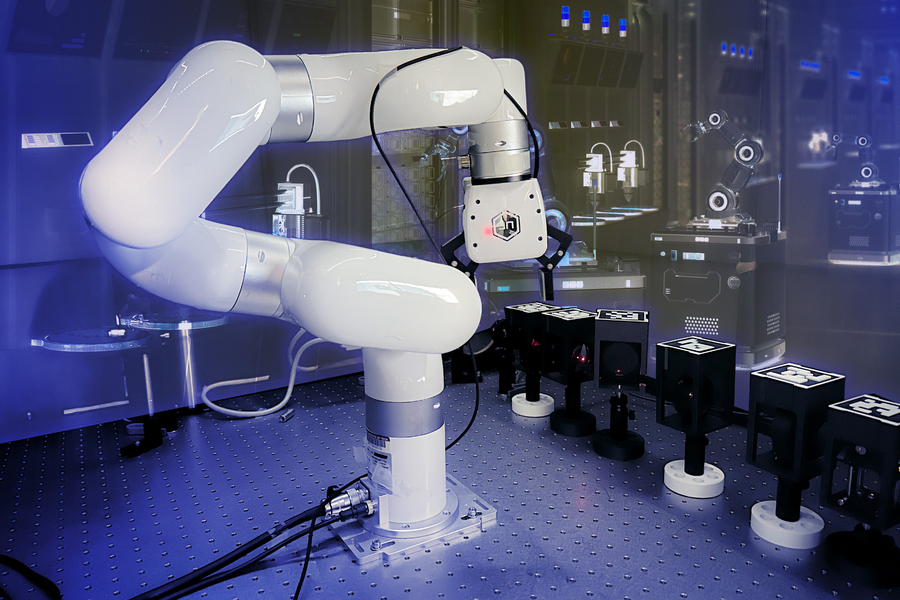
MIT researchers have developed a robotic, reconfigurable optics laboratory that can autonomously build and run precision experiments. The system could reduce the time scientists spend manually arranging and aligning optical components for research involving solar cells, sensors, displays, quantum technologies, and advanced materials.
Optics experiments often require researchers to position mirrors, lenses, cameras, and light sources with extreme precision. Complex setups can take days or even months to prepare. MIT’s system automates the entire process, from assembling components to tuning their positions with micron-scale precision and dismantling the setup afterward.
At the center is a seven-joint robotic arm mounted beside a metallic tabletop. Optical components sit inside custom 3D-printed housings equipped with QR codes that identify their type, dimensions, and capabilities. Magnetic bases secure the components, while a Wi-Fi-enabled motorized tool makes fine adjustments to mirrors and other devices. Overhead cameras help the system monitor the workspace.
Researchers demonstrated the technology by asking the robot to construct a functioning laser cavity. The system completed 50 autonomous maneuvers in 30 minutes. When researchers deliberately disturbed components, the robot automatically realigned the setup to maintain laser intensity. This self-correction could be particularly valuable because even small vibrations or temperature changes can disrupt sensitive optical experiments.
The researchers are also developing cloud-based access that could eventually allow scientists to remotely submit experimental protocols to robotic laboratories. Such facilities could operate continuously, rebuild experiments on demand, and monitor long-running tests without requiring constant human attention.
Potential industrial applications include faster prototype testing for cameras, displays, solar cells, and AR/VR systems. The MIT team is already using the robotic laboratory to investigate carbon-capture materials. By automating repetitive setup and alignment work, the researchers envision laboratories where scientists can spend more time developing ideas while robots handle precision-intensive experimental tasks.
