

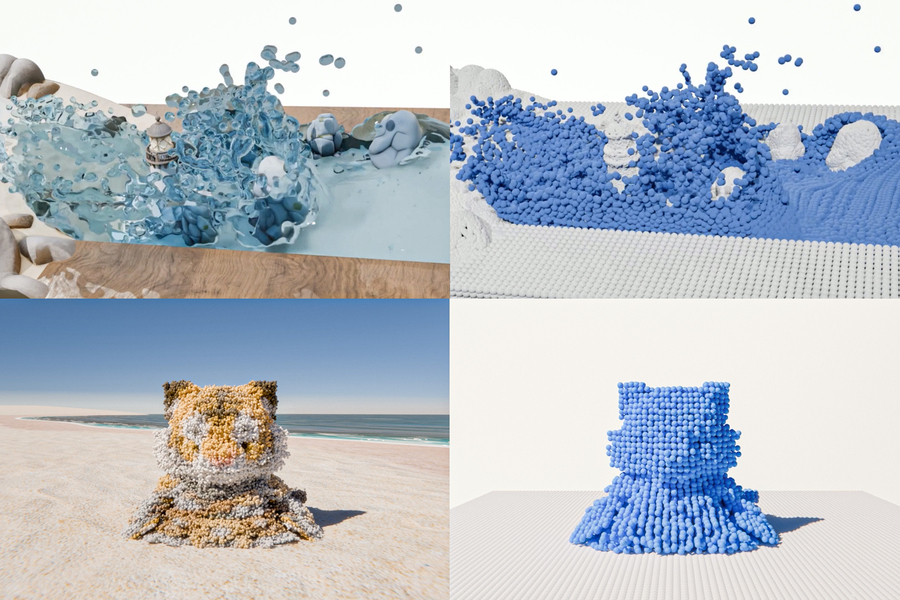
Researchers at MIT, the University of British Columbia, and collaborating institutions have developed WorldParticle, an artificial intelligence system capable of simulating multiple physical phenomena using a single deep-learning architecture. The technology could reduce reliance on specialized simulation software traditionally required for different materials and physical processes.
Conventional simulations depend on mathematical equations and numerical solvers tailored to specific phenomena, such as fluid movement, deformable solids, or protein folding. WorldParticle replaces this fragmented approach with a neural network that learns physical dynamics and predicts material behavior across different environments.
The system uses a Lagrangian representation, dividing objects into thousands or millions of three-dimensional particles. It analyzes their positions, velocities, and physical properties to predict movement over successive simulation steps. External forces are incorporated to improve predictions under changing conditions.
To manage computational complexity, researchers developed a particle-merging technique that compresses information while preserving important physical details. This allows the model to handle large simulations without excessive processing demands.
WorldParticle was tested across six physical phenomena, including granular materials, deformable objects, and proteins. Researchers reported higher accuracy than conventional numerical simulation methods in their evaluations. For example, the system reproduced collapsing sand more realistically than some baseline approaches, while protein motion simulations ran approximately 100 times faster.
Potential engineering applications include modeling interactions between fluids and flexible structures, studying soil behavior during robotic manipulation, and developing soft robots. The technology could also support drug development, materials research, and astrophysical simulations.
The researchers envision extending WorldParticle into a general-purpose simulation framework capable of handling previously unseen materials and physical conditions. Their long-term objective is to create an AI foundation model for scientific simulation.
Although further development is needed, WorldParticle demonstrates the potential of unified AI models to simplify complex simulations, accelerate engineering research, and enable investigations that conventional tools struggle to perform.
